
“We want to return to Myanmar...But we cannot return unless our lives and families are safe,” said one of several Rohingyas living in camps across India, after the recent International Court of Justice (ICJ) ruling that held Myanmar responsible for genocide.
ICJ president Yuji Iwasawa on Thursday said the top UN court, in a 9-6 decision, found that Myanmar “has committed genocide against the Rohingya group in northern Rakhine State, in violation of its obligations under the Genocide Convention”, while ordering the Southeast Asian nation to allow Rohingya who fled the violence to return home.
While the Rohingyas welcomed the judgment, calling it historic, those in India demanded they are treated as survivors of genocide and not as criminals or illegal infiltrators.
Deep Dive
What did the ICJ rule about Myanmar and the Rohingya?
Why are Rohingya refugees in India reluctant to return to Myanmar?
What has India said about the return of Rohingya refugees to Myanmar?
“Justice for the Rohingya must not end with today’s ruling. It must lead to accountability, reparations, protection, and ultimately, our safe and dignified return to our homeland,” Sabber Kyaw Min, founder and director of the Rohingya Human Rights initiative, said in a statement.
Also Read | Myanmar calls International court's Rohingya genocide ruling ‘unfair’
{{/usCountry}}Also Read | Myanmar calls International court's Rohingya genocide ruling ‘unfair’
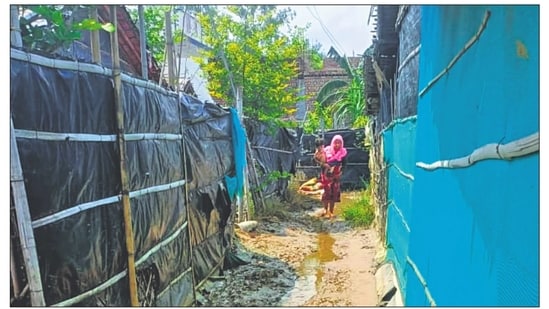
{{/usCountry}}In Haryana’s Nuh district, around 1,695 Rohingya refugees live in 10 settlements. “Living away from our homeland, not knowing when we can go back, has been difficult for our community. But we cannot return unless our lives and families are safe and we are allowed to live with equal rights and dignity,” said Kamal Hussain, a Rohingya refugee in one of the camps.
Ali Johar said the community hoped to rebuild their lives in Myanmar rather than remain displaced indefinitely. “We want our children to grow up in their homeland without fear. For that to happen, we need security, recognition of our rights and the assurance that we will not be persecuted again,” he said.
In Jammu, where many Rohingyas live in temporary camps, Zabul Haq (30) said he was not willing to go back as there was no safety. He came to India at the age of 16 in 2012 and is currently a sanitation worker. “I have a wife and four children. With great difficulty we make our ends meet. Though one cannot forget his roots but we can’t think of going back,” he said.
Also Read | Myanmar guilty of genocide against Rohingya, rules ICJ
In the old city of Hyderabad, 45-year-old Jaffer Alam, living in a camp at Balapur, welcomed the judgement. “If we are given assurance that our rights are protected and there is no threat to our lives, we are ready to go back to Myanmar,” said
Alam, along with his family, fled Rakhine state in Myanmar in 2014, and still has relatives in his country.
“We are living in a pathetic condition here, eking out livelihood as a daily labourer. I was also booked in a petty theft case by the police here. If everything goes well, we will go back to Myanmar,” he said.
Mohammad Taher (30) said: “My sister is still in Myanmar, living in a miserable condition in a remote village, after Buddhist monks drove her away from my house,” Taher said, adding he would like to go back to Myanmar if they are assured a life of dignity and respect, without being subjected to harassment.
Also Read | Myanmar committed genocide during 2017 Rohingya crackdown, UN court rules
According to Taher, there are around 10-15,000 Rohingyas in Hyderabad and most of them are daily wage
ABOUT THE AUTHOR
A principal correspondent, Ravi Krishnan Khajuria is the bureau chief at Jammu. With nearly 25 years of experience with Hindustan Times, The Tribune and Kashmir Times, he covers politics, defence, crime, terrorism, Indo-Pak border skirmishes, legislative assembly proceedings, health and civic and environmental issues for Jammu region. He also reports geo-political developments from strategic Ladakh region.
Leena Dhankhar is Senior Editor and Bureau Chief, Gurugram, at Hindustan Times, where she has spent over 17 years chronicling the transformation of one of India's fastest-growing urban regions. From starting her career as a crime reporter to leading the Gurugram bureau, her journalism has been defined by investigative reporting, in-depth storytelling and an unwavering focus on public interest. Over nearly two decades, she has reported extensively across crime, politics, civic governance, elections, real estate, environment, courts, sports, education and entertainment, covering Gurugram, Faridabad, Nuh and Palwal. Her reporting has exposed several major scams and systemic failures, including insurance frauds, waste management irregularities, illegal arms manufacturing units in Nuh, illegal mining in the Aravallis, organised crime networks and governance lapses affecting millions of residents. Known for her investigative work and exclusive stories, Leena has reported on high-impact national issues, including the Nicaragua charter flight carrying Indian migrants that was turned back amid allegations of human trafficking, exposing the growing network of illegal immigration rackets. Her work has also focused on gang wars, prison administration, juvenile crime, women and child protection systems, the functioning of the Juvenile Justice Board and Child Welfare Committee, and environmental challenges such as pollution, waterlogging and deteriorating civic infrastructure. Beyond hard news, Leena has extensively documented Haryana's rich heritage, forests and wildlife, bringing attention to the state's historical landmarks, biodiversity, conservation efforts and ecological challenges through immersive reportage and feature writing. Her journalism has consistently gone beyond breaking news. She has documented Gurugram's rapid urbanisation through long-form narratives and enterprise reporting on issues ranging from pothole-ridden roads, flooding and waste management to the changing social fabric of India's Millennium City. She also writes widely read feature columns, including The Outsider, Changemaker, and Concern for Gurugram, profiling people, places and ideas shaping the city's identity. Leena is the author of Gurugram School Murder, published by Juggernaut Books, a deeply reported account of one of India's most high-profile school murder investigations. She is currently working on her second book, an investigative work exploring some of India's most significant scams and fraud investigations. Beyond print journalism, she has expanded her storytelling through public speaking and digital media. She is a TEDx speaker and has produced podcasts exploring Gurugram's transformation, civic challenges and untold stories. Her work reflects a commitment to narrative journalism that combines rigorous reporting with compelling storytelling. A law graduate with an MBA in Human Resources, Leena brings a multidisciplinary perspective to her reporting, particularly on governance, public policy and legal affairs. She has travelled extensively across India to pursue investigative assignments, often reporting from remote locations and conflict-prone areas in search of stories that matter.
Srinivasa Rao is Senior Assistant Editor based out of Hyderabad covering developments in Andhra Pradesh and Telangana . He has over three decades of reporting experience.