The roof over part of the Indira Gandhi airport collapsed, underpasses across the city flooded, and traffic across the Capital was disrupted after heavy rains — 148.5 mm (14.8cm) in three hours between 2.30am and 5.30 am; and 228.1 mm (22.8 cm) in 24 hours to 8.30am; the highest in a June day since 1936 — lashed Delhi and its environs early on Friday, with the southwest monsoon marking its arrival. With this spell, Delhi has recorded 234.5mm of rainfall so far this month, the Union Territory’s highest for June since 1936, when 415.8mm was recorded.
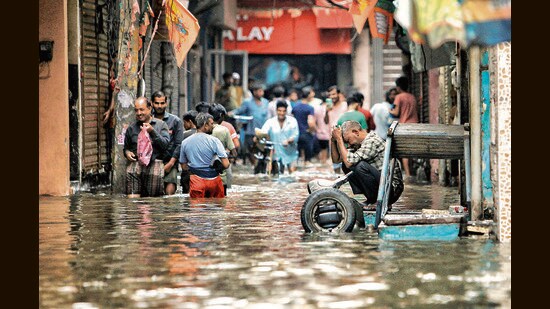
While extreme rainfall was responsible for the chaos, the situation was exacerbated by an administration that had not prepared for the rains and was inadequate in terms of the pace and magnitude of its response to the crisis. For months, Delhi’s elected Aam Aadmi Government and the Lieutenant Governor have traded charges on issues related to governance. Friday’s events showed that despite the surfeit of government bandwidth in the Union territory — apart from the elected UT government and the LG, Delhi is also the base of the Union government, and has its own elected corporation — there is no real accountability in the Capital of a country that will soon have the third largest economy in the world.
Across the city, at least eight people were feared dead in rain-related incidents. While a cab driver died in the roof collapse at IGI, three people — including two children — drowned in separate incidents, one person was electrocuted, and three workers were feared dead after they were trapped in mud and water in a basement when an under-construction building collapsed in Vasant Vihar area of South Delhi.
The situation was redeemed somewhat by schools being shut for the summer vacation and most people choosing to work from home on the last day of the week, but Delhi’s residents, coming off an over-month-long heatwave were on Friday reminded that the city-state is no haven during the monsoon (or, for that matter, winter, when air quality plunges to hazardous levels on most days).
{{/usCountry}}The situation was redeemed somewhat by schools being shut for the summer vacation and most people choosing to work from home on the last day of the week, but Delhi’s residents, coming off an over-month-long heatwave were on Friday reminded that the city-state is no haven during the monsoon (or, for that matter, winter, when air quality plunges to hazardous levels on most days).
{{/usCountry}}As if to perhaps highlight the apathy, the roof of part of Delhi’s T1 domestic terminal collapsed, killing one person. While the new minister for civil aviation, and the Bharatiya Janata Party were quick to point out that this structure was built when a previous government was in charge (and was not the extension inaugurated by the Prime Minister on March 10 this year), fact is, the terminal has been under maintenance in phases since May 2019.
The intense rain occurred due to the southwest monsoon advancing rapidly in the last 24 hours and covering the entire national capital territory of Delhi. IMD officially declared the onset of the southwest monsoon over Delhi on Friday, a day later than its usual date of June 27.
While the rains were unprecedented, civic authorities of the country’s Capital were ill-prepared to handle heavy rainfall.
Agencies pass the buck
The Municipal Corporation of Delhi (MCD), Public Works Department (PWD), Irrigation and Flood Control (I&FC) unit, New Delhi Municipal Corporation (NDMC) and Delhi Development Authority (DDA) claimed that over 90% of their work of desilting and cleaning of drains was completed by last week. According to data from Delhi police, there are 308 critical locations across the city where waterlogging was seen at any point during the monsoon season last year. Of these, about 210 locations are under PWD.
On Friday, as the extent of damage became clear, the agencies blamed each other for the mess.
“We have over 2100 kilometres of drains that were all cleaned and desilted. However, sudden heavy rainfall in a short span will lead to waterlogging that was eventually cleared using pumps and most of our arterial roads were completely dry by afternoon. In some places there were problems because DJB’s sewer lines overflowed into our underpasses. At Tilak Bridge underpass, the drain walls of MCD collapsed,” said a PWD official.
Mayor Shelly Oberoi, who was inspecting the waterlogged sites, claimed that the “situation was far better in comparison to previous years”.
A senior MCD official said that the corporation mostly manages the smaller drains in the city which flow into the larger drains managed by PWD, and Irrigation and Flood Control. “Without an outfall in the larger drains, the backflow will impact the residential areas. MCD in its official report dated June 27 has claimed that 95.46% of desilting work has been completed and by June 30, 78,062 tonnes of silt will be taken out,” the official said.
The deadline to complete this desilting work was June 15 .
A senior DJB official said that run-off from rainwater should be carried by the storm water drains and the sewage system is meant to cater to wastewater. “Water logging is not connected to sewer. It’s due to clogging of storm drains which other agencies maintain. Sewer lines are separate from storm water drains,” the official said, adding that instructions have been issued to run the sewage pumping stations (SPS) at maximum level.
Confusion on city roads
While the rains tapered off by 8am, the flooding disrupted life, with tens of thousands of commuters stuck in traffic for hours. There was more confusion at the airport where Terminal 1 was closed, and people were being directed to other terminals. Soon after the roof collapse at 5.30am, flight operations were halted at Terminal 1 and 81 flights were cancelled till 2pm after which the flights operating from Terminal 1 (SpiceJet and IndiGo flights operate from T1) were diverted and operated from Terminals 2 and 3.
All underpasses in the city were submerged, including the Pragati Maidan tunnel that was recently repaired and the Minto Bridge underpass that was removed as a “waterlogging hotspot” last year and did not see any flooding for two years after two drains were especially created for it.
And from Lodhi Colony to Golf Links to New Friends Colony to Vasant Vihar, the flooding created havoc.
“The drains were choked and water harvesting pits didn’t work. So, all the water from the main Press Enclave Marg entered our homes. My furniture is spoilt, carpets are wet, and the wooden flooring is making a squeaking noise because water has soaked through... We are paying high property tax but this is the kind of work that authorities are doing,” said GL Verma, president of Ekta Apartment RWA in Saket.
Shashi Tharoor, Congress MP from Thiruvananthapuram, posted a video of the flooded road outside his home on X (formerly Twitter).
“This is the corner just outside my home in Lutyens’ Delhi. Woke up to find my entire home under a foot of water - every room. Carpets and furniture, indeed anything on the ground, ruined. Apparently, the storm water drains in the neighbourhood are all clogged so the water had no place to go. And they switched off the electricity since 6am for fear of electrocuting people. Warned my Parliament colleagues that I might not make it there without a boat. But the city managed to pump water out of the roads, and I did arrive in time,” posted Tharoor.
As Delhi reeled (read drenched) from the rather harsh first rains of the season, the Lieutenant Governor (LG) and Delhi ministers “held meetings” to discuss how damage control can be done, going forward.
After the meeting, Delhi water minister Atishi said that Delhi saw about 25% of its total monsoon rainfall in a single day due to which several places witnessed waterlogging.
“It was decided that a combined 24x7 emergency control room of all water related departments — DJB, MCD and I&FC will be set up at PWD headquarters, which will monitor waterlogging 24 hours a day and take action. All departments will inspect their static and mobile water pumps by tonight (Friday) and ensure that all pumps are ready to pump out water. Every department will form Quick Response Teams, which will be deployed to remove waterlogging at the ground level to check problems in their areas,” irrigation and flood control department minister Saurabh Bharadwaj said.
The minister released two phone numbers — 1800110093 (for calls), 8130188222 (WhatsApp) — for people to complain about waterlogging.
In another emergency meeting held at Raj Niwas, the LG ordered the setting up of a 24x7 emergency control room; the testing of all static pumps of PWD, I&FC, MCD, DDA and NDMC; the completion of remaining de-silting work ; the activation of the disaster response cell under DDMA ; and monitoring of critical locations by officials. He also asked all senior officers on leave to report for duty immediately and said no leave would be sanctioned for the next two months, officials aware of the development said.
“The LG has taken a serious note of the lack of preparedness for emergency response system in the eventuality of excessive rainfall and resultant waterlogging across the city. That the desilting works had yet not been completed and the Flood Control Order had yet not been issued, came out during the meeting,” the LG’s office said in a statement.
Experts say that the solution to this annual mayhem is in adopting a combination of short-term and long-term measures. In the short-term, experts said that desilting and cleaning of drains should be done much ahead of the monsoon.
Sarvagya Srivastava, retired engineer-in-chief of Public Works Department (PWD), said, “The first step to solve this recurring problem would be to separate the sewage system from the drainage system of the city completely. Currently, unplanned disposal of waste leads to seepage of sewage into storm water drains which get blocked, leading to back-flow of water on to streets every time the city receives even moderate levels of rain.”
In the long-term, Delhi will have to develop a robust drainage masterplan and enhance the capacity of the drains keeping future demand in mind, experts added.