Weather Bee | The long dry spell before rain and snow hit north India
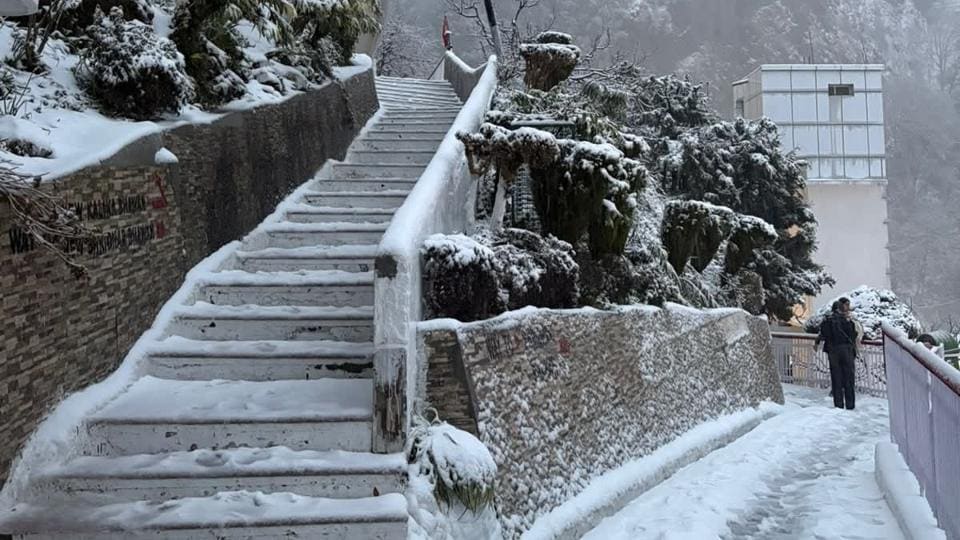
Large parts of northern India received rain or snow on January 23. This was the result of a western disturbance, a storm originating in the Mediterranean region
Large parts of northern India received rain or snow on January 23. This was the result of a western disturbance, a storm originating in the Mediterranean region that brings winter precipitation to India’s northern parts. While this storm has affected weather in northern India several times this winter, it is only the current spell that is causing widespread rain.
A long dry spell before the snow (HT Photo)
This lack of rain from the storm so far had made the post-monsoon season very dry across most of northern India. An HT analysis suggests that the scale and severity of this dry weather was very high, although perhaps not felt as acutely as during the summer months. Moreover, while other regions may not have had as long a continuous spell, cumulative rainfall is very low almost everywhere from the period starting mid-November.
One of the starkest examples of the dry spell is Uttarakhand, which received rain and snow after a 62-day dry spell as of January 22 (the India Meteorological Department, or IMD, counts rain in the 24-hour period ending at 08:30 am as the rain for the day). Such a long dry spell is possible for small places, but harder to occur for a state of Uttarakhand’s size. The simple reason is that one or another weather system usually leads to rain in at least one small part of a large state, ending its overall dry spell. Therefore, the spell that ended on January 23 was the second-longest dry spell for the state since 1901, according to IMD’s gridded data. The only longer spell was in 1916–17, when an 85-day-long spell lasted until January 10, 1917.
gfx
To be sure, size is not the only reason it is rare for a state like Uttarakhand to have a long dry spell in winter. It is also a state more likely to be affected by western disturbances, as these storms tend to affect northern parts of India more. This can be seen in the fact that Chhattisgarh had a 61-day-long dry spell as recently as 2023, which ranked only sixth longest for the state. Its dry spell’s length on January 22 was 52 days, ranking only 11th highest.
Another way to see Uttarakhand’s unique position this winter is by looking at a map of the length of the dry spell as on January 22. This shows that large parts of Rajasthan, Punjab and Haryana had received rain just two to three weeks ago, while parts of Uttarakhand had not received rain for more than 90 days.
Map
To be sure, a shorter dry spell in states like Rajasthan, Punjab and Haryana does not mean they are experiencing a particularly rainy winter season. The southwest or summer monsoon retreated from the entire country on October 16. Punjab, Haryana and Delhi have rainfall deficits of 87.9%, 93.4% and 99.6%, respectively, since then compared to the Long Period Average (LPA), which IMD defines as the average rainfall during the 1971–2020 period used for tracking rainfall performance. This means that even these states have received very little rain.
The list of states with large rainfall deficits grows longer if cumulative rainfall performance is assessed from more recent dates. Among 23 large states and Union Territories, seven recorded a deficit of 60% or more (classified as “large deficient” by IMD) during the October 16–January 22 period. This number increases to 13 states/UTs for the November 1–January 22 period and 20 for the November 16–January 22 period. In fact, only two of the 23 large states — Tamil Nadu and Kerala — recorded a surplus during the November 16–January 22 period.
Gfx
These statistics suggest that it is not just western disturbances that have delivered sub-par rainfall in the period following the southwest monsoon. The other major driver of rainfall during this period is the northeast monsoon, which brings rain to peninsular India from October to December. That Karnataka and Andhra Pradesh have also recorded large deficits since November suggests that this weather system, too, failed to deliver as much rain as expected. This is why the widespread rain and heavy snow on January 23 has come as a relief for at least the northern parts of the country. How much this has altered the status of accumulated deficits, however, will be known only on January 24, when data for the 24-hour period ending at 08:30 am is published.
Get the latest India News, breaking headlines and real-time updates from across the country. Stay informed about politics, government policies, crime, weather and major national developments.
Home/India News/Weather Bee | The Long Dry Spell Before Rain And Snow Hit North India

 E-Paper