
 E-Paper



Week after fire at Assam gas well, tremors continue; govt orders study
Since June 9 when the oil well caught fire, residents of Baghjan and Natun Rongagora villages which are close to the site, have been complaining of repeated tremors. Some houses have also developed cracks due to the tremors.


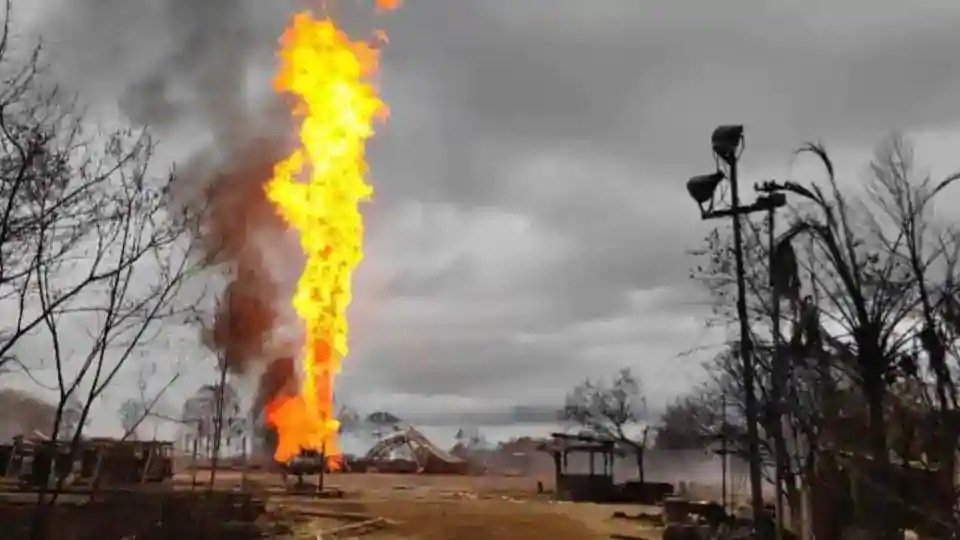
Assam government on Monday asked a group of scientists to conduct a study on the tremors being felt at Baghjan in Tinsukia district, where a natural gas well of Oil India Limited (OIL) caught fire on June 9, two weeks after it started releasing gas and oil condensate following a blow-out.
Chief Minister Sarbananda Sonowal met scientists of Indian Institute of Technology-Guwahati (IIT-G) and CSIR-North East Institute of Science and Technology (CSIR-NEIST) and asked them to conduct the study on emergency basis and submit a report so that the government can take appropriate steps.
During a visit to the site along with union petroleum minister Dharmendra Pradhan on Sunday, Sonowal had promised that a study would be done to probe the reasons for the tremors.
Since June 9 when the well caught fire, residents of Baghjan and Natun Rongagora villages which are close to the site, have been complaining of repeated tremors. Some houses have also developed cracks due to the tremors.
“We started experiencing tremors from Wednesday, a day after the well caught fire. That night the tremors lasted for nearly 10-12 hours and walls of several houses got cracked,” said Hiren Senapati, president of eco-development committee of Natun Rongagora.
“The tremors have been happening intermittently now. Nearly 80% of our villagers are staying in relief camps, the rest who were in their homes are scared to live there because of the tremors, which could be around 5 on the Richter scale,” he added.
Authorities at OIL have also asked CSIR-NESIT to carry out a study of the induced seismicity (tremors and quakes caused by human activity including oil and gas operations) in Baghjan and neighbouring areas because of the blow out.
“Five broadband seismographs will be deployed by CSIR-NESIT at five sites for data to be recorded for 7-10 days. Locations have been identified and preliminary civil work for deployment of the instruments is in progress,” said a release issued by OIL on Monday.
“It is possible that some tremors had happened in the area close to the well, which witnessed a blow out and subsequently caught fire. From a scientific point of view, we are very keen to look at what are these tremors and analyse its impact,” said G Narahari Sastry, director, NEIST.
Meanwhile, work continued at the well site to control the fire and plug the blow out. OIL had earlier said that the process could take about 4 weeks.


