
 E-Paper



Welfare state must ensure nobody dies of hunger, says Supreme Court
The court was hearing a petition filed by a bunch of social activists led by Anun Dhawan, seeking directives to the Centre and all states for starting subsidised canteens and community kitchens in all states to ensure food security in the wake of the crisis triggered by the Covid-19 pandemic.


A welfare state must ensure that nobody dies of hunger, the Supreme Court observed on Tuesday as it pressed for the framing of a pan-India scheme to run community kitchens across the states.
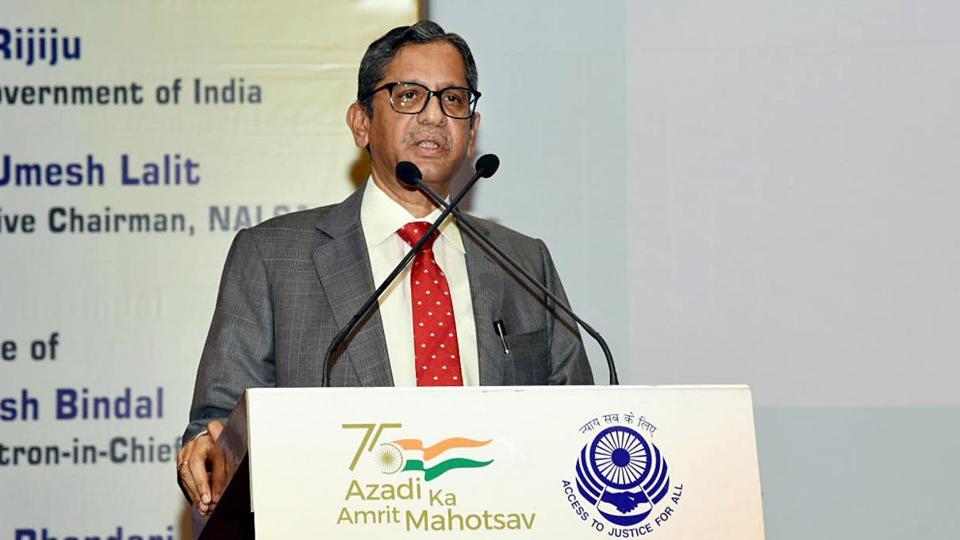
Directing the Union government to formulate a scheme in consultation with the states, a bench headed by Chief Justice of India NV Ramana also pulled up the Centre for filing its affidavit in the court through a low-ranking officer.
“You have to respect the institutions. You are undermining the Supreme Court. We will throw this affidavit. We won’t accept this affidavit,” said the bench, which also comprised justices AS Bopanna and Hima Kohli.
The court was hearing a petition filed by a bunch of social activists led by Anun Dhawan, seeking directives to the Centre and all states for starting subsidised canteens and community kitchens in all states to ensure food security in the wake of the crisis triggered by the Covid-19 pandemic.
On October 27, the court had asked the Centre to come out with a policy decision about the implementation of a community kitchen scheme after taking into consideration similar programmes already in operation in different states.
However, when the proceedings started on Tuesday, the bench noted that not much progress has been made since the last order of the court and that the Union government is still in the process of collecting information from the states. It was also noticed that no categorical statement had been made about a model scheme that could be implemented across the country.
Apart from the slow progress, what irked the court was the fact that the Union government’s affidavit was filed by an under-secretary despite the court’s directive that only officers at the secretary level and above are competent to file affidavits in the Supreme Court.
“How can an under-secretary file an affidavit? Despite the judgment of this court, you let an under-secretary file this. Tomorrow, some desk officer will file it. Is this how you want to treat the Supreme Court?” the bench asked additional solicitor general Madhvi Divan.
“We are saying it for the last time. We will not let this continue,” added the bench, prompting Divan to tender an apology. She also informed the bench that the central government is in the process of framing a scheme.
The bench responded: “There has to be some focus areas. Focus has to be on some areas in states like Maharashtra, Odisha, Bihar and Jharkhand where hunger is more.”
At this point, attorney general KK Venugopal also appeared in the case on behalf of the central government, saying a meeting was held on September 9 but it did not lead to anything concrete. He further submitted that a scheme can be made in four weeks.
To this, the bench replied: “If you want to take care of hunger and save people from dying, no state will say no. Responsibility of every welfare state is to look into this. It is the first and foremost duty of every welfare state to provide food to the hungry people.”
It further remarked: “We are concerned about hunger. We are not on malnutrition right now. Food supplements, etc., can be taken up separately. We want all to take care of hunger first...the purpose of this matter is to ensure food to hungry people...for people who are dying of hunger.”
In its order, the court recorded: “Finally, three weeks’ time from today is granted to the Union of India to come up with a model community kitchen scheme agreeable to the states/UTs...We direct all the state governments/UTs to attend the meeting to be organized by the Union of India and cooperate with them in coming up with the said scheme, which can be made uniformly applicable.”


