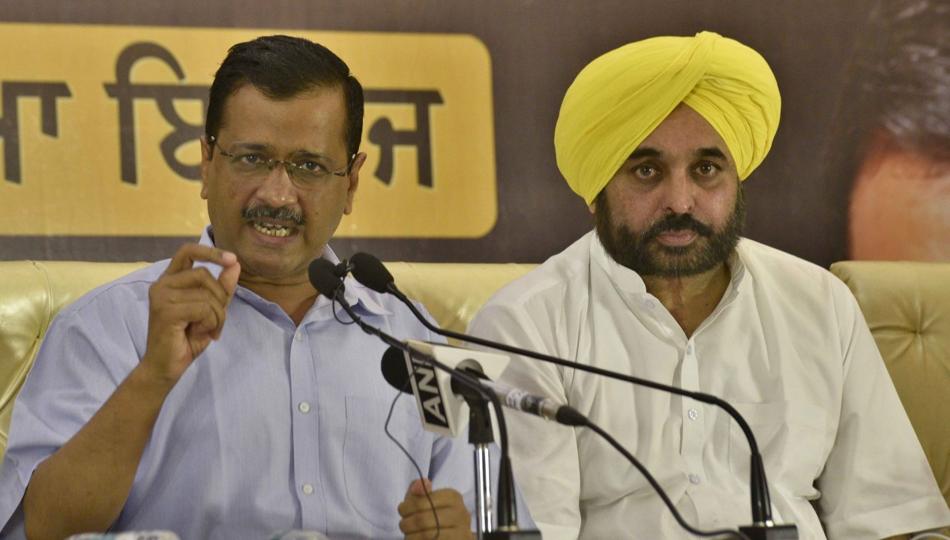
With months to go for a high stakes assembly election in Punjab, leaders of the Aam Aadmi Party have been exuding confidence after a more than encouraging debut in the Chandigarh Municipal Corporation results, declared on Monday. AAP national convener and Delhi chief minister Arvind Kejriwal and the state unit chief Bhagwant Mann, who both campaigned in the polls, lost no time in terming its feat of emerging as the single-largest party as a “sign of the coming change”.
The
With months to go for a high stakes assembly election in Punjab, leaders of the Aam Aadmi Party have been exuding confidence after a more than encouraging debut in the Chandigarh Municipal Corporation results, declared on Monday. AAP national convener and Delhi chief minister Arvind Kejriwal and the state unit chief Bhagwant Mann, who both campaigned in the polls, lost no time in terming its feat of emerging as the single-largest party as a “sign of the coming change”.
The AAP's surge in Chandigarh, the shared capital of Punjab and Haryana, will serve as a much-needed morale booster for the party. The AAP had made a stunning debut in Punjab in 2014 with four of the 13 Lok Sabha seats and took the number two position in the 2017 state polls, but then failed to meet heady expectations as it plunged into disarray
The results
In Chandigarh too, the AAP had first entered the poll fray in 2014 with actor-model Gul Panag as its nominee against another actor-turned-politician Kirron Kher. She did put up a good fight, securing 1,08,679 votes with 23.97% of the total votes polled, but lost. The party slipped in the next parliamentary elections in 2019 as its candidate, former Union minister Harmohan Dhawan, got just 13,781 votes (3%) votes and could not save his security deposit.
However, it received a boost at the grassroots level in August 2021 when former Chandigarh Congress president Pardeep Chhabra, who was miffed with former MP and Congress treasurer Pawan Bansal for his removal from the post, switched sides to join the AAP. A number of other senior Congress leaders and party workers followed Chhabra into the party. Several were then given tickets and went on to win against their erstwhile colleagues.
The AAP, which aggressively pitched its ‘Delhi model’, won 14 out of the total 35 seats to become the single-largest party, but with the lowest vote share of 27.1% among the three main players. This was thanks to the massive support it got in villages and rehabilitation colonies where its promises of free water, free Wi-Fi hotspots, free treatment and no new taxes worked. Against this, the BJP got 29.3% votes and the Congress 29.8%, but won fewer seats. The AAP won eight of 12 wards dominated by rehabilitation colonies and three of the six village/semi-urban wards. There appears to have been concentrated voting in these wards, helping the AAP win more seats, even though its vote share is lower overall. The AAP candidates lost their security deposits in eight wards whereas this figure is two for the Congress and not a single BJP candidate forfeited his or her security deposit. In the last MC elections in 2016, the BJP had bagged 20 seats and the Congress 5 in the house of 26. The number of wards was increased to 35 this time with the inclusion of rural areas.
What the results mean
The BJP’s slump is being attributed to anti-incumbency, resentment against high fuel prices and rising inflation, frequent hikes in water tariff and its failure to deal with a problem with garbage collection in the city. BJP’s Chandigarh unit head Arun Sood said that results are not as per their expectations but the party has not lost. “With its campaign based on freebies, the AAP was able to mislead some sections of voters,” he said.
Its one-time partner, the Shiromani Akali Dal (SAD), is a marginal player in Chandigarh and contested the elections in alliance with the BSP, but could only retain the one seat it had. Traditionally, the Congress would benefit from the BJP’s slide, but this time it worked to the AAP’s advantage.
Chandigarh Congress president Subhash Chawla attributed his party’s poor tally to close fights in several wards which they lost by very low, even single digit, margins. “The AAP spent a lot on misleading advertisements and was able to mislead some people with promise of freebies. These promises are not workable,” he said.
The AAP’s dream debut in the city is an alarm bell for the traditional players, the Congress and Shiromani Akali Dal (SAD), in Punjab. Both parties are beset with their own set of problems. The ruling Congress is hamstrung by internal squabbling, particularly the tussle between chief minister Charanjit Singh Channi and Punjab Congress president Navjot Singh Sidhu over the chief ministerial face going forward. On Tuesday, two sitting Congress MLAs Fatehjung Singh Bajwa and Balwinder Singh Laddi jumped ship to the BJP, blaming the internal bickering for their decision. The Akalis, on the other hand, are worried about the sacrilege and drug issues, which proved to be their nemesis in 2017, dominating the poll narrative, besides the impact of 22 farmer organizations’ decision to jump into the poll ring in its pockets of support in the peasantry.
Why this does not necessarily translate to success in Punjab
For the AAP, the Chandigarh win could not have come at a more opportune time, but the party’s attempts to project it as a sign of political change in Punjab may be a little far fetched. Chandigarh, being seen by some as a microcosm of Punjab, cannot be considered the bellwether of the agrarian state.
For one, the demography is entirely different. Hindus comprise 80.78% of Chandigarh’s population and Sikhs 13.11%, according to the 2011 census. In contrast, Sikhs are in a majority in Punjab at 57.69% whereas Hindus comprise 38.49% of the state’s population. Ashutosh Kumar, a professor of political science at Panjab University, says that the Chandigarh win will surely send a message to the state because the city’s soul is very much Punjabi, but the municipal poll results here cannot be construed as an indicator of the mood of voters all across the state. “Chandigarh is a middle-class society, whereas Punjab is predominately an agrarian state with very different challenges, ground realities and priorities. The people of Punjab are looking for an alternative. If the AAP wants to put up a strong challenge, it has to project a good CM-face and avoid the mistakes of 2017,” he adds.
In the previous state elections, besides micro-managing the campaign from Delhi, the party had not named the CM-face and was targeted by its rivals for trying to impose “outsider Kejriwal” on the state. Again, Kejriwal and his team are steering the election campaign. Another challenge for the party is the emergence of the Sanyukt Samaj Morcha (SSM), a political party floated by 22 farmer organizations which has thrown its hat in the ring. Guru Nanak Dev University’s former head of political science Professor Jagrup Singh Sekhon said the AAP was beginning to get support in rural areas as an alternative to people fed up with traditional parties, but it will now have to compete with the SSM which has a strong presence at booth level in every village. Given the challenges it faces, while the Chandigarh results bring cheer, it needs to correct its errors from its assembly campaign five years ago, where it failed to capitalize on a groundswell of support.
One Subscription.
Get 360° coverage—from daily headlines
to 100 year archives.
Archives
HT App & Website