When he sensed a hand brush his waist, around an hour after the collapse of the pedestrian bridge in Morbi on Sunday, Azaz Mehboob was instantly gripped by fear — it must be another lifeless body that he would be pulling out on an evening of despair, he thought.
It turned out to be much worse.
“As I pulled out that man’s body, I found a dead woman’s arms clasping his leg. Then, as I pulled the woman out, another
When he sensed a hand brush his waist, around an hour after the collapse of the pedestrian bridge in Morbi on Sunday, Azaz Mehboob was instantly gripped by fear — it must be another lifeless body that he would be pulling out on an evening of despair, he thought.
It turned out to be much worse.
“As I pulled out that man’s body, I found a dead woman’s arms clasping his leg. Then, as I pulled the woman out, another person’s lifeless arms were latched on to her feet. In the end, it was a chain of six people clasping each other, possibly in their attempts to survive. None of them made it,” said Mehboob, a painter who was one of the first responders at the site of the bridge collapse that has claimed at least 135 lives.
What Mehboob witnessed was only one ghastly sight of desperation that the early rescuers had to encounter.
“I let out a loud cry when I pulled out a woman’s body from the water,” said Mehboob friend, Ahmed Ibrahim. As he pulled the woman out with her one hand, he found a toddler’s arms slip out of her other hand. “I managed to retrieve the child too along with the woman. I think it may have been her son,” Ibrahim said.
Mehboob and Ibrahim were among about 20 brave residents of Makra Niwas, a neighbourhood next to the bridge, to arrive within minutes at the scene. Over the next four hours or so — until government rescue agencies took over the rescue operation — they worked in the dark, using tyre tubes, blankets, their swimming skills, and their familiarity with the area, to rescue people and recover bodies.
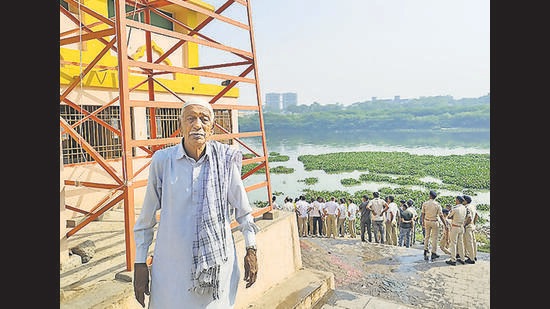
“For us local residents, the bridge and its surrounding areas are like home. This is where our children learn swimming, this is where a few accidentally drown, and this is where they occasionally die by suicide,” said Abbas Arav Chaniya, a 78-year-old.
Chaniya was not new to a rescue. As a government bus driver, he had made eight rounds carrying survivors from the accident site to the hospitals on the day of the Machchhu dam failure in 1979, when thousands were killed by government estimates.
This time, too old to venture in, he stood at the banks and guided the younger lot. “The boys from our locality didn’t care about the clothes they were wearing, or the phones they carried. Many of them just jumped in the water with tyre tubes,” said Chaniya.
Due to their close association with the bridge and the water below, and the threat it posed, most houses in this neighbourhood have tyre tubes, he explained.
As they waded through muddy, filthy waters marked by broken glass and thorns, shrieks flooded their ears. “People were dangling from rods protruding from the collapsed bridge. Many were trying to stay afloat, but I think most of them had drowned before we even began rescuing,” said Hitesh Prajapati, a local transporter.
They primarily focused on saving those still alive. “Almost half of all victims I encountered were children. We made them sit inside tubes and pushed them to the banks from where they were rushed to hospitals,” said Prajapati. If the rescuers couldn’t know if the victims were dead or alive, they felt their chests, or placed their fingers on their nose to be sure. “At the beginning, we didn’t have the luxury of bringing out the dead. Anyway, any person submerged in water for 10 minutes wouldn’t have survived,” he said.
They saw mothers who refused to leave the water until their children were found, and a rescued man who jumped back in to find his missing wife. “We couldn’t persist in saving such people. There were many more waiting to be helped,” Prajapati said.
As more locals joined in the rescue operation, they focused on victims who landed on the hard rocks on the two sides of the river. “There were people with broken limbs, with bones protruding out of their dangling arms. There were a couple of injured people with their intestines popping out, and a young boy with a severed arm,” said Mushtaq Hussain, another rescuer.
Since the river bank, where many lay injured on the rocks, was inaccessible by vehicles, the rescuers used blankets and bedsheets to carry the victims up a steep climb to the motorable road. There, other locals loaded them in cars, autos and motorcycles to rush them to the nearest hospitals, the Morbi Civil Hospital the most preferred among them.
The first responders used the flashlights on their phones initially — until halogen lights arranged by the local administration within 60-90 minutes made their task slightly easier but no less demanding.
After a couple of hours, as hope of finding survivors diminished, the locals focused on pulling out the dead. The skilled swimmers among them would hold their breath, and dive into the water for a few seconds to see what they could find — several would emerge holding a body, and asking for help to pull it out.
“Some bodies were so heavy that it took four-five of us to pull them to the shore,” said Mehboob, who lost count of how many he and his friends rescued. “All the gutters of Morbi open into this river, making it highly polluted. So, it was a task for the rescuers to stay under the water for more than a few seconds,” added Chaniya.
Pushpa Ben, a local who arrived at the bank to aid the rescue operation, said she came across a pregnant woman being pulled out. “She looked dead to me, but some people made a desperate attempt to revive her,” she said. “I just kept screaming to everyone, ‘jaan bachni chahiye, jaan bachni chahiye (save her life),” a tearful Pushpa added.
It was only on Monday morning that Mehboob got to know that two of his close friends, Alfaz Bhai and Riyaz Bhatti, were among the dead. “I think one of the heavy bodies I pulled out was of my own, Alfaz Bhai,” Mehboob said.
But he can’t be sure — he didn’t see the face because he was ready to dive in again.
One Subscription.
Get 360° coverage—from daily headlines
to 100 year archives.
Archives
HT App & Website