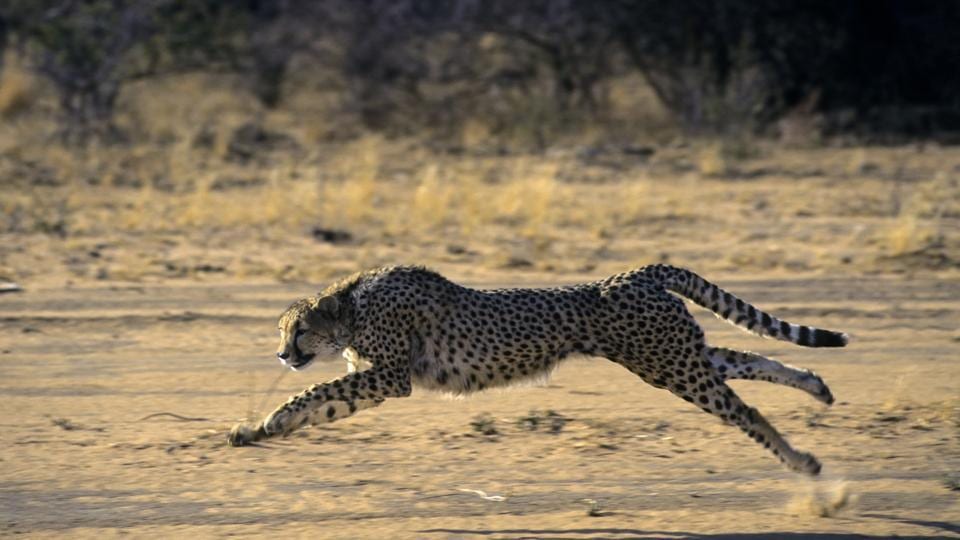
The cheetah, back seven decades after going extinct in India, owes its charm largely to its speed. What is it that enables the fastest land mammal to reach a top speed above 100 kilometres per hour (in short bursts), accelerating from 0 to 70 in just 2.5 seconds? It is a question that continues to intrigue scientists.
Also Read: Cheetahs to set foot in India after 70 years
Part of the answer lies in physiology, which is well understood: the cheetah’s body is structured for sprinting, with key roles played by a flexible spine, a light skeleton, a long tail, and large nostrils. And part lies in mechanics, knowledge about which is still evolving.
Built to sprint
The cheetah’s spine is so flexible that it curves far enough to allow it to move its hind feet in front of the forefeet. The light skeleton makes it easier to carry its weight while running, the long tail is crucial for balance, and the large nostrils and large heart combine to enable faster breathing and faster pumping of blood, which supplies the muscles with more oxygen while running. The cheetah’s collarbones are small and the shoulder blades, which are vertical, are not attached to the collarbone, an adaptation that allows it to take longer strides.
The speed, however, comes at a price. The cheetah’s sprints must necessarily be of short duration to prevent its body from overheating. It needs to pause and catch its breath to allow the muscles recover. A cheetah can maintain its top speed for only about 250-300 metres.
{{/usCountry}}The speed, however, comes at a price. The cheetah’s sprints must necessarily be of short duration to prevent its body from overheating. It needs to pause and catch its breath to allow the muscles recover. A cheetah can maintain its top speed for only about 250-300 metres.
{{/usCountry}}Also, because of the larger nostrils, not enough space is left for large teeth. And as a result of its smaller teeth, a cheetah has limited fighting abilities against other predators.
Forces at play
Mechanics involves the forces that come into play when the cheetah is running, and these are different when one pair of feet is touching the ground (stance phase) and when all the limbs are in the air (flight phase).
This is true of any animal that is galloping. Why, then, can a galloping horse not reach the same speed as a cheetah? Dr Tomoya Kamimura, an assistant professor at Japan’s Nagoya Institute of Technology, and colleagues examined this question in a paper in Nature Scientific Reports (2021), one among a number of studies led by Kamimura and published in various journals over the last few years.
They found an explanation in the flight phase. The cheetah gallops in two different ways — “gathered flight”, when all four limbs are beneath the body, and “extended flight”, when the limbs are stretched out. Lacking the cheetah’s flexible spine, a horse is not capable of extended flight, suggesting that this is a key factor in giving the cheetah its speed.
In the flight phase, fewer forces obstruct the body. In the stance phase, the body is subjected to a reaction force through the limb in contact with the ground. “In the flight phase, the cheetah’s body receives only gravitational force… When the force is small, deceleration by the forelegs is reduced, which results in higher average speed,” Kamimura said in an email response.
Using simulations based on a computer model of a cheetah in motion, the team derived equations of motion and solved them. They then compared the solutions to real-world data, and found that galloping cheetahs indeed matched the findings for certain flight types, through spine bending.
In a later study, published in Frontiers in Bioengineering and Biotechnology this year, Kamimura and colleagues examined the impact of collision when the cheetah’s feet touch the ground. Once again, they found the influence of the flexible spine. “Our research revealed the mechanism under which the flexible spine of the cheetah reduces the collision impact while running,” Kamimura said.
More to learn
In their April study, in which Kamimura’s team focused on when the cheetah’s feet touch the ground, the researchers accounted for the difference in ground-contact timings between the forelegs and hind legs. The cheetah’s motion, however, also depends on the difference in timings between the left and right limbs touching the ground. “In future research, we would like to improve our model to investigate the dynamical effects of different foot-contact timings between four legs on quadrupedal galloping,” the authors write.