
 E-Paper



Why is Sikh soldier a bogeyman for Chinese army at Ladakh
China’s PLA has installed loudspeakers at the friction points that spew its propaganda on the standoff, accuse New Delhi of escalating tensions to divert from domestic issues and even belt out Punjabi pop numbers

 Prefer HTon Google


Not far from the Rezang La-Rechin La ridgeline that has emerged as a key friction point between Indian and Chinese troops, the Chushul brigade headquarters mess still houses artefacts including a gold statue of the Laughing Buddha seized by the Sikh regiments more than a century ago.
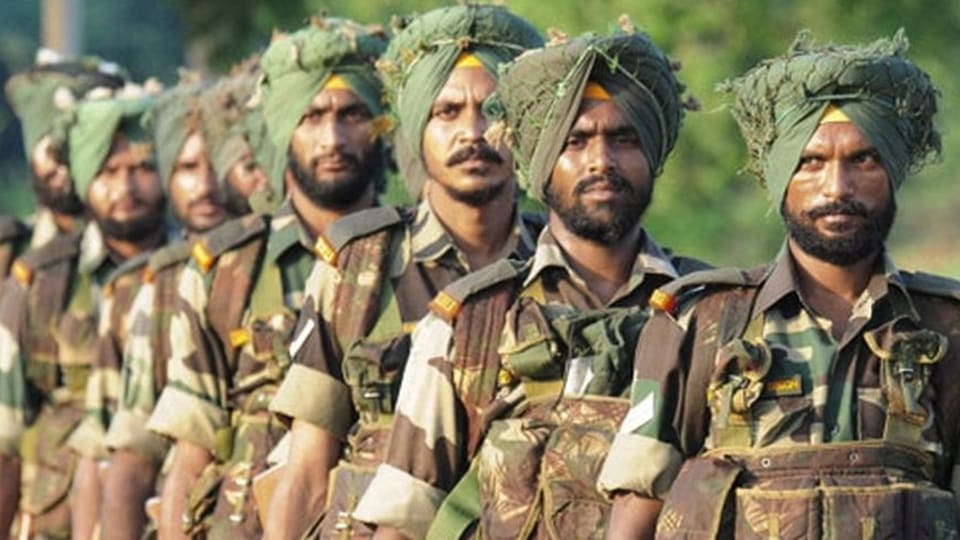
The soldiers were part of an eight-nation mission to neutralise China’s Boxer Rebellion at the turn of the last century, an uprising led by young farmers and workers against foreign influence. The British Army had brought in Sikh and Punjab regiments among others.
The alliance troops moved into Beijing after the Boxer fighters threatened foreigners and kept 400 foreigners holed up in Beijing’s Foreign Legation Quarter. The siege lasted 55 days before 20,000 alliance troops reached Beijing and fought their way in. Nearly 8,000 of them belonged to the British Army from India, many of them Sikh and Punjab regiments. After the victory, according to an account by one Indian sepoy, the British army indulged in looting: French and Russian troops killed civilians and raped women.
The statue of the Laughing Buddha at the army mess in Chushul was one of the items brought back by the soldiers. A gilded bronze bell dating back to the 1368-1644 Ming dynasty - one of the missing 16 - looted by a British general, was eventually returned by the Indian Army to Beijing’s Temple of Heaven in 1995.
In his seminal book, India’s China War, Australian journalist Neville Maxwell said the Chinese leadership used the humiliation suffered after the revolution to build a movement to restore the country. Maxwell also believed there was a link between this mindset and the 1962 war.
An Indian army commander said this historical context could be a reason why the China’s People’s Liberation Army psy-ops focuses so much on the Punjabi, or Sikh soldiers.
China’s PLA has installed loudspeakers at the friction points that spew its propaganda on the standoff, accuse New Delhi of escalating tensions to divert from domestic issues and even belt out Punjabi pop numbers aimed at the Indian soldiers deployed to counter PLA.
India and China have held several rounds of talks at the military and diplomatic level. The last one was at the level of external affairs minister S Jaishankar who had a two-hour-long meeting with his Chinese counterpart Wang Yi in Moscow that helped ease tensions between the two countries. But there is no evidence yet that a resolution is round the corner.
New Delhi is not impressed by the Chinese political rhetoric that India needs to disengage first, that the genesis of the present stand-off lies in August 5, 2019 nullification of article 370 and the redrawn Indian map or that, as the Chinese envoy Sun Weidong puts it, both sides need to meet halfway to restore peace at the border.
India believes that China should restore status quo ante as prevailing on April 20 this year when the PLA parked itself closer to the Line of Actual Control, setting off a series of face-offs with Indian army patrol parties at several locations along the LAC in Ladakh and elsewhere.


