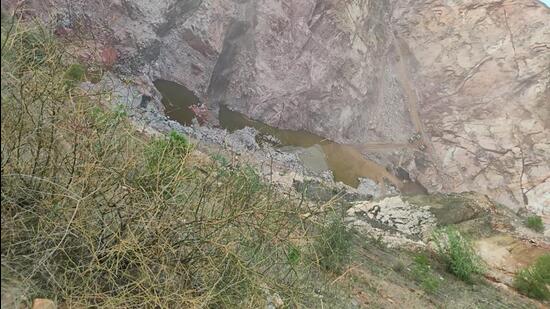
Residents of Pichopa Kalan village in Haryana’s Charkhi Dadri district were on Wednesday evening jolted by the sound of an explosion that reduced a significant portion of a hillock to rubble. The blast was allegedly orchestrated by a powerful mining cartel operating with tacit support from state authorities, marking yet another alarming instance of illegal mining in the region.
Activists and locals say this is only the latest episode in a troubling pattern stretching across Haryana, from Mewat (Nuh) to
Residents of Pichopa Kalan village in Haryana’s Charkhi Dadri district were on Wednesday evening jolted by the sound of an explosion that reduced a significant portion of a hillock to rubble. The blast was allegedly orchestrated by a powerful mining cartel operating with tacit support from state authorities, marking yet another alarming instance of illegal mining in the region.
Activists and locals say this is only the latest episode in a troubling pattern stretching across Haryana, from Mewat (Nuh) to Bhiwani’s Dadam hills and the Haryana-Rajasthan border. They accuse authorities of turning a blind eye to blatant violations, emboldened by political patronage and official inaction.
This incident follows a chillingly familiar script seen across Haryana.
Despite a Supreme Court ban on mining in the ecologically critical Aravalli range, such activities persist unabated, leaving behind a trail of environmental devastation and human tragedy.
On January 1, Subhash Singh, a resident of Pichopa Kalan, was severely injured in a rockfall caused by illegal quarrying – underscoring the dangers of unchecked mining in the Aravallis.
Activists and locals argue that the authorities’ inaction emboldens the mining mafia, turning hills and forests into open quarries.
“They eat away entire hillocks and commit brazen dacoity of the state’s mineral resources,” said Mukesh Sangwan, a local resident visibly upset by the scale of destruction. “This is an ecological disaster in the making, and no one in power seems to care.”
When contacted, mining officer Rinku Chauhan suggested the hillock collapse was due to “natural loosening” of the soil. “We are taking strict measures to ensure there are no illegal activities being carried out,” Chauhan claimed.
However, locals and environmentalists dismissed this explanation, asserting that the event bore all the hallmarks of an orchestrated blast. They questioned why soil would “conveniently loosen” in ways consistent with other illegal mining incidents.
Expanding web of illegal mining
There, a hillock in a protected segment of the Aravallis was allegedly detonated, sparking outrage among environmentalists and residents. It was the fourth such incident reported in a single month. Investigations revealed that the mining mafia operates with impunity, often exploiting jurisdictional disputes between Haryana and Rajasthan.
In Rava village, locals reported nightly blasts and the disappearance of entire hillocks.
Rajasthan and Haryana authorities remain embroiled in jurisdictional disputes, with accusations of complicity and negligence on both sides.
Haryana’s mining minister, Krishan Panwar, has repeatedly dismissed allegations of illegal mining, claiming that disputed hillocks belong to Rajasthan. However, an FIR registered by Rajasthan authorities identified the hill as being on Haryana territory, naming four of the six accused as residents of Nuh’s Ferozpur Jhirka area.
While the Haryana government has proposed installing boundary pillars and conducting geo-spatial surveys to resolve border disputes, locals and environmentalists view these measures as ineffective. They argue that the destruction of hills continues unabated under dubious jurisdictional claims.
Illegal mining is not confined to border areas. Districts like Mahendergarh, Rewari, Faridabad, and Gurugram are also plagued by illicit stone and mineral extraction. In December, the National Green Tribunal criticized Haryana authorities for failing to curb illegal quarrying in Faridabad’s Anangpur area.
“Every time there’s an incident, they announce measures, but nothing changes,” said environmentalist Vaishali Rana, questioning why officials focus on boundary issues instead of preventing the loss of entire hills.
Local leaders in Charkhi Dadri also allege they have repeatedly complained to officials. “We have filed multiple complaints with the authorities, but no action has been taken,” said Mandeep Chaoudhary, Zila Parishad chairman of Charkhi Dadri. “These unsafe practices are leading to frequent accidents, and each incident seems more audacious than the last.”
Ecological cost
The destruction of the Aravalli range has far-reaching consequences. Environmentalist Neelam Ahluwalia, founding member of the People for Aravallis group, warns that the range is being decimated for construction materials, driving Haryana toward desertification.
“As part of an independent state committee under the NGT, I visited all seven Aravalli districts in Haryana last year. My report, submitted to the Haryana government, highlighted the indiscriminate mining of the Aravallis. At this rate, Haryana will soon face severe water scarcity and desertification,” Ahluwalia said.
She pointed to the Desertification and Land Degradation Atlas-2021 by the Indian Space Research Organisation (ISRO), which revealed that 8.2% of Haryana’s land had already degraded by 2019 due to deforestation and mining. In Charkhi Dadri, nearly all Aravalli hills, except for a small section under the Aravalli Plantation Project, have been destroyed. Similar devastation is evident in Mahendergarh, where both legal and illegal mining have left landscapes barren.
In Bhiwani, ongoing legal mining operations are expected to continue until 2036. Experts fear that by the time these leases expire, the Aravallis in the district will be completely razed. Ahluwalia emphasized the urgent need for sustainable practices and alternative building materials to save the 670-million-year-old mountain range. “Without the Aravalli range—which serves as a barrier against desertification, a water recharge zone, and a pollution sink—life for millions in this region will be unsustainable,” she warned.
Political voices and public outcry
Critics have accused the state government of complicity in the rampant illegal mining.
Senior Congress leader and former Haryana chief minister Bhupinder Singh Hooda alleged that the BJP-led government has allowed the mining mafia to siphon off resources worth thousands of crores, resulting in a ₹20,000-crore revenue loss. He said, “Despite repeated complaints and FIRs, no substantial action has been taken. This inaction implies that the mafia enjoys protection from those in power.”
The death of DSP Surender Singh Bishnoi in 2022, who was allegedly killed by a truck involved in illegal mining, highlights the dangers faced by those who challenge this powerful nexus. Yet, activists claim the government’s response has been lacklustre, allowing illegal activities to flourish unchecked.
Nuh MLA Aftab Ahmed echoed these concerns, accusing authorities of normalising such crimes. “Basic FIRs are not filed in most cases, and the mining mafia continues to operate as if above the law,” Ahmed said. Congress MP Randeep Singh Surjewala also criticized the government, calling for a High Court-monitored Special Investigation Team to probe the nexus between politicians and the mining mafia.
“The illegal blasting, unauthorized paths to extract minerals, and digging beyond permissible depths are brazen acts of the mining mafia in Pichopa Kalan,” Surjewala said. “It’s running amok with the connivance of the BJP government.”
State government’s response
Haryana’s environment minister Rao Narbir Singh said he was “alarmed” by the reports of continued illegal mining and promised a comprehensive inspection of the Pichopa Kalan incident within a week. “Those found guilty will face strict action,” Singh said.
However, locals remain sceptical, pointing to similar assurances made in the past that failed to yield concrete results.
For instance, in Rava village, the December destruction of a hillock prompted FIRs and promises of action. Yet, no arrests were made, and mining activities have reportedly continued unabated. Activists argue that unless the government enforces stringent penalties and establishes proactive monitoring mechanisms, illegal mining will only escalate.
A grim warning
The destruction in Pichopa Kalan is emblematic of a broader crisis gripping Haryana. From Nuh to Faridabad, illegal mining has eroded the state’s natural heritage, undermined the rule of law, and endangered human lives. The Aravallis, once a symbol of resilience, now face the grim prospect of complete annihilation.
Environmentalists argue that sustainable practices, including the use of alternative building materials, must replace the relentless exploitation of natural resources. Community-led initiatives and public awareness campaigns could play a critical role in holding authorities accountable.
Ultimately, however, the fight against illegal mining requires political will. Without it, the hills of Haryana may soon exist only in memory, and the state’s ecological future will hang by a thread. Pichopa Kalan’s shattered landscape stands as a stark warning: unless decisive action is taken, Haryana risks losing its natural and environmental legacy forever.
One Subscription.
Get 360° coverage—from daily headlines
to 100 year archives.
Archives
HT App & Website