The Bruhat Bengaluru Mahanagara Palike (BBMP) said on Wednesday that it would work on short-term and long-term solutions to help ease traffic congestion and help smoother vehicular flow in major traffic choke points in the city.
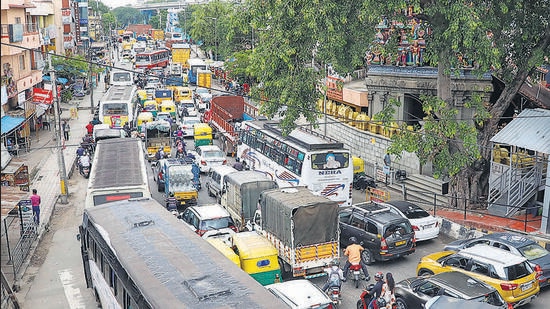
“If we implement even small changes, then 15-20% traffic movement can be improved,” Tushar Girinath, the chief commissioner of the BBMP said on Wednesday.
The BBMP said that it has streamlined coordination between various civic agencies and traffic police, among others, to implement measures like improving the quality of road surface, better signalling, creating bus bays and using diesel pumps to remove water-logging to reduce congestion in the city.
Girinath, quoting the feedback from the traffic police, said that there was no need for specific bus lanes to improve traffic flow.
“The bus lane, we did this as an experiment and the traffic department has said that it is not stopping vehicle movement and have removed it,” he said.
Bus lanes on major roads like Outer Ring Road (ORR) and a few other roads had desirable results on heavy-traffic density corridors before the Covid-19 pandemic-induced lockdowns.
As one of the longest technology corridors in Bengaluru, the 32-kms long road from Silk Board to Hebbal sees one of the highest numbers of vehicles as hundreds and thousands of workers use this route to reach the hundreds of corporations who have a presence here, adding to the large and long traffic pile-ups.
{{/usCountry}}As one of the longest technology corridors in Bengaluru, the 32-kms long road from Silk Board to Hebbal sees one of the highest numbers of vehicles as hundreds and thousands of workers use this route to reach the hundreds of corporations who have a presence here, adding to the large and long traffic pile-ups.
{{/usCountry}}The bus lane, promoted as “Cities on the Move Challenge–Where there is a bus, there is a way”, did see significant success to improve travel time.
Over 6,565 buses are plying on various routes across Bengaluru, ferrying over 2.5-3 million or nearly 50% of the total commuters in the city. However, the city administration and successive state governments’ priority has been to implement the metro network, the construction of which has taken away space on roads, leaving little room for the bus lane.
“Serious about reducing congestion in Blr? BMTC is the only answer. 1. reduce fares
2. remove fuel tax on bmtc 3. let bmtc hire staff (incl. those dismissed for strike)
4. more buses, esp. Mini 5. launch bus priority lanes in high traffic zones with painted demarcation,” Shaheen Shasa, a Twitter user said, in a post on Wednesday.
The pandemic has also forced higher dependence on private vehicles as people fear contracting the Covid-19 in public transport. To be sure, there are over 10 million vehicles for as many people in Bengaluru, which is among the highest in the country in terms of the vehicle to population ratio.
MN Srihari, former additional chief secretary of Karnataka and expert on traffic engineering, said that most of these ‘meetings and measures’ of the BBMP is an eye wash.
“The police or politicians cannot ease congestion. Planning should be done and there should be an approach by calling on experts. Just like Doctors, traffic management engineering is an actual subject and experts in this field will give solutions,” he said.
“Let them remove parking on roads as it is meant for traffic movement but this won’t be done. Because parking takes away almost one third of the road space. Bengaluru is an old city. It transformed from a village to a mega city but the roads remain narrow. Let the BBMP construct 2-3 multi-level car parking and charge people to park there. But no one has the guts to do this,” he said.
He said that there is a traffic signal every 200 meters in the city and the authorities should think of creating more “green corridors” in which signals would synch and provide a good stretch of open signals to vehicles heading in one direction.
Bengaluru beat 415 other cities in 57 countries to emerge on top of the list of the world’s worst traffic in 2019, according to a report by TomTom, a Netherlands-based global provider of navigation, traffic and map product, company.
“Bengaluru takes the top spot this year with drivers in the southern Indian city expecting to spend an average of 71% extra travel time stuck in traffic,” TomTom said in its report.
Long delays in implementing projects like Bengaluru Metro, introducing alternative mass transit options, and providing basic infrastructure like good roads have led to a large number of private vehicles pouring into the streets and adding to painfully long traffic jams almost on every street.
According to TomTom’s 2019 report, a commuter spent an additional 243 traffic hours annually? while driving during peak hours.
The report said during the time spent on roads, “people in Bengaluru could have planted 244 trees, watched 215 episodes of Game of Thrones or watched 139 football matches”.
On June 25, Karnataka chief minister Basavaraj Bommai instructed the officials to take measures to reduce traffic congestion at 10 prominent spots in the city including Hebbal, Mahadevapura Outer Ring Road, and Silk Board Junction and Whitefield Road, which witness huge traffic jams.
The chief minister directed the works to be supervised by Deputy Commissioners of Police (DCPs) of the concerned area. The measures would include synchronisation of traffic signals and removing the obstacles to smooth the flow of vehicular traffic.