When a position of law is liable to cause great unsettlement in the world of business and investment, the Supreme Court cannot leave the issue to the vagaries of future litigation, a seven-judge bench said on Thursday, adding that the impact of a wrong precedent will be severe.
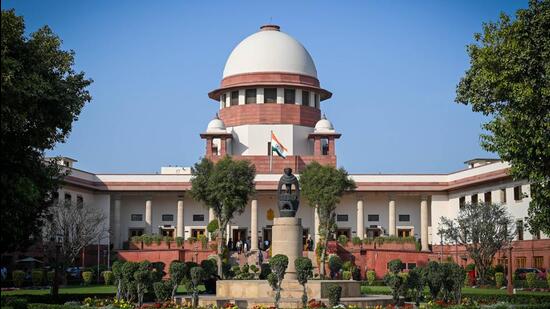
“We are a constitutional court. When a position of law is liable to cause grave public injury and uncertainty, and great unsettling in the world of business and investment, surely, the point in time in which the controversy should be resolved cannot be left to the vagaries of future litigation. It’s the duty of the court to seize the opportunity,” said the bench led by Chief Justice of India Dhananjaya Y Chandrachud. The bench also comprised justices Sanjay Kishan Kaul, Sanjiv Khanna, Bhushan R Gavai, Surya Kant, JB Pardiwala and Manoj Misra.
The observations came as the bench reserved its judgment on a plea demanding reconsideration of the court’s April 2022 judgment, which held an arbitration clause is void and not enforceable in law if the agreement is unstamped or insufficiently stamped. By 3:2, the majority verdict in April said that a court could go into the aspects of stamping and other compliances before the arbitrator is appointed.
This judgment triggered serious concerns over further delays in the appointment of arbitrators by adding one more layer of scrutiny, besides being contrary to India’s pro-arbitration stance.
{{/usCountry}}This judgment triggered serious concerns over further delays in the appointment of arbitrators by adding one more layer of scrutiny, besides being contrary to India’s pro-arbitration stance.
{{/usCountry}}As the seven-judge bench considered a curative petition to overrule the April 25 judgment, senior advocate Shyam Divan, representing one of the parties in the case, on Thursday questioned the jurisdiction being exercised by larger bench. Divan contended that curative was not the appropriate jurisdiction to rest a legal position since a curative jurisdiction is essentially meant to address a wrong between parties.
“There must be a legitimate jurisdiction to determine a particular issue and therefore, the bench has to decide this in an appropriate cause at an appropriate time. These are not the proceedings in which the issues can be decided...It’s of extreme importance for the institution to ‘means and ends’ test,” Divan added. He said that the April judgment in the NN Global case needs to be relooked at in separate and more appropriate proceedings.
But the bench told Divan that the issue has already been segregated by it between factual and legal causes. “We are only examining the legal issue. On facts, at the end of it all, we can still dismiss the curative petition against your client. While we want to settle a point of law, we are equally conscious of doing justice in the facts of a particular case,” it said.
Stating that there is an unsettled legal cause which has a wide ramification, the court said that the legal ratio required to be broken down without waiting for some other case to come up.
“The impact of a wrong precedent is so severe, and our history has shown that...What you have to ensure is that you do not confine your arguments only to one or two parties in a matter like this. That is why we have invited a broad diversity of views on both sides,” said the bench, as it decided to continue hearing the case.
The decision in the case was reserved following the arguments in the case over the last two days. On Wednesday, the bench expressed its doubt on the correctness of the April ruling, observing that stamping has nothing to do with validity of an agreement. It added that provisions of the Contract Act will make it clear that any lacuna in stamping of an agreement does not render the document invalid but can only impact its admissibility as evidence and consequently, its enforceability.
The issue was referred to the seven-judge bench by the top court on September 26, citing the “limitless uncertainty in the area of arbitration” triggered by its April ruling.
The April verdict, by 3:2 majority, relied on the 1899 Indian Stamps Act that required certain agreements to be compulsorily registrable or chargeable to stamp duty when it held that a court could go into the aspects of stamping and other compliances before the arbitrator is appointed. According to the majority view, a court is bound to examine the instrument at a pre-appointment stage, and if it is found to be unstamped or insufficiently stamped, the instrument is to be impounded at that stage, declaring the arbitration agreement to be void.
The two other judges on the bench, comprising the minority, however flagged concerns that the view taken by the majority in the judgment has the propensity of frustrating the objective of the Arbitration and Conciliation Act, as a scrutiny on stamp duty at the threshold can stall the process and will lead to procedural complexity and delay in litigation before courts.