The question whether India can trust Nawaz Sharif is incongruous to state the least. There isn’t an option other than engaging with an elected leader, more so when he’s making all the right noises. So much so that he told an interviewer that he’d visit India even without an invite.
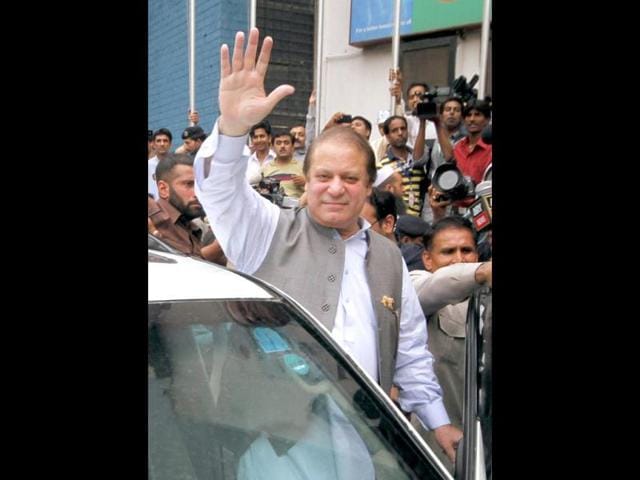
Not that Sharif will really come uninvited. In a manner of speaking, he showed how keen he was to set up talks with India. The Pakistan Muslim League (Nawaz) chief was strikingly candid in the many conversations he has had with the media, telling Geo TV’s Hamid Mir that for relations to improve, both sides will have to give up the retributive “tit for tat” approach that guided cross-border terror.
The former premier recalled with fondness his Lahore Summit with AB Vajpayee who, according to him, wanted the year 1999 to be “the year of resolution of Indo-Pak issues.” He might not be able to deliver to New Delhi’s satisfaction on his promise to share the Kargil inquiry report or have investigated the ISI’s role in Mumbai’s 26/11. But his statements made peace with India an electoral issue.
Sharif’s agenda signified a major shift away from the jingoism of yore. Barring occasional jibes, anti-India rhetoric isn’t any more a part of the mainstream Pakistani discourse. Even Imran Khan’s Pakistan Tehreek-e-Insaaf (PTI) restricted its criticism of India to “human rights violations” in Kashmir. The anti-India venom permeates from the fringes inhabited by jihadists with a vested interest in hostilities. Sharif’s main challenge will be to rein in these elements enjoying the moral, political and material support of a section of the civil-military establishment.
{{/usCountry}}Sharif’s agenda signified a major shift away from the jingoism of yore. Barring occasional jibes, anti-India rhetoric isn’t any more a part of the mainstream Pakistani discourse. Even Imran Khan’s Pakistan Tehreek-e-Insaaf (PTI) restricted its criticism of India to “human rights violations” in Kashmir. The anti-India venom permeates from the fringes inhabited by jihadists with a vested interest in hostilities. Sharif’s main challenge will be to rein in these elements enjoying the moral, political and material support of a section of the civil-military establishment.
{{/usCountry}}A case in point is that of the Pak-based United Jehad Council’s Syed Salahuddin who hails from the Indian side of Kashmir. He perhaps was parroting the lines dictated to him by his ISI hosts while warning Sharif against befriending New Delhi at the expense of the Kashmir dispute. Salahuddin’s advice was as unsolicited as it was misplaced. As a Kashmiri born and raised in Punjab, the PML(N) leader is, from his country’s perspective, twice qualified to defend its interests.
Sharif actually is charged with entering into tacit pacts with Hafiz Sayeed of Lashkar-e-Taiba (LeT) and Hakimullah Mehsud of the Tehrik-e-Taliban Pakistan (TTP), among others, to keep them from perpetrating violence in Punjab where the electorate gave him a landslide mandate. The TTP despises democracy as a western concept. It wants Islamic rule in Pakistan.
Towards realising that broader agenda, it let right-wingers including the PML(N), PTI, Jamaat-e-Islami and the Jamiat-e-Ulema-e-Islam (JUI) campaign freely. The playfield was simultaneously made uneven by targeting the secularist PPP, the Awami National Party and the Muttahida Quami Movement (MQM). “Mehsud played the referee in these elections. The mandate was snatched from us through terrorist threats,” alleged the ANP’s Asfandaryar Wali.
The PM-elect will have to disprove the charge through concrete action. Mocked as Tajir-e-Azam (trader-in-chief) by the late Benazir Bhutto in his earlier stints as premier, Sharif’s first a businessman, then a politician. He knows better that winning elections is easier than delivering on promises of good governances.
He needs calm on the borders and within Pakistan to repair the economy, curb inflation, generate jobs and resolve the energy crisis. For that to happen, he’d need to engage at once with India and the jihadists exporting terror across frontiers. His task is doubly daunting as militant outfits such as the TTP and LeT cannot be easily marginalised or made to hold fire.
Their positions against democracy, the US and India are rigid if not cast in stone. One will have to wait and see whether the army’s on the same page as the new political establishment to resolve these complexities for authoring a new chapter in Indo-Pak relations. General Ashfaq Parvez Kayani has advised Sharif to move gradually on the India front. But more instructive for us will be the new Chief’s thinking after Kayani finishes his extended term later this year.
As his country’s tallest leader with a solid base in Punjab, Sharif’s political gravitas is comparable with that of Vajpayee, his Indian interlocutor of 1999. The former Indian premier led a paradigm shift in his party’s “akhand bharat” approach by visiting Lahore’s Minar-e-Pakistan that’s a memorial to the Pakistan movement that partitioned India.
Vajpayee could pull it off within the larger Sangh parivar on the strength of his persona. But General Pervez Musharraf’s Kargil brought the good effort to naught. For his part, Sharif’s committed to picking up the threads from where they left off some 14 years ago. He cannot succeed unless he’s able to negate the philosophy of hate that guides the army to use terrorism as a strategic and foreign policy tool against India.
Besides a strong political will, Sharif’s single party rule in Islamabad will need a coalition of ideas to rewrite the sub-continent’s troubled history. Since it takes two to tango, his challenge will have to be seen as its own by the political class in India.