For US President Barack Obama, the Republic Day parade where India will showcase its military might could well be like leafing through a forgotten album of sepia-tinted photographs from the annals of history, albeit with the odd contemporary colour snapshot popping up from time to time.
Obama will be sharing the dais with President Pranab Mukherjee and PM Narendra Modi, while motorised carriers bearing India’s finest weaponry will stream past down New Delhi’s Rajpath.
And although the Indian Air Force will showcase contemporary acquisitions such as its newly purchased Poseidon P-8 I maritime surveillance aircraft, which was developed by Boeing for the US Navy, and transport aircraft such as Lockheed’s updated C-130 Hercules, and Boeing’s C-17 Globemaster, Obama will also get to see a lot of Russian military hardware, not all of it modern. He’ll see attack choppers such as the Mi-35 (vintage: 1980), the Sukhoi MKI fighter planes (which Hindustan Aeronautics Ltd. makes under licence from Russia) and MiG-29 K carrier-based fighters.
Seeing them may remind Obama of the US Air Force’s new Lockheed Martin F-22 Raptors, the first fifth generation all-weather stealth fighters that can cruise at ultra-high speeds and combine manoeuvrability with stealth in evading surveillance. What may also cross his mind is the US offer to sell to India modern American helicopters – Chinooks for transport and Apaches for attacks.
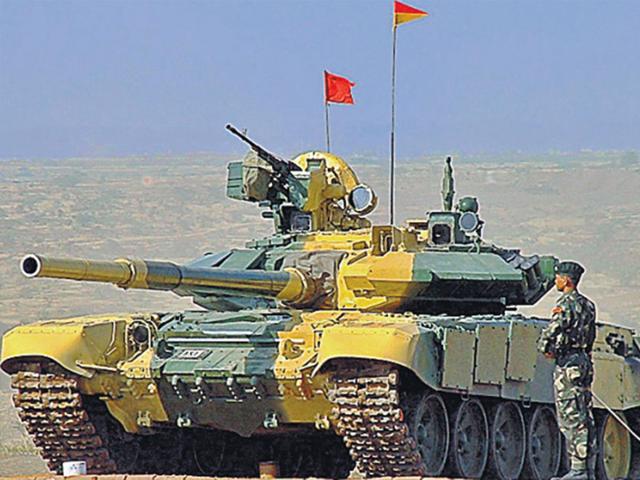
The parade will also showcase other Russian technology-based equipment such as the Indian Army’s T-90 aircraft-killer tanks (first produced 23 years ago) and T-72 or Tank-Ex main battle tanks (first developed in the 1970s), a reminder to the US of wars fought long back, including the one that was somewhat of a different kind known as the Cold War. Although India’s overt reliance on Russian-manufactured weapon systems like the BrahMos cruise missile may be on display, India’s Defence Research Development Organization (DRDO) will also showcase its indigenously-built weapon locating radar, which has been in development and trials since the Kargil War in 1999, and the Akash medium range surface-to-air missile, which was deployed with the IAF in the 2000s.
And the Indian Navy will showcase a model of the INS Kolkata, a guided missile destroyer that was inducted by Modi in July last year. It has stealth features and is armed to the teeth but in comparison to the 10 nuclear-powered super aircraft carriers and scores of destroyers in the US Navy’s repertoire, it is nothing.
In terms of technology or otherwise, India’s military hardware is not a patch on what the armed forces of the US have at their disposal, and China is far ahead in numbers and indigenisation.
{{/usCountry}}In terms of technology or otherwise, India’s military hardware is not a patch on what the armed forces of the US have at their disposal, and China is far ahead in numbers and indigenisation.
{{/usCountry}}The US military, in particular, has a mind-boggling array of weapons that could make close-quarter combat in wars of the future totally outdated— whether it is on land, in the air or at sea. The other sharp contrast in terms of arms and weaponry will be evident on the dais itself.
President Obama is the head of the world’s largest exporter of defence equipment, while Prime Minister Modi is the head of the largest importer. And as for defence budgets: at $640 billion, the annual spending by US on defence is roughly 13 times the $47 billion that India does.