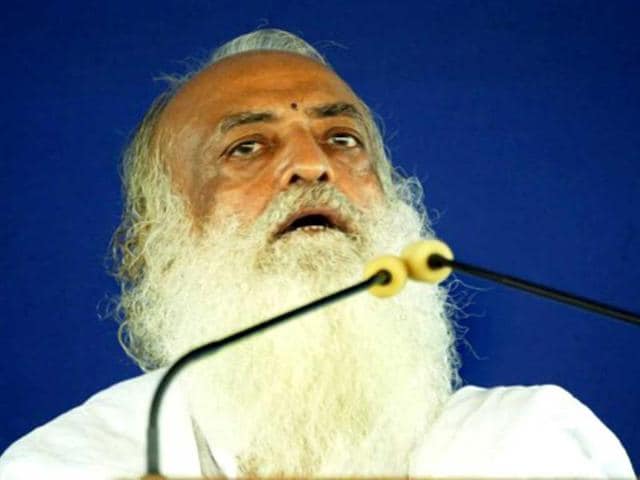
Going over the utterances of a string of well-placed personalities on the December 16 gang rape, one may wonder if the sound bites were collected from some cuckoo’s nest. Mohan Bhagwat, the RSS chief whose word is law in the BJP, pronounced that rape is unknown in “Bharat” but is rampant in “India”. BJP MLA in Rajasthan Banwari Lal Singhal went a step further in demanding a ban on skirts as school uniform to “keep girl students away from men’s lustful gaze”. Puducherry education minister T Thiagarajan matched Singhal’s sartorial innovativeness by prescribing a kind of “overcoat” for girl students, not to speak of banning mobile phones. A khap panchayat leader spotted the real culprit – chow mein. Eating of which, he said, prompted libidinous urges. Jamaat-e-Islami Hind secretary general Nusrat Ali demanded abolition of co-education schools, and a strict disciplining of girls’ hemlines. But the “top loony” award was reserved for Asaram Bapu, who alternates between a spiritual leader and land grabber; his famous advice to the victim of the bus rape was that she must share much of the blame since she ought to have held one of the rapists by hand and called him brother.
Does such a welter of asinine remarks cause doubt that the ‘sample’ is skewed? Maybe a smarter set of people would have sounded the right words, but there is little reason to disbelieve that the political class was so entirely blown out of the water by the spontaneity of the protest rallies that it ran out of ideas and ways to respond. When the President of India’s MP son described the protests as a congregation of “dented and painted” ladies, his linguistic limitations were accompanied by an outright bafflement. In Lutyens’ Delhi, the rape and murder was not news. The excited crowd was. It took the Prime Minister an entire week to respond. Home minister Sushil Kumar Shinde got irked by the suggestion that he might address the protesters: “If some Maoists hold a rally, am I required to meet them too?”
The confusion and irritation of the neta types tells its own story. In India’s heartland, rape is not really news and certainly not as much news as perennially outraged TV anchors imagine it to be. A simple calculation makes evident the extent of under-reporting of rape in India. In the US, the Department of Justice reported 191,670 victims of rape or sexual assault in the year 2005. India has a population nearly four times that of the US. So it is expected to report about 800,000 cases. But in 2008, the last year for which figures are available, there were just 21,464 cases of rape reported that were in keeping with the definition of the offence provided by the penal code (Sec 375 IPC). In a country where rape is a simultaneous show of authority and power, the figure could be many times more.
{{/usCountry}}The confusion and irritation of the neta types tells its own story. In India’s heartland, rape is not really news and certainly not as much news as perennially outraged TV anchors imagine it to be. A simple calculation makes evident the extent of under-reporting of rape in India. In the US, the Department of Justice reported 191,670 victims of rape or sexual assault in the year 2005. India has a population nearly four times that of the US. So it is expected to report about 800,000 cases. But in 2008, the last year for which figures are available, there were just 21,464 cases of rape reported that were in keeping with the definition of the offence provided by the penal code (Sec 375 IPC). In a country where rape is a simultaneous show of authority and power, the figure could be many times more.
{{/usCountry}}RSS chief Bhagwat, himself rooted in India’s feudal sub-soil, has also given voice to his patriarchal world view by saying that marriage is a contract in which husbands are to work outside and wives must take care of (read stay at) home. One of his followers in the Rajasthan BJP has now reminded his constituency of the canonical phrase ‘pati parmeshwar’ (husband is God), thus presenting Bhagwat’s “contract” in an even more unequal way.
In the West, judges are often sceptical about rape as most cases involve “date rape” in which the woman consents to stay close to the man for quite a while, only to later claim that she had never agreed to sex. The man obviously contests the claim. Judges are called upon to analyse the victim’s ‘signal’, which, if found mixed, makes conviction difficult. In British courts, this is called a “mucky sex” case. In India, on the other hand, the victim often has little option, particularly if she is a Dalit and the rapist belongs to both a higher class and caste. In such instances, there is little chance that a case will actually get registered with the police as the latter, in the Hindi heartland at least, follow the caste code more rigidly than the penal code. Migrating to cities due to economic reasons, these upper caste country yokels, starved of their regular sexual prey, at times cross the red line by attacking educated modern women. After realising the enormity of their action’s consequences in a 21st century urban milieu, they then proceed to kill their victim. This is perhaps what happened in the Munirka bus rape case.
All ancient societies were lenient when it came to rape, though scriptural works are full of homilies for women. Christianity and Islam have some qualified safeguards against the violation of married women but nothing to help prevent the widespread scale of non-consensual sex in India. According to Apastamba Dharma Sutra, the 400 BC code which governed Hindu society, there is a long list of relations in which cohabitation is forbidden but there is no mention of the ethicality of forcible sex or its lack. The Judeo-Christian world may have left its patriarchal past behind, but India hasn’t. Famously, many centuries coexist in India. The British, during their rule over India, seldom interfered with her social practices. But when they did, it was with an iron fist. There was no sati in British India after Bentinck abolished it in 1829. If India’s present rulers think that women demand more respect, they should set up ‘mahila courts’ in every block, and assemble a cadre of judges that is dedicated to the cause of women. Mere words won’t suffice.
Sumit Mitra is a Kolkata-based writerThe views expressed by the author are personal