It is easy to miss Kailash Satyarthi, who is almost six feet tall, when he is with aggrieved parents at the office of his organisation, the Bachpan Bachao Andolan, at Kalkaji in south Delhi. He talks to them at a pitch lower than normal. Before they have finished telling him their issues, he has decided which of his team members can help them out.
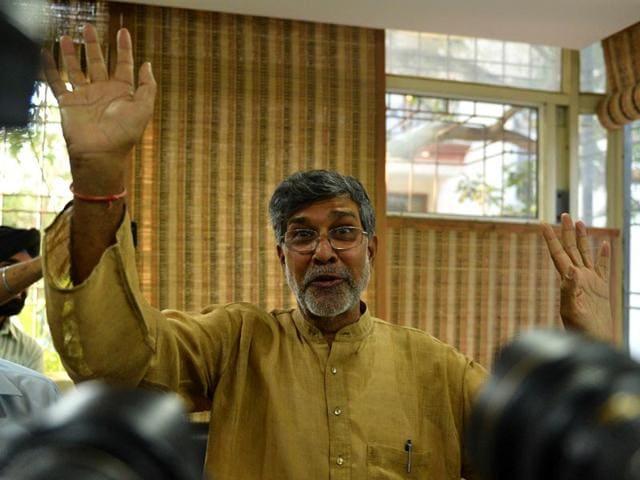
The 60-year-old child rights activist and campaigner, who jointly won the Nobel Peace Prize 2014 with Pakistani teenager Malala Yousafzai, beating Edward Snowden and the Pope, does not mind posing for the camera. The engineer-turned-activist believes that to keep working for child rights, one needs to keep alive the child inside.
How has your life changed after receiving the Nobel peace prize?
Nothing much has changed in terms of the time I spend at the Bachpan Bachao Andolan (BBA) office. The nature of work has changed, though. It has become very demanding. There has been a flurry of media queries. Many people have been visiting to congratulate me. I have been receiving thousands of emails. It is difficult to segregate them. It is difficult to say no to people. This is beyond my imagination. It has gone too fast and too big.
You have been working in the child rights sector for about three decades. What have you learnt?
I learnt that nothing is impossible. I took up the issue of child labour when it was a non issue. When we started working, there was no research material or inference. We were charting unexplored territory. While I was saying it was child servitude and not poverty, the general perception was that it was alright for poor children to work. I said there was an element of slavery and denial of human rights. This was new thinking and it was a big task to make people understand this. I also learnt that it is crucial to trust others and make a team. You have to work with people who may not be very professional, geniuses or knowledgeable. I am essentially driven by some sort of spirituality rather than any political ideology.
Are you a practising Hindu?
I believe in the oneness of God but I don't believe in any traditional or conventional religion. I don't visit temples. I believe that God can manifest himself or herself through the purest of creatures and that could be children.
You said that when you started working, it was an unexplored territory. Did you have a mentor or guru?
Not really. I was influenced by several people. From an early age, I had been reading the writings of Mahatma Gandhi and about various freedom fighters such as Subhash Chandra Bose and Bhagat Singh.
Anyone in civil society?
I can't say. I was influenced by Swami Dayanand and Swami Vivekanand. Due to that, I considered becoming a sanyasi and joining a global brotherhood to translate the Indian virtues of sacrifice, compassion and love into actions. But gradually, I became involved in other things. I was active in student politics in my college in Vidisha (Madhya Pradesh).
You have received a dozen awards from Europe and the US. You have been involved in the global march against child labour and the South Asian Coalition on Child Servitude (SACCS), a coalition of more than 200 NGOs working on child rights issues in India, Pakistan, Nepal, Bangladesh and Sri Lanka. Why is it that in India, except for journalists and social activists, people hardly know you?
I have been working at two levels simultaneously. One has been direct action and directly working with children, parents and communities in the remotest areas of India and also across the world in places like Ghana and Ivory Coast. I have also been operating at the highest policy levels. That includes making new laws, budgetary allocation for education and elimination for child labour in various countries. This leaves you with limited time. In this time, if you socialise with people in the development sector and media, you become a known figure. You get a kind of recognition and people started knowing your work. I never cared for that. It is not because I am a saadhu. I am happy to see media reports quoting my team mates. It shows that BBA is not individual centric. You see, in our country, glamour, fame, recognition and a person's credentials are all intermingled. If you are famous, you are authentic. I do not think like that. Authenticity lies in your personal conviction and the result of your work on the ground. It is also about the mindset. A lot of attention has been paid to the charity mode of intervention which is considered humanitarian and gets you praise and recognition. When you talk about child rights in terms of justice, human rights, equality and fundamental issues, you don't get that kind of recognition. There is also the political aspect. If you are in politics and trying to do something good, you are immediately picked up by the media. We were never close to any political party.
You mentioned the traditional mindset about child labour. What are your views about children who are getting educated but are also learning some form of traditional skills that have been in their families for generations?
When I started working against child labour in the carpet industry, I was approached by many parents whose children had been lured, kidnapped and forced to work somewhere else. We moved the Supreme Court which appointed a commissioner. He studied the issue and submitted that children working in the carpet industry were not local children. They had never seen or touched a carpet in their lives. No local child was doing this work. You are fooling people by saying that you are making them learn a traditional craft.
Take the example of children who used to work in the Ferozabad bangle and glass industry. The parents of those children had never worked in that industry. Only the kids were doing so. No factory owner would allow his children to work in such a hazardous environment. That is mere propagation. I am not against learning skills. Skill development is something this is needed in our country. But it must be guaranteed that there is no element of exploitation or compulsion or lack of choices. If a child between 15 and 18 years of age goes to school and is learning a skill freely in his or her family environment, there is nothing wrong in that. An educated child with skills will do much better than an illiterate skilful child. Children across economic strata should learn skills. There should be skills building sessions in schools after class 10. But it should not happen at the cost of the right to education.
A criticism of your work came from economist Jagdish Bhagwati. In 2001, when BBA was working to stop child labour in the carpet industry, he gave an interview to a national daily where he said if sanctions were imposed on this industry in Hoshiarpur, then poor families would send their kids to some other industry elsewhere. According to him, the solution was to have NGOs work at ground level and to fund families to send their children to school.
I had a lengthy discussion with Bhagwatiji on this subject after he expressed this opinion. My position on this issue is clear and it applies to various countries. There are around 17 crore children involved in child labour across the globe and 20 crore adults are jobless. There have been studies in a few countries where it has been established, through empirical evidence, that when children are forced to work due to poverty or other reasons, they belong to families with parents who do not get paid employment for 100 days in a year. The child is working for around 400 hours in a year. How does one break this vicious circle? If you allow child labour to continue, then you are allowing adult illiteracy and intense poverty to continue. If we cannot understand this vicious circle, I wonder what economics are we discussing here. It was not only Bhagwatiji. There are many economists, social scientists academicians and ordinary people who used to think like that. Secondly, wherever children are engaged in labour, a few factors are common. For example, it immediately results in lowering of adult wages. Children are the cheapest source of labour. Also, they cannot form unions, go on strike, approach labour courts. They are the most vulnerable physically and mentally. Therefore, child labour perpetuates and causes adult unemployment, poverty and eventually, illiteracy. Wherever there is child labour, there is illiteracy. Wherever there is illiteracy, poverty is bound to follow. There is a third aspect. In many cases, children working in hazardous conditions suffer physical ailments. They lose their organs. It is an irreparable loss. First, you make them an asset for 5-10 years and then you make them a liability forever.
You work in more than 100 countries including Latin America and Africa. Tell us about your experiences.
Almost 60 per cent of child labour in the world exists in the agriculture sector. This is because people in India and globally, including the US, think that this is normal. Our argument is that the nature of the agriculture sector has changed a lot from what it was 20-30 years ago. With the use of insecticides, pesticides and various machines, it has become a hazardous sector. The second aspect here is the commercialisation of agriculture. Currently, many children in this sector do not belong to traditional farming families. Most of these farmers are part of a long supply chain. Another major global intervention of ours is in the education sector. I have been the co-founder and founding president of the global campaign for education. I have been working on the inter-linkages between child labour and education. I have been trying to fight against some of the identified and hidden obstacles in achieving education. These include child labour, trafficking, slavery, violence against children and child servitude. Earlier, people were unable to see the connection between child labour and education. I was part of this process which has made a paradigm shift globally towards the notion of education. People used to think of it as charity. Even the US did not have a right-based approach regarding education.
You mentioned the traditional mindset about child labour. What are your views about children who are getting educated but are also learning some form of traditional skills that have been in their families for generations?
When I started working against child labour in the carpet industry, I was approached by many parents whose children had been lured, kidnapped and forced to work somewhere else. We moved the Supreme Court which appointed a commissioner. He studied the issue and submitted that children working in the carpet industry were not local children. They had never seen or touched a carpet in their lives. No local child was doing this work. You are fooling people by saying that you are making them learn a traditional craft.
Take the example of children who used to work in the Ferozabad bangle and glass industry. The parents of those children had never worked in that industry. Only the kids were doing so. No factory owner would allow his children to work in such a hazardous environment. That is mere propagation. I am not against learning skills. Skill development is something this is needed in our country. But it must be guaranteed that there is no element of exploitation or compulsion or lack of choices. If a child between 15 and 18 years of age goes to school and is learning a skill freely in his or her family environment, there is nothing wrong in that. An educated child with skills will do much better than an illiterate skilful child. Children across economic strata should learn skills. There should be skills building sessions in schools after class 10. But it should not happen at the cost of the right to education.
A criticism of your work came from economist Jagdish Bhagwati. In 2001, when BBA was working to stop child labour in the carpet industry, he gave an interview to a national daily where he said if sanctions were imposed on this industry in Hoshiarpur, then poor families would send their kids to some other industry elsewhere. According to him, the solution was to have NGOs work at ground level and to fund families to send their children to school.
I had a lengthy discussion with Bhagwatiji on this subject after he expressed this opinion. My position on this issue is clear and it applies to various countries. There are around 17 crore children involved in child labour across the globe and 20 crore adults are jobless. There have been studies in a few countries where it has been established, through empirical evidence, that when children are forced to work due to poverty or other reasons, they belong to families with parents who do not get paid employment for 100 days in a year. The child is working for around 400 hours in a year. How does one break this vicious circle? If you allow child labour to continue, then you are allowing adult illiteracy and intense poverty to continue. If we cannot understand this vicious circle, I wonder what economics are we discussing here. It was not only Bhagwatiji. There are many economists, social scientists academicians and ordinary people who used to think like that. Secondly, wherever children are engaged in labour, a few factors are common. For example, it immediately results in lowering of adult wages. Children are the cheapest source of labour. Also, they cannot form unions, go on strike, approach labour courts. They are the most vulnerable physically and mentally. Therefore, child labour perpetuates and causes adult unemployment, poverty and eventually, illiteracy. Wherever there is child labour, there is illiteracy. Wherever there is illiteracy, poverty is bound to follow. There is a third aspect. In many cases, children working in hazardous conditions suffer physical ailments. They lose their organs. It is an irreparable loss. First, you make them an asset for 5-10 years and then you make them a liability forever.
You work in more than 100 countries including Latin America and Africa. Tell us about your experiences.
Almost 60 per cent of child labour in the world exists in the agriculture sector. This is because people in India and globally, including the US, think that this is normal. Our argument is that the nature of the agriculture sector has changed a lot from what it was 20-30 years ago. With the use of insecticides, pesticides and various machines, it has become a hazardous sector. The second aspect here is the commercialisation of agriculture. Currently, many children in this sector do not belong to traditional farming families. Most of these farmers are part of a long supply chain. Another major global intervention of ours is in the education sector. I have been the co-founder and founding president of the global campaign for education. I have been working on the inter-linkages between child labour and education. I have been trying to fight against some of the identified and hidden obstacles in achieving education. These include child labour, trafficking, slavery, violence against children and child servitude. Earlier, people were unable to see the connection between child labour and education. I was part of this process which has made a paradigm shift globally towards the notion of education. People used to think of it as charity. Even the US did not have a right-based approach regarding education.
What is the advocacy part played by your organisation?
Advocacy has two aspects. One is awareness building. It is the preventive part. People have to be conscious about the evil called child labour so that they can stop it right at the source. And this is not easy as you have to engage various influential people in society such as priests, teachers and village heads. The first thing we ensure is that all children are withdrawn from exploitative labour without any raid or legal intervention. Secondly, all children are enrolled in schools. Thirdly, village children form a children's parliament or baal panchayat. This is a process of inculcating democratic values in them.
What is your opinion about India's efforts to tackle child labour?
Child labour is a social evil. Society's response to the issue is very crucial. Social will is lacking right now. We also need better law enforcement. We need to see how to integrate the issue of child labour with the larger development framework including poverty alleviation, rural development and right to education. I believe the current regime's focus on the girl child and on social issues is proactive.
Some people say that this award is an international recognition of India's failure to tackle child labour and that we stand exposed before the world.
India is an open country with not only functional but a vibrant democracy. The judiciary is doing a great job. If we talk about various judgments or observations of the Supreme Court on a wide range of issues such as human rights and corruption, can we say that the court has exposed India's dark side for everyone to see? Similarly, media has been reporting heinous crimes. We cannot say that because it reflects poorly on our country, media organizations should abstain from highlighting these issues.