
Sign in

Litigation policy to dispose of cases involving govt in 3 yrs

The cabinet is to take up a law ministry proposal that aims to dispose of in three years cases involving the Centre and also minimise litigation by the government, the country’s biggest litigant.

Updated on: Aug 17, 2015, 02:25:10 IST
Hindustan Times | By , New Delhi
Share
Share via
  • facebook
  • twitter
  • linkedin
  • whatsapp
Copy link
  • copy link

The cabinet is to take up a law ministry proposal that aims to dispose of in three years cases involving the Centre and also minimise litigation by the government, the country’s biggest litigant.

Article image

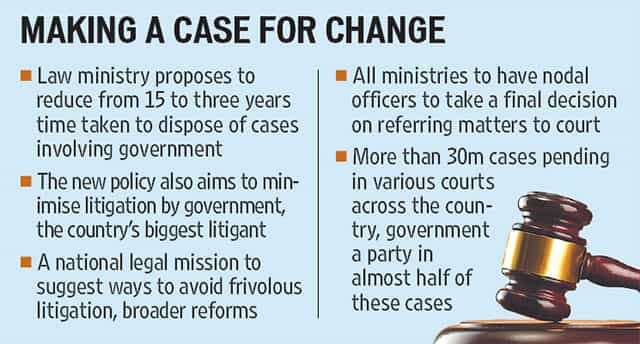
The new litigation policy — the draft of which has been seen by HT — wants the government to be a facilitator of justice and not a blocker by being a “compulsive litigant”.

“We want to transform government as an institution which does not believe in entering into unnecessary and avoidable litigation by taking appropriate steps at pre-litigation stage itself,” a law ministry official said on condition of anonymity.

The move will go a long way in reducing the burden on an overworked judiciary battling poor infrastructure, shortage of judges and a huge backlog.

To push the change, the policy draft recommends setting up of a national legal mission that will define broader reforms and also ensure their implementation through an empowered committee at the national level and six regional panels.


Article image

“The ministries will have to adhere to the policy direction on filing of cases and appeals provided by the mission,” a government official said.

More than 30 million cases are pending in various courts of the country and the government is a party in almost half of these cases. Of these, about 26 million are pending in lower courts.

Typically, on an average it takes 15 years for such cases to be settled, a big drain on resources.

The government is of the opinion that most cases can be disposed of in three years.

According to government officials, the policy -- for the first time – calls for cost-analysis benefit before filing of a case.

It says the government should avoid moving court if legal costs outweigh financial gains arising out of a favourable judgment.

The government, said officials, often ends up spending huge amounts of money to deny a small financial benefit to an employee.

A large number of cases involve unhappy employees taking the government to court over salary or pension benefits or promotions.

The policy -- first mooted by the UPA on the recommendations of the law commission -- will encourage government counsels to go to courts prepared, armed with necessary documents on the first day of hearing itself. They would also be asked not to ask for rescheduling of hearings on flimsy grounds.

Out-of-court settlements, whenever feasible, would also be looked into.

Each ministry will get a nodal officer whose word would be final in legal matters as well as decisions on moving court. A mechanism will also be in place to reduce litigation and delays.

Officials tend to play safe and leave it to courts to take the final call on matters involving legal interpretation. Nodal officials would help curb this practice, sources said.

Most of the ministries have approved the policy draft which has been circulated for the cabinet’s approval.

  • Chetan Chauhan
    ABOUT THE AUTHOR
    Chetan Chauhan

    Chetan Chauhan is the National Affairs Editor looking into all aspects of news and features from across India. A Chevening scholar with over three decades of experience in reporting and news management, Chetan has extensively covered all important aspects of the social sector, political economy, environment and climate change nationally and internationally. He did a journalism course at the Reuters Institute of Journalism in Oxford and Digital Media training at Nanyang Technological University in Singapore. He started as a reporter with The Statesman in 1996 and joined the Hindustan Times in 2000 in the metro bureau covering environment, crime and Delhi politics. He covered hot local news, from the Jessica Lal murder case to the rebellion of Delhi Congress MLAs against then Chief Minister Sheila Dikshit, to the replacement of toxic vehicle fuel with cleaner compressed natural gas (CNG) in the national capital. Some of his stories on air pollution became part of the Supreme Court’s landmark MC Mehta versus Government of India case in the National Capital Region (NCR), forcing the government to take corrective measures. As part of the national political bureau since 2004, he covered important central sectors such as environment, education, social justice, labour, rural development, water resources, renewable energy, agriculture, broadcasting and the Planning Commission for more than a decade producing several exclusive and investigative breaking stories. His specialisation is the environment, having covered at least a dozen United Nations global conferences on climate change, biodiversity and wildlife including climate summits in Paris, Copenhagen and Bali. He also covered India’s two five-year plans ---11th and 12th and reported on drafting and execution of right based laws such as Right to Education, Right to Information and rural job guarantee law, MG-NREGA, now being introduced in new format as VG-RAM-G Act. He has in-depth knowledge of social sector issues. He was one of the first to report on tigers vanishing from Sariska and Panna wildlife reserves in 2004 and 2008, respectively, leading to the setting up of the National Tiger Conservation Authority (NTCA) and the introduction of stringent penal provisions for poaching. He has written extensively on the rising human-animal conflict in India and the degradation of India’s biodiversity hotspots because of mining and other activities. Since 2004, Chetan has covered Parliament comprehensively and participated in training on the nuanced coverage of Parliament proceedings. He has travelled extensively across India to cover national and provincial elections since 1998, especially in the Hindi heartland states, considered India’s road to power. He writes a regular column for Hindustan Times, Ecostani, on important national politics, economy, Himalayan ecology and environmental issues. His other responsibilities include providing inputs for edits and edit page articles for the publication, apart from managing news flow from across India.Read More

Get the latest India News, breaking headlines and real-time updates from across the country. Stay informed about politics, government policies, crime, weather and major national developments.