Prime Minister Narendra Modi invoked former PM Manmohan Singh on Sunday in the face of opposition from Congress-ruled states over his decision to scrap the Planning Commission, saying a new body was needed to “strengthen” the federal structure and empower states.
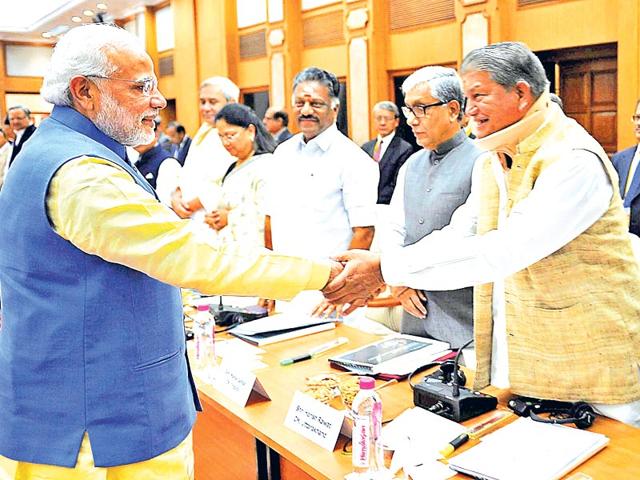
Speaking at his first meeting with chief ministers to seek suggestions on the new body to replace the plan panel, Modi stressed it was impossible for the nation to develop without its states.
“Can we develop a new mechanism that plans according to India’s strengths, empowers states, and brings on board all economic activity, including what happens outside the government,” the PM asked. Modi also recalled feeling the need for a better platform to articulate the views of states when he used to attend the plan panel’s meetings as Gujarat CM.
Stressing "cooperative federalism", Modi said the process of policy planning has to change from "top to bottom" and "bottom to top". It was impossible for the nation to develop unless states develop, he added.
The government dismantled the Planning Commission through a Cabinet decision on August 13, two days before the PM announced it during his Independence Day speech.
{{/usCountry}}The government dismantled the Planning Commission through a Cabinet decision on August 13, two days before the PM announced it during his Independence Day speech.
{{/usCountry}}Chief ministers of Congress-ruled states, however, appeared unimpressed and praised the plan panel’s work in reducing regional and income disparities.
“The Planning Commission is a time-tested institution and the government should strengthen it instead of scrapping it. We need it to protect the interest of the deprived sections,” said Uttarakhand chief minister Harish Rawat after the day-long meeting at the PM’s Race Course Road residence.
To counter the Congress charge, Modi recalled remarks made by Manmohan Singh on April 30 this year, when the former PM had raised four questions about the future of the Planning Commission and the need for the institution to reinvent itself to remain relevant.
“Manmohan Singh, who was associated with the Planning Commission for a long time, had noted the body has no futuristic vision in the post-reform period,” Modi said in his concluding remarks.
Rawat, however, dismissed Modi’s contention, saying Singh never advocated the scrapping of the institution. “He (Singh) only said the panel needs to re-invent and change."
Congress CMs also expressed dismay at not been consulted before the decision to scrap the planning body. They said the issue should have been discussed in the National Development Council --- a body of all chief ministers headed by the PM.
“It came as a bolt out of the blue,” said a chief minister of a Congress-ruled state, referring to the PM announcement of disbanding the Planning Commission.
Many Congress CMs, however, praised Modi for organising a retreat with chief ministers with no central minister or official present.
“We chatted with each other and the PM. Modi listened to our suggestions and appeared positive,” said a CM of a Congress-ruled state.
Summarising the discussions, finance minister Arun Jaitley said there was a “large” consensus on the need to scrap the Planning Commission since the present context had changed with a need to “decentralise” decision making.
All CMs agreed that states have to play a bigger role in nation building, Jaitley said, adding that the “one-size fits all” concept of Central schemes have to be changed.
“Most states favoured an alternate body where both the Centre and the state participate and a bottom-up approach to policy making is adopted instead of a top-down approach,” the minister said.
Jaitley also said Modi had stressed on Team India comprising the PM and the chief ministers, the council of ministers and the bureaucracy at the Centre and the states.
The Team India concept, according to Modi, was a combination of three teams – the Prime Minister and chief ministers; the Union council of ministers; and the bureaucracy at the Centre and in states, PTI reported.
(with agency inputs)