Using NASA’s Spitzer Space Telescope, astronomers have detected what they believe is a planet two-thirds the size of Earth.
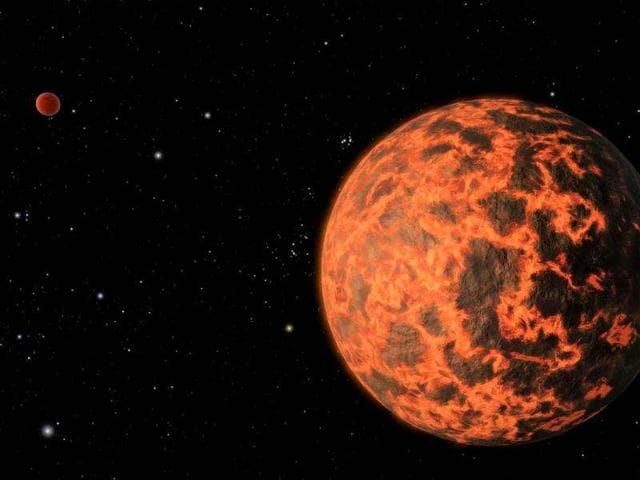
The exoplanet candidate, called UCF-1.01, is located a mere 33 light-years away, making it possibly the nearest world to our solar system that is smaller than our home planet.
Exoplanets circle stars beyond our sun. Only a handful smaller than Earth planets have been found so far. Spitzer has performed transit studies on known exoplanets, but UCF-1.01 is the first ever identified with the telescope, pointing to a possible role for Spitzer in helping discover potentially habitable, terrestrial-sized worlds.
“We have found strong evidence for a very small, very hot and very near planet with the help of the Spitzer Space Telescope,” said Kevin Stevenson from the University of Central Florida in Orlando.
“Identifying nearby small planets such as UCF-1.01 may one day lead to their characterization using future instruments,” Stevenson noted.
In addition to UCF-1.01, Stevenson and his colleagues noticed hints of a third planet, dubbed UCF-1.02, orbiting GJ 436.
Spitzer has observed evidence of the two new planets several times each. However, even the most sensitive instruments are unable to measure exoplanet masses as small as UCF-1.01 and UCF-1.02, which are perhaps only one-third the mass of the Earth. Because knowing the mass is required for confirming a discovery, the researchers are cautiously calling both bodies exoplanet candidates for now.
{{/usCountry}}Spitzer has observed evidence of the two new planets several times each. However, even the most sensitive instruments are unable to measure exoplanet masses as small as UCF-1.01 and UCF-1.02, which are perhaps only one-third the mass of the Earth. Because knowing the mass is required for confirming a discovery, the researchers are cautiously calling both bodies exoplanet candidates for now.
{{/usCountry}}Of the approximately 1,800 stars identified by Kepler as candidates for having planetary systems, just three are verified to contain sub-Earth-sized exoplanets. Of these, only one exoplanet is thought to be smaller than the Spitzer candidates, with a radius similar to Mars, or 57 percent that of Earth.
“I hope future observations will confirm these exciting results, which show Spitzer may be able to discover exoplanets as small as Mars,” said Michael Werner, Spitzer Project Scientist at NASA’s Jet Propulsion Laboratory (JPL) in Pasadena, Calif.
Stevenson is lead author of the paper, which has been accepted for publication in The Astrophysical Journal.