On any ordinary day, there is little to distinguish Kantabanji railway station in western Odisha from the hundreds of other stations in Tier III towns across the country. A near-deserted platform, a few passengers huddled together in the waiting room and a breathtakingly beautiful expanse of nature beyond. But for a few weeks or months post Dussehra every year, Kantabanji assumes a sinister kind of importance in transporting human cargo from the villages of Odisha to southern states such as Andhra Pradesh, Karnataka and Tamil Nadu, where they work mostly in the brick kilns for a period of six months before returning home to till their meagre lands.
"During the migration season, the station is so crowded, there is no space for one to walk on the platform. The trains to Karnataka, Andhra and Tamil Nadu are mostly at night. Often trains are forcefully stopped for hours here by the labour contractors to facilitate the transfer of workers. Everyone has their share. The cops are paid Rs 5,000 to Rs 10,000 per group for their support," says a local labour contractor. Poaching is common and he informs that fights often break out and people get killed by agents in a bid to get the maximum number of labourers. "A smart contractor can make up to Rs 1,000 on one person," he adds. Another labour contractor says he earns about a lakh during the six months of migration.
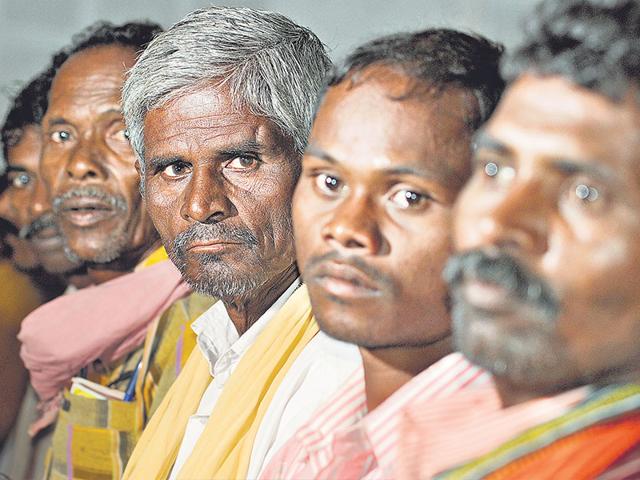
Official estimates peg the number of labourers who migrated to neighbouring states from Bolangir, a migration-prone district in western Odisha to 22,000 in 2013-14. "But this is the number of those who went through registered labour contractors," Bolangir district collector Dr M Muthukumar had told Hindustan Times in September last year. Many are taken illegally by unlicensed contractors. At the same time, Bolangir MP, Kalikesh Narayan Singh Deo had said the real figure would be closer to three lakhs annually. Officials at Actionaid, an NGO that directly, or through local partners, works for the rights of these labourers, say about 60 per cent of these labourers get trapped into working as bonded labourers - a system that was abolished in the country through the Bonded Labour System (Abolition) Act, 1976.
The railway station at Kantabanji, from where agents traffic labourers to several states. (Left) Dura Mahananda, 50, says her family got trapped into the slave trade because they needed to clear their debts. (Photo: Samir Jana/HT)
In May 1978, the Ministry of Labour launched a centrally sponsored scheme on 50:50 basis to assist state governments in their task of rehabilitation of rescued bonded labourers and provides Rs 20,000 as assistance to each rescued bonded labourer. In the case of the seven North Eastern States, 100% central assistance is given if states express their inability to provide their share. State governments have also been advised to integrate the rehabilitation scheme with other ongoing poverty alleviation schemes. The centre also has the provision to provide states with funds to conduct survey for identification of bonded labourers every three years and for awareness-building exercises. In 2014, three non-governmental organizations, Actionaid and Jan Jagran Dadan Sangha (JJDS) and Solidarity Group on Abolishing Bondage and Migration of Bolangir, Odisha, wrote to the National Human Rights Commission (NHRC) complaining that 239 labourers rescued by them were still awaiting even primary state assistance. In February this year, the labourers each received Rs 20,000 after NHRC intervention. But most of them are yet to be integrated into any social security schemes, says Murali, a local activist. "Most of the states understand that rehabilitation ends the moment an amount of Rs 20,000 is paid to the rescued labourers. Therefore, most of them avoid these measures. Since there is no effective rehabilitation policy in place, the rescued labourers are rendered jobless, leaving them vulnerable to go back to the same contractor or owner. Unless rehabilitation in terms of daily income is ensured, this system cannot be abolished completely," says Justice D Murugesan, member, NHRC. Justice Murugesan looks after the subject of 'Bonded Labour', among other sectoral issues concerning human rights.
Speaking to the Hindustan Times in September 2014, Pabitra Mandal, project director, DRDA, Bolangir had said, "There is enough opportunity under the MGNREGA scheme for these people. They are aware of it, but still not availing it. The reason being that they receive advance from the labour contractors and under the MGNREGA you have to wait for the completion of the job to get the money." That the advance lures people can't be denied. Dura Mahananda, a resident of Bhalupita village, roughly 30 kilometers from Bolangir town, says, "We have no land, not even a house. My husband and I worked as daily wage labourers. But we wouldn't get work every day. Only for two-three months during the farming season in the monsoons. My husband would earn Rs 100 per day, I would earn Rs 60 per day. We had also taken a loan of Rs 20,000 for my daughter's wedding." So when the sardar, as the labour contractors are called there, offered them Rs 15,000 per head for six months to make bricks at a kiln in Andhra Pradesh, the offer seemed too good to refuse.
Ten people from her village, including her, got trapped as bonded labourers and were released in 2014. Another 13 released during the same time were from the nearby village of Kadalimunda. Forty-one year old Khagapati Kumbhar of Maharapadar village in Khaprakhol district was rescued in 2012. "Whenever we asked for the money, the brick kiln owners would say he had paid the sardar for our work. We had no phones. Our voter identity cards were taken away. Guards were placed in the working area and living quarters," he says. There are over 700 people in the village. But as of September 2014, only 50-60 of them had job cards that entitled them to get work under the MGNREGA scheme. Even those with job cards, such as Bhakta Bag of Kadalimunda village, complain that work and payment under government schemes is irregular.
The problem is not isolated to Odisha. "Activists and academics estimate that some 10 million bonded labourers are working in India's key industries. Odisha, Bihar, UP, Jharkhand and West Bengal are the main source areas," says Chandan Kumar of Actionaid. He adds, "While inter-generational bonded labor has decreased with time, the number of chronically poor and landless workers that enter debt bondage is increasing. There are certain sectors where bonded labour system is more widely prevalent, like in agriculture, brick-kilns, weaving etc."
Lack of action taken against those employing bonded labourers adds to the difficulty in checking the problem. "The District Magistrates or the authorities having powers to enquire into complaints do not prosecute the owner. The NHRC's experience is that after the rescue of bonded labourers, in 99 per cent cases, prosecution is not launched. Even if it is launched, there is hardly any conviction or sentence under the Act," says Justice Murugesan.
Meanwhile the trains with their human cargo continue to roll out of stations like Kantabanji. The relief of Rs 20,000 may keep the rescued labourers at home for a few months, but with no long-term assurance of livelihood, gambling with destiny seems better than immediate starvation to most.
We only get work for two months during the rains. I would earn Rs 100 per day, my wife Bhanumati would earn Rs 80 per day. We are a family of five. Two months of proper work can't sustain us for the year. For the rest of the time, we would do odd jobs when we could. Then in 2013, a contractor came to the village to look for people to work in the brick kilns in the south," says 40-year-old Santosh Kumbhar.
The sardar promised Rs 5,000 for six months of work plus an additional Rs 100 per person per week to buy food. He also bought their train tickets and off went the entire family. "But the sardar disappeared after taking us there and we never got any money. Sometimes we were given Rs 100 to buy food. If we asked for money, the malik would threaten to sell us off. My 12-year-old son Susanta was made to do the work of turning the bricks. One day, he was not well. The malik would beat him up. One day he beat him on the hand with an iron rod so badly that he was seriously injured. But he was not given any proper treatment. Two months after he was hit, we were rescued by the social workers and Susanta was treated in a hospital in Cuttack, but he has been maimed for life," rues Santosh saying,
The railway station at Kantabanji, from where agents traffic labourers to several states. (Left) Dura Mahananda, 50, says her family got trapped into the slave trade because they needed to clear their debts. (Photo: Samir Jana/HT)
In May 1978, the Ministry of Labour launched a centrally sponsored scheme on 50:50 basis to assist state governments in their task of rehabilitation of rescued bonded labourers and provides Rs 20,000 as assistance to each rescued bonded labourer. In the case of the seven North Eastern States, 100% central assistance is given if states express their inability to provide their share. State governments have also been advised to integrate the rehabilitation scheme with other ongoing poverty alleviation schemes. The centre also has the provision to provide states with funds to conduct survey for identification of bonded labourers every three years and for awareness-building exercises. In 2014, three non-governmental organizations, Actionaid and Jan Jagran Dadan Sangha (JJDS) and Solidarity Group on Abolishing Bondage and Migration of Bolangir, Odisha, wrote to the National Human Rights Commission (NHRC) complaining that 239 labourers rescued by them were still awaiting even primary state assistance. In February this year, the labourers each received Rs 20,000 after NHRC intervention. But most of them are yet to be integrated into any social security schemes, says Murali, a local activist. "Most of the states understand that rehabilitation ends the moment an amount of Rs 20,000 is paid to the rescued labourers. Therefore, most of them avoid these measures. Since there is no effective rehabilitation policy in place, the rescued labourers are rendered jobless, leaving them vulnerable to go back to the same contractor or owner. Unless rehabilitation in terms of daily income is ensured, this system cannot be abolished completely," says Justice D Murugesan, member, NHRC. Justice Murugesan looks after the subject of 'Bonded Labour', among other sectoral issues concerning human rights.
Speaking to the Hindustan Times in September 2014, Pabitra Mandal, project director, DRDA, Bolangir had said, "There is enough opportunity under the MGNREGA scheme for these people. They are aware of it, but still not availing it. The reason being that they receive advance from the labour contractors and under the MGNREGA you have to wait for the completion of the job to get the money." That the advance lures people can't be denied. Dura Mahananda, a resident of Bhalupita village, roughly 30 kilometers from Bolangir town, says, "We have no land, not even a house. My husband and I worked as daily wage labourers. But we wouldn't get work every day. Only for two-three months during the farming season in the monsoons. My husband would earn Rs 100 per day, I would earn Rs 60 per day. We had also taken a loan of Rs 20,000 for my daughter's wedding." So when the sardar, as the labour contractors are called there, offered them Rs 15,000 per head for six months to make bricks at a kiln in Andhra Pradesh, the offer seemed too good to refuse.
Ten people from her village, including her, got trapped as bonded labourers and were released in 2014. Another 13 released during the same time were from the nearby village of Kadalimunda. Forty-one year old Khagapati Kumbhar of Maharapadar village in Khaprakhol district was rescued in 2012. "Whenever we asked for the money, the brick kiln owners would say he had paid the sardar for our work. We had no phones. Our voter identity cards were taken away. Guards were placed in the working area and living quarters," he says. There are over 700 people in the village. But as of September 2014, only 50-60 of them had job cards that entitled them to get work under the MGNREGA scheme. Even those with job cards, such as Bhakta Bag of Kadalimunda village, complain that work and payment under government schemes is irregular.
The problem is not isolated to Odisha. "Activists and academics estimate that some 10 million bonded labourers are working in India's key industries. Odisha, Bihar, UP, Jharkhand and West Bengal are the main source areas," says Chandan Kumar of Actionaid. He adds, "While inter-generational bonded labor has decreased with time, the number of chronically poor and landless workers that enter debt bondage is increasing. There are certain sectors where bonded labour system is more widely prevalent, like in agriculture, brick-kilns, weaving etc."
Lack of action taken against those employing bonded labourers adds to the difficulty in checking the problem. "The District Magistrates or the authorities having powers to enquire into complaints do not prosecute the owner. The NHRC's experience is that after the rescue of bonded labourers, in 99 per cent cases, prosecution is not launched. Even if it is launched, there is hardly any conviction or sentence under the Act," says Justice Murugesan.
Meanwhile the trains with their human cargo continue to roll out of stations like Kantabanji. The relief of Rs 20,000 may keep the rescued labourers at home for a few months, but with no long-term assurance of livelihood, gambling with destiny seems better than immediate starvation to most.
We only get work for two months during the rains. I would earn Rs 100 per day, my wife Bhanumati would earn Rs 80 per day. We are a family of five. Two months of proper work can't sustain us for the year. For the rest of the time, we would do odd jobs when we could. Then in 2013, a contractor came to the village to look for people to work in the brick kilns in the south," says 40-year-old Santosh Kumbhar.
The sardar promised Rs 5,000 for six months of work plus an additional Rs 100 per person per week to buy food. He also bought their train tickets and off went the entire family. "But the sardar disappeared after taking us there and we never got any money. Sometimes we were given Rs 100 to buy food. If we asked for money, the malik would threaten to sell us off. My 12-year-old son Susanta was made to do the work of turning the bricks. One day, he was not well. The malik would beat him up. One day he beat him on the hand with an iron rod so badly that he was seriously injured. But he was not given any proper treatment. Two months after he was hit, we were rescued by the social workers and Susanta was treated in a hospital in Cuttack, but he has been maimed for life," rues Santosh saying,
Maimed by his employer, Susanta Kumbhar, 12, is unsure of his future now. (Photo: Samir Jana/HT)
"All this is my fault. If I hadn't gone there in the hopes of finding a better life, my son wouldn't have lost his hand."
Poverty teaches these people a strange kind of stoicism. Susanta is attending the local school now. But ask him what he wants to do with his life and he says with a strange calm, "I don't know. What will I do with one hand?" Susanta was not the only one in the family to be harassed. The boy's 14 year old sister, Jayanti, remembers, "He used to abuse me and say dirty things to me. His men would guard us all the time."
'If we asked for money, the malik would beat us up'
I used to weave mats with my family members. We manage to sell about twenty in a week, each for Rs 60. There are ten members in the family. I needed money to rebuild the house and had taken some loan from the sardar, about Rs 5,000. He asked me to go work in the brick kilns with my family and promised me more money for the work. We went in December 2013 and were supposed to work there till April 2014," explains 48-year-old Makardhwaj Angariya. Once there though, it was the usual story of abuse and being denied payment. "We only got Rs 100 per week per person for food. Nothing of the money that was promised for making the bricks. If we asked for money, the malik would beat us up. I worked there like that for three-and-a-half months. Then I escaped. But my family was left behind," he says. Once he was free, he approached social workers in Odisha to help rescue his family.
Makardhwaj Angariya with his wife Jagiya, and daughter Brindawati (left). (Photo: Samir Jana/HT)
"They misbehaved with the women. After my father ran away, he would abuse us even more, threaten to make us work even at night. Sometimes he would beat us. Sometimes he would tell my mother that there were young girls in the family and he would do things to them. His men would guard the workers all the time," recalls 16-year-old Brindawati. One day one of the women in their family had been ill, but the malik's men dragged her to the kiln and forced her to work. Angariya contacted Actionaid after he escaped and returned with the police. His family was rescued along with other bonded labourers working there. The family is back in their village now, weaving mats as before. But money continues to be a problem and the house is far from being repaired. Not all of the family members who worked as bonded labourers have managed to get a release certificate, proof of their having served in bondage, and therefore, have little hope of a rehabilitation package from the government.
WHAT THE LAW SAYS
According to the Bonded Labour System (Abolition) Act, 1976, bonded labour is defined as "the system of forced, or partly forced, labour under which a debtor enters, or has, or is presumed to have, entered, into an agreement with the creditor…" and thus "forfeits the freedom of employment or other means of livelihood for a specified period or for an unspecified period" and "the right to move freely throughout the territory of India".