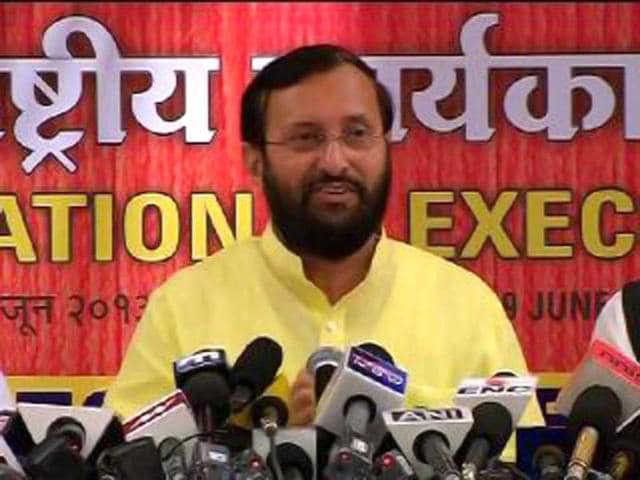
A day after G-20 sherpa Suresh Prabhu said that India should not align with China on climate issues, the government distanced itself from his view with environment minister Prakash Javadekar saying it was his 'personal' opinion.
A day after G-20 sherpa Suresh Prabhu said that India should not align with China on climate issues, the government distanced itself from his view with environment minister Prakash Javadekar saying it was his “personal” opinion.
{{^htLoading}} {{/htLoading}}
Prabhu comments had led to speculation that India may break away from the Basic group that has India and China with South Africa and Brazil. Javadekar refused to either confirm or deny reiterating that what Prabhu said was his personal view.
Moving away from China can help India in isolating itself from taking emission mitigation cuts, which appears to be eminent for China. With 22% of Indians poor as against less than 10% for China, India may also get more financial aid from the rich nations to fight climate change.
The Basic group was formed at the Copenhagen climate conference to provide emerging economies a separate identity in the global climate geo-politics and put forth their view point which was different from that of other developing countries. Despite the new group, India and China remained integral part of G-77 plus China, a powerful block of countries in the climate talks.
{{^htLoading}} {{/htLoading}}
{{^usCountry}}
However, the government’s decision to insist on inclusion of climate change in G-20 agenda despite resistance by China has led to the view that India would be bringing a dramatic change in its climate change before the Lima climate summit later this month.
{{/usCountry}}
{{#usCountry}}
However, the government’s decision to insist on inclusion of climate change in G-20 agenda despite resistance by China has led to the view that India would be bringing a dramatic change in its climate change before the Lima climate summit later this month.
{{/usCountry}}
“Standing with China does not help India,” Prabhu had said. He also added that India should have a more open climate stand for the talks that is expected to conclude in Paris in 2015 with an agreement on a new climate deal to be effective from 2020 onwards.
Javadekar on Friday said India has not finalised its stand for the Lima climate talks and it would be done in the next two weeks after series of consultations and scientific presentations.
{{^htLoading}} {{/htLoading}}
However, government sources said the Prime Minister’s Office was readying the text on India’s climate stand and first glimpse of it will be visible at the G-20 summit in Australia in which Prime Minister Narendra Modi would be participating.
“The tricky issue of climate change cannot be dealt without being discussion at the highest geo-political platforms. One should not forget that climate change is closely linked with economy and therefore, it should be discussed at G-20,” a senior government official said.
Although PM Modi did not attend the United Nations Climate Summit in September, he was keen on discussing climate change at G-20. Prabhu had also played an important role on India insisting on inclusion of global warming as an agenda for discussion.
Chetan Chauhan is the National Affairs Editor looking into all aspects of news and features from across India. A Chevening scholar with over three decades of experience in reporting and news management, Chetan has extensively covered all important aspects of the social sector, political economy, environment and climate change nationally and internationally. He did a journalism course at the Reuters Institute of Journalism in Oxford and Digital Media training at Nanyang Technological University in Singapore. He started as a reporter with The Statesman in 1996 and joined the Hindustan Times in 2000 in the metro bureau covering environment, crime and Delhi politics. He covered hot local news, from the Jessica Lal murder case to the rebellion of Delhi Congress MLAs against then Chief Minister Sheila Dikshit, to the replacement of toxic vehicle fuel with cleaner compressed natural gas (CNG) in the national capital. Some of his stories on air pollution became part of the Supreme Court’s landmark MC Mehta versus Government of India case in the National Capital Region (NCR), forcing the government to take corrective measures. As part of the national political bureau since 2004, he covered important central sectors such as environment, education, social justice, labour, rural development, water resources, renewable energy, agriculture, broadcasting and the Planning Commission for more than a decade producing several exclusive and investigative breaking stories. His specialisation is the environment, having covered at least a dozen United Nations global conferences on climate change, biodiversity and wildlife including climate summits in Paris, Copenhagen and Bali. He also covered India’s two five-year plans ---11th and 12th and reported on drafting and execution of right based laws such as Right to Education, Right to Information and rural job guarantee law, MG-NREGA, now being introduced in new format as VG-RAM-G Act. He has in-depth knowledge of social sector issues. He was one of the first to report on tigers vanishing from Sariska and Panna wildlife reserves in 2004 and 2008, respectively, leading to the setting up of the National Tiger Conservation Authority (NTCA) and the introduction of stringent penal provisions for poaching. He has written extensively on the rising human-animal conflict in India and the degradation of India’s biodiversity hotspots because of mining and other activities. Since 2004, Chetan has covered Parliament comprehensively and participated in training on the nuanced coverage of Parliament proceedings. He has travelled extensively across India to cover national and provincial elections since 1998, especially in the Hindi heartland states, considered India’s road to power. He writes a regular column for Hindustan Times, Ecostani, on important national politics, economy, Himalayan ecology and environmental issues. His other responsibilities include providing inputs for edits and edit page articles for the publication, apart from managing news flow from across India.