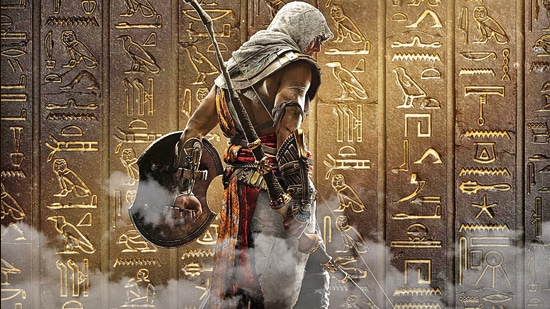
Translating hieroglyphics calls for more than simple substitution. Ancient Egyptians commonly used more than 700 symbols. Their text has no vowels, no spaces, and is inscribed in different directions. Spellings vary across the centuries. And because it was all written or inscribed by hand, the symbols often vary in appearance. Pronunciation remains a mystery. But new tech — AI, Google tools, 3D printed vocal chords — is hoping to fill in some of the gaps. Take a look.
Google translates
Translating hieroglyphics calls for more than simple substitution. Ancient Egyptians commonly used more than 700 symbols. Their text has no vowels, no spaces, and is inscribed in different directions. Spellings vary across the centuries. And because it was all written or inscribed by hand, the symbols often vary in appearance. Pronunciation remains a mystery. But new tech — AI, Google tools, 3D printed vocal chords — is hoping to fill in some of the gaps. Take a look.
Google translates
When game developer Ubisoft was creating Assassin’s Creed: Origins (2017), they knew they wanted to get the period detail right. This meant working with Egyptologists to recreate Cleopatra’s Egypt from the 1st century BCE. In return, Ubisoft set up the Hieroglyphics Initiative, applying machine learning to speed up the tedious translation process.
Google took over the project in 2017 and worked with the Australian Centre for Egyptology at Macquarie University, software firm Psycle Interactive, and Ubisoft to develop Fabricius, launched in 2020. The app, available on the Google Arts & Culture website, lets users approximate English and Arabic words into hieroglyphics. The app’s translations aren’t 100% accurate, but they make academics’ work simpler. And for us, they’re a fun introduction to a dead language.
Machine learning for decipherment
In 2019, researchers Jiaming Luo and Regina Barzilay of the Massachusetts Institute of Technology (MIT) created an artificial intelligence program to help decipher ancient scripts. Their algorithm studied patterns in how languages change over time. It then used that knowledge to identify similarities between an undeciphered language, Ugaritic, and a known related one, Hebrew. The AI was able to align words from the two languages, and offer translations. Egyptologists could potentially use the program to try to decipher the hieroglyphics that have eluded them so far. CT scans to recreate sounds
Researchers have been using all kinds of scans, 3D imagery and image enhancement to peer more closely at mummies. One CT scan managed to yield such clear images from the well-preserved vocal tract of a priest named Nesyamun that scientists used it as a guide to simulate his voice, about 3,000 years later, in 2020. Researchers at Royal Holloway, University of London; University of York; and Leeds City Museum created a 3D-printed mould of his throat and mouth, then ran soundwaves through it. They’ve only recreated a grunt so far, but who knows what Nesyamun might say next.
One Subscription.
Get 360° coverage—from daily headlines
to 100 year archives.
Archives
HT App & Website