It’s an old dream, in many ways.
Pick an asteroid, land on it, scoop out some of its precious resources and bring them home.
In the 1898 sci-fi novel Edison’s Conquest of Mars, by American astronomer and author Garrett P Serviss, a team heading off a Martian attack discovers one made largely of gold.
They are tempted; so tempted. But eventually ignore it and stick to their original mission.
128 years later, entirely new missions are taking shape.
A slew
It’s an old dream, in many ways.
Pick an asteroid, land on it, scoop out some of its precious resources and bring them home.
In the 1898 sci-fi novel Edison’s Conquest of Mars, by American astronomer and author Garrett P Serviss, a team heading off a Martian attack discovers one made largely of gold.
They are tempted; so tempted. But eventually ignore it and stick to their original mission.
128 years later, entirely new missions are taking shape.
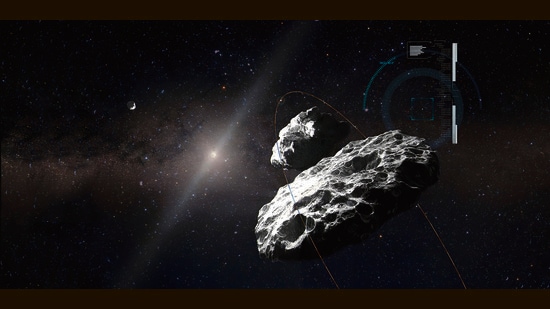
A slew of private players, as well as government-funded agencies such as NASA (the US National Aeronautics and Space Administration), JAXA (the Japan Aerospace Exploration Agency) and CNSA (the China National Space Administration), are developing and testing new technology with which they could study and collect samples from these space rocks. There has been remarkable progress over the past five years. It still takes incredibly long and remains incredibly difficult to land and manoeuvre on an asteroid. But…
* This July, China’s Tianwen-2 space probe reached the near-Earth asteroid Kamo’oalewa after a 400-day journey. It will aim to collect data on the morphology, composition and structure of the asteroid, and bring surface samples home.
* In 2023, NASA’s Osiris-Rex returned a capsule with about 120 gm of rock and dust from asteroid Bennu, the largest such sample ever collected. It took the craft about seven years to make the round trip.
* In 2020, JAXA’s Hayabusa2 returned with about 5 gm of surface material from the carbon-rich asteroid Ryugu. This mission took six years.
* The UAE’s MBR Explorer, scheduled for launch in 2028, plans an ambitious seven-asteroid tour to investigate the resource potential of water-rich asteroids. Such water can potentially be converted into rocket fuel (by isolating the hydrogen) and used for life support on extended space missions.
These missions have been extensions of space research, and experiments to demonstrate new technology. These national agencies have no stated mission to mine on asteroids. In the private sector, meanwhile…
* California-based AstroForge aims to launch its DeepSpace-2 next year. This is its second such attempt, after a first that failed in 2025, losing communication capability and drifting off. This time, the goal will be to study a set of metal-rich asteroids about three to nine months’ journey away, and perhaps attempt to land on one.
* TransAstra, also California-based, has been developing new technology towards such missions. Last year, it tested what it calls CaptureBag: an inflatable, space-grade sack that can potentially open around an asteroid about the size of a bus, secure it, and hold it for transport. It is also exploring the feasibility of moving a 100-tonne asteroid (about the size of a bungalow) into a stable near-Earth orbit, to potentially turn it into a research outpost for processing and manufacturing materials in space.
These are the two companies making the most quantifiable progress, but a number of others have secured funding and in various stages of framing similar missions. (If the sound of all this worries you, click here for a bit on the risks, costs and trade-offs.)
ROCKS TO RICHES
The promise underlying these gambits is the same.
Asteroids — the small, rocky fragments left over from the formation of the solar system about 4.6 billion years ago — are rich in all kinds of things we need on Earth, and things we will need on extended journeys through space.
Think, iron, nickel and water, all of which could be used in space. Also, rare earth elements vital for electronics systems (which makes them vital for everything from green technology to weapons systems). And precious metals such as gold and silver.
Enthusiasm for such mining has been growing for over a decade. In 2012-13, a tiny group of early movers made their first bids; by 2018-2019, they had failed and folded. Funding was hard to come by then; the technology has made leaps since.
In an extractive global economy dependent on rare earth elements, it is widely believed that now is the time to attempt this leap.
“There are about a billion asteroids spread throughout the solar system, and they constitute a very important resource for the future of humanity,” says Joel Sercel, founder and CEO of TransAstra. “There’s enough material in the asteroids to build worlds in space with about 1,000 times the carrying capacity of Earth. It’s time we tapped into it.”
Geopolitics — particularly the rise of China — is driving the race, of course.
“The US-China competition and the energy-transition debate have pushed critical minerals much higher up the political agenda than they were around 2016-17,” says Ian Lange, professor of economics and business, and deputy director of the Critical Materials Innovation Hub, at the Colorado School of Mines.
MINE GAMES
How much of the precious elements do these asteroids hold?
Matthew Gialich, co-founder and CEO of AstroForge, points out that platinum-group metals (PGM) such as platinum, palladium, rhodium, iridium, ruthenium and osmium are so rare on Earth that “at average concentrations inferred from meteorite databases, a 1-km-wide asteroid could theoretically contain roughly a century’s supply of platinum-group metals at today’s consumption trajectory.”
The trouble, he adds, is how do you actually get to the right ones? “The answer is: We don’t know yet.”
Therein lies the crux of the problem. Prospecting alone is so difficult and exorbitant an exercise that cost might determine where the first excursions go.
TransAstra is identifying highly accessible near-earth objects (NEOs) that it hopes to operate on. These, Sercel points out, are easier to reach than the Moon.
It is unclear just how lucrative these space rocks would be, but the asteroids that do hold great riches are often out of reach.
NASA, for instance, launched a research mission to land and collect surface samples on the asteroid Psyche in 2023. The craft is on track to land there in 2029. Psyche is believed to be so rich in various metals that it could completely alter the world economy. But it is more than 280 km wide at its widest, making it too big for anyone to approach with current asteroid-mining technology; and it is six years away.
“Psyche’s theoretical mineral wealth is irrelevant,” as Sercel puts it. “It is too large and too deep in space to mine economically.”
ORE WE THERE YET?
And that’s just the landing and mining bit.
There will also need to be real excavation and refinery systems that work in zero gravity, reliable storage and transport architecture, and safe, economic return pathways to make all this work. Markets would need to adjust too. Bring too much of a rare resource back and one risks disrupting profit graphs, including one’s own, as Lange points out.
The start-ups are a lot more optimistic. Asteroid mining is a beginning, they believe.
Affordable launch vehicles will eventually make for easier exploration, which will open the gates to industries in space. “There will be much larger constellations of satellites, massive data centres, hotels and research outposts in space,” says Sercel. He is convinced this will be a good thing.
The exploration of the universe is the next market that will dictate the path of human history, adds Gialich. “It will be the largest economic marketplace ever created, deep space.”
Click here for a look at the expected carbon costs, on a warming Earth.
.
THE TECH: HOW WOULD IT WORK?
On Earth, excavators push against the earth. In low-gravity, where every action triggers a rebound, a digger or excavator would simply push the machine and its rock apart.
To combat this, some companies are developing laser-based technology. The material thus mined could then be brought to Earth, which would drive costs up immensely, since it would mean a long two-way journey. Or it could be used in space, to make things like rocket fuel and support lunar and in-space operations.
Water, for instance, could be shipped directly to astronauts. It could also be used as a source of oxygen, as is currently done aboard the International Space Station. The hydrogen and oxygen could additionally be split to create rocket fuel in orbit.
NASA is already encouraging this approach on the Moon. “Resources such as metals, oxygen and water found in space may support exploration farther in the solar system, including on the Moon and Mars,” a NASA spokesperson told Wknd via email.
.
WHERE DOES THE LAW STAND ON ALL THIS?
Space exploration is governed by the 1967 Outer Space Treaty. It defines outer space as the “province of all mankind” and stipulates that celestial bodies cannot be appropriated by any country.
What the treaty does not address specifically is how the resources on celestial bodies are to be governed.
At the moment, countries from the US to Luxembourg, UAE and Japan are framing domestic laws that detail how space resources can be claimed, without appropriating the celestial body itself. The UN is working to frame recommendations on the “peaceful uses of outer space”.
But recommendations would not be legally binding, Ian Lange, professor of economics and business, and deputy director of the Critical Materials Innovation Hub, at the Colorado School of Mines, points out.
On the ground it could play out very much like a gold rush. The California-based asteroid-mining start-up TransAstra, in fact, named its survey telescope technology Sutter, after a spot in that state that sparked the gold rush in 1848. “We think our Sutter technology will help find the asteroids needed to foment a gold rush to space,” founder and CEO Joel Sercel told Wknd.
There are echoes that go back even further.
In the absence of a strong legal framework, “this part of the space race,” says Lange, “could bear similarities with the dominance and influence wielded by European powers when they first went over to North America.”
One Subscription.
Get 360° coverage—from daily headlines
to 100 year archives.
Archives
HT App & Website