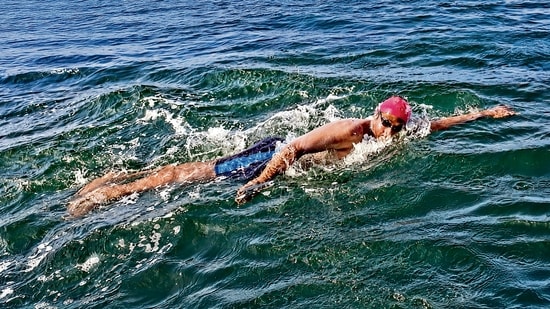
Eight hours into his swim across the Tsugaru Strait, a 19.5-km stretch in Japan, the suffering began.
Water temperatures had dropped to 8 degrees Celsius. He could see the finish line in the distance, yet he felt like he just wasn’t moving. As the accompanying boat drew near to hand him a drink, Anshuman Jhingran stared at his crew and murmured, “Who are you?”
“I didn’t recognise them because hypothermia had set in and my brain couldn’t process much,” says
Eight hours into his swim across the Tsugaru Strait, a 19.5-km stretch in Japan, the suffering began.
Water temperatures had dropped to 8 degrees Celsius. He could see the finish line in the distance, yet he felt like he just wasn’t moving. As the accompanying boat drew near to hand him a drink, Anshuman Jhingran stared at his crew and murmured, “Who are you?”
“I didn’t recognise them because hypothermia had set in and my brain couldn’t process much,” says the 21-year-old. “This was unlike anything I had ever experienced. I just kept telling myself: You have to get this done.”
It took 12 hours and 40 minutes. When he finally clambered ashore, he had completed the last of his Oceans Seven swims: a feat that involves seven of the most daunting open-water challenges in the world.
He hadn’t just finished, either. Jhingran had set a record. He is now the youngest male to ever pull it off. (The youngest-ever is Caitlin O’Reilly from New Zealand, who was 20 when she completed the challenge in 2024.)
“When it was done,” Jhingran says, laughing, “there was such relief that I wouldn’t have to return to those waters again.”
***
His ability to laugh off a seemingly impossible challenge is, in many ways, how he ended up an open-ocean swimmer.
Jhingran was 15 when a cycling accident near his home in Navi Mumbai broke his wrist and forearm, ending what had been a promising start as a competitive swimmer.
So he’d lost his speed, he thought. Could he focus on endurance and take to the open waters?
He had no idea what he was signing up for, Jhingran laughs. “I thought it would be a good distraction from all the competing I was missing out on, and far better than sitting at home.”
On his first open-ocean swim, in the Arabian Sea, he was stung by jellyfish, which he compares to being electrocuted over and over. His father asked him to consider getting out of the water, but he said he would see the swim through. When he was done, Jhingran says he knew this was something he could throw himself into.
The switch meant he had to retrain his body. He began to spend all day with his trainer at the pool, sometimes starting in the morning and not leaving the water until the sun had begun to set and his pool mates had returned for the evening session.
He had to pile on the pounds, since a higher body-fat ratio helps keep the body warm, makes it more buoyant and provides energy on long swims where nutrition is minimal. Jhingran rapidly gained 20 kg, and faced hurtful jibes.
But all the while, new wins were piling up.
“I told this swimmer who called me a motaa saand (fat bull) that I had just set a record for the youngest person to ever swim the North Channel,” he says. (He crossed it at 18, in 2023.)
That swim, between Ireland and Scotland, marked the launch of his Oceans Seven bid. He battled real cold for the first time, in waters that were at 13 degrees Celsius (a comfortable pool temperature is about 26 degrees Celsius; normal body temperature is 37). He came face-to-face with moody swells that tossed him about casually, and seemingly bottomless depths.
***
“The mind gives up much before the body,” Jhingran says.
In moments when he felt overwhelmed or afraid, he thought of his parents, homemaker Kiran Jhingran, 55, and financial-services executive Sandeep Jhingran, 56. The hours his mother spent by his side at the pool, caring for him after bouts of intense training. The money his father had poured into his dreams, because he wanted to see his son happy. He also pictured how painful it would be to abandon the attempt, wasting all the training and effort. These visions kept him going.
As each swim stretched out, his longest over nearly 16 hours, the loneliness, especially in the dark, became something of a demon in the water.
“The only time someone is cheering you on is in the first few minutes and towards the end. The rest of the time, you’re alone with your own thoughts. It can get quite stressful,” he says. “There are times you question all your life decisions: What am I doing here? What made me think I would make it?”
***
In the great expanse, time often stands still, and it can genuinely feel like one is going nowhere. It’s just a dark void below and glimpses of sky as one surfaces to breathe, Jhingran says.
He would break the tedium by singing peppy songs in his head or chanting the Hanuman Chalisa. He would take in tiny details of the boat that moved by his side; and think of the first thing he would eat once he was back on land. His favourite song: Walk Alone by Fearless Motivation. His favourite post-swim meal: a pizza and strawberry ice-cream (“to get rid of all the salt in my mouth”).
He would repeat inspiring lines in his head: The devil whispers: you cannot withstand the storm. The warrior replies: I am the storm. “I’ve had quotes like these in my head for years, and continue to draw strength from them,” he says.
By the end of 2024, he had finished four of the seven swims, including the longest: the 42-km, shark-infested Molokai Channel in Hawaii, which took him 14 hours and 21 minutes. Shark repellent works for the great whites, Jhingran says. “It doesn’t work as well on the small cookiecutter sharks, so you just rely on luck.”
It was eventually the popular 33-km English Channel that posed the most formidable challenge. Jhingran ended up swimming the equivalent of almost twice the distance, because of strong currents. He finished in 15 hours and 49 minutes, his longest bout so far.
“These swims have taught me to be patient, which is an integral part of my life now,” he says. “I used to get anxious if I didn’t get results immediately. Now I know that if there are problems, there will also likely be solutions.”
One Subscription.
Get 360° coverage—from daily headlines
to 100 year archives.
Archives
HT App & Website