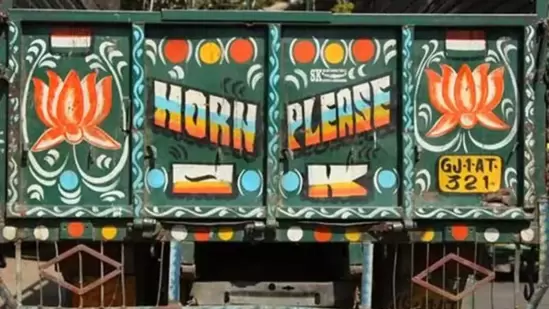
Every day, millions of Indians travel by road, and during the commute, you will most likely see a truck with ‘Horn OK Please’ painted on the back in colourful shades. But did you know that the phrase wasn't a mere decorative whim of Indian truck drivers?
The origin of ‘Horn OK Please’
On May 28, an influencer couple, Rajat and Isha, who go by ‘chartered couple’ on Instagram, shared a video explaining why trucks in India write ‘Horn OK Please’ on the back of the truck.
According to them, the phrase originated as a serious cautionary indication during World War II. Kerosene-fueled trucks were used at the time to move troops, and they were highly unstable; kerosene would cause the trucks to explode at the slightest accident. Hence, ‘Horn Please. On Kerosene’ was painted on the back of trucks, which later shortened to ‘Horn OK Please.’
What does ‘OK’ stand for?
“You will find this single line written on every Indian truck: ‘Horn OK Please.’ You have likely seen it thousands of times, but have you ever wondered what the ‘OK’ in the middle stands for? After all, it could have simply been ‘Horn Please’ or ‘Please Horn’. So, why ‘OK’? The answer lies in World War II,” the influencer wondered.
{{/usCountry}}“You will find this single line written on every Indian truck: ‘Horn OK Please.’ You have likely seen it thousands of times, but have you ever wondered what the ‘OK’ in the middle stands for? After all, it could have simply been ‘Horn Please’ or ‘Please Horn’. So, why ‘OK’? The answer lies in World War II,” the influencer wondered.
{{/usCountry}}Explaining the story behind the very common phrase, the influencer said, “In the 1940s, the British were shipping India's diesel supply to Europe for their army, leading to a diesel shortage in India.” He added, “Consequently, kerosene was used as an alternative fuel to operate Indian trucks. Kerosene is far more volatile than diesel; even a minor collision could cause the truck to explode like a bomb.”
To address this, the influencer stated that the British painted a warning on the back of every truck: "Horn Please On Kerosene." This was intended to alert vehicles approaching from behind that the truck was running on kerosene.
“Over time, people stopped writing 'On Kerosene,' leaving only the two letters ‘OK’. Indians began placing this between ‘Horn’ and ‘Please,’ resulting in the phrase ‘Horn OK Please’,” he added. A 2010 release by the Mahindra Truck and Bus confirmed the theory.
Maharashtra bans ‘Horn OK Please’
In the end, the influencer mentioned that the Maharashtra government banned this sign. According to reports, the ban was implemented in 2015 because the state's transport department believed it encouraged drivers to honk unnecessarily every time they passed a truck or tempo, sending an extremely wrong message to the public.
Note to readers: This article is for informational purposes only and is based on user-generated content from social media. HT.com has not independently verified the claims and does not endorse them.