“The sword,” says CA Bhavani Devi, after taking a second to remember exactly what it was that caught her fancy when she first saw two people fencing at a school event. Bhavani, then 10, was intrigued. They looked like armoured warriors, she adds, fighting each other with their jackets and masked helmets.
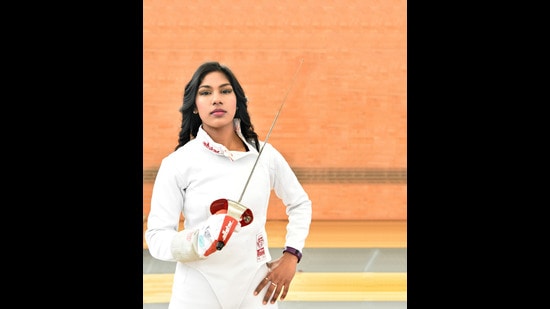
She wanted to wear the lamé (the thick, insulated fencing jacket that defines the scoring areas), put on the mask and wield a sword. She first picked one up at her school in Chennai later the same year. It was one of the sports on offer, as part of a state government initiative.
Later, asked to pick between foil and sabre fencing, she went for the fastest — sabre. It suits her quick reflexes, she says.
Over 17 years, Bhavani has brandished her weapon with the single-minded focus of representing India at the Olympics. Though fencing is one of the oldest Olympic disciplines, women’s sabre was only introduced in 2004. Bhavani remembers watching the women fencers at the 2008 Games. That was also the year she finished school and joined the Sports Authority of India (SAI) academy in Thalassery, Kerala, training under coach Sagar Lagu.
This year, in Tokyo, the 27-year-old will make history as the first Indian fencer to compete at the Olympics.
{{/usCountry}}This year, in Tokyo, the 27-year-old will make history as the first Indian fencer to compete at the Olympics.
{{/usCountry}}Until Bhavani, the sport had little to no presence across most of India. She struggled to find good trainers. One of five children born to a middle-class Hindu priest and a homemaker, her parents struggled to fund her passion too. Buying the equipment (just the electrically conductive jacket and the helmet can cost ₹1.5 lakh, and they have to be changed each year) and arranging for all the travel was difficult. People also ridiculed them for letting their daughter play “a sport with no future”.
When Bhavani qualified for the Tokyo Olympics during the Sabre World Cup in Budapest last month, through her world ranking (currently #42), all the struggle felt worth it.
“I was remembering my father (he died in November 2019) and the hard work my parents have done for me. I felt happy that I made the right decisions in my life,” Bhavani says. “I have focused only on fencing all my life and seen a lot of ups and downs — handling both good and bad phases, staying away from my family, all for my Olympic dream.”
She desperately wanted to live that moment four years ago, but the years preceding the 2016 Rio Olympics were the toughest of her career.
“Due to financial constraints, I could not compete in many competitions in 2014 and 2015. I even thought perhaps I would step away from the sport. I was tired of organising funds, sponsors, travel.”
Then, in 2016, Bhavani was awarded a scholarship by the non-profit Go Sports Foundation, which has been sponsoring some of India’s top athletes in sports that get too little attention. This renewed her ambition and paved the way for her to train in Italy, under Nicola Zanotti — who coached the Italian national team for the last three Olympics.
She was now living in the country with the most Olympic medals in her sport, sharpening her game against quality opponents. Immediately, she blossomed.
Bhavani won the Senior Commonwealth Fencing Championship in Canberra in 2018, and won silver at the 2019 Tournoi satellite tournament in Belgium. The biggest break came at the World Championship in 2019, when she reached the last 16 and firmly put herself on the road to Tokyo, breaking into the Top 45 of the world rankings.
Bhavani was cruising along comfortably, and then the pandemic hit. She was in Belgium when Italy went into lockdown, and returned to India just before lockdown was enforced here. The fencing world cup was postponed. With the toll climbing around her, Bhavani had to fight nerves and restlessness.
She trained alone, at home, fighting with a dummy on her terrace. When lockdown ended, she began to practice at the Centre for Sports Science at Ramachandra University, with coach Zanotti offering instruction on a screen.
She knew it wasn’t enough. She was losing valuable training time, she was away from her base. She hadn’t played a tournament in a year. Finally, in November, she travelled back to Italy and restarted training with Zanotti by her side.
“I have seen her fence from an early age and we worked together till 2015,” says Lagu, her first coach, who was by her side at the World Cup in Budapest last month. “She is very dedicated and focused. After 2015, we decided she should train in Italy. She has given fencing a huge thrust in India.”
Now it’s her time to shine.
“I have always believed that every situation is teaching me something, making me stronger. I always knew it was going to be tough. That I may or may not make it. But I also knew I wanted to make every sincere effort,” Bhavani says. “I have always believed that you should follow your soul — it knows the way.”
BHAVANI DEVI: QUICK FACTS
Before she settled on fencing, Bhavani Devi played a range of sports — taekwondo, karate, volleyball. She also trained in Bharatanatyam. She has a lot of restless energy, she says.
One of her most treasured memories is training with her idol, Mariel Zagunis of the US, ahead of the Rio Olympics qualification tournaments in 2016. A two-time Olympic medallist, Zagunis won the first gold in individual sabre when the event was introduced at the Games in 2004.
Bhavani now trains under the renowned Nicola Zanotti, who coached the Italian national fencing team for the last three Olympics. But it took three years for that to work out. Zanotti was impressed with Bhavani’s skill but she didn’t have the funds to live in Italy and train under him. In 2016, Bhavani got a scholarship from the non-profit Go Sports Foundation and was finally able to move there.