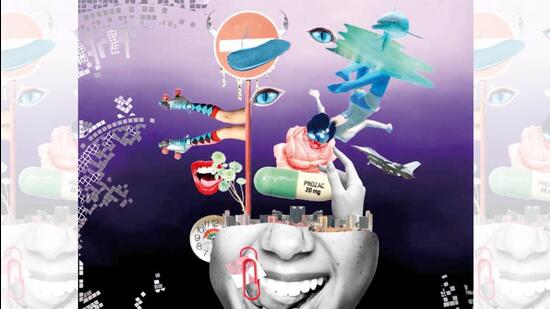
Conversations around art take many forms. On the most basic level, there is a simple question: How relevant is art? More importantly, what kind of artists get the limelight? Any space that curates art, from a specific region or otherwise, often has to grapple with these questions and strike a fine balance between the relevance of art and the pool of artists that merit the spotlight. When Lisa Ray and Singapore-based art patron Ayesha Khan founded The Upside Space, a curator-led NFT marketplace spotlighting art and artists from Southeast Asia, South Asia and the Middle East, they were acutely aware of how intimidating art can seem. The space opened to the world recently on December 8, 2022.
“It represents the new evolution in art but this new evolution is inclusive and welcome,” Lisa says. “For us, it’s a process of exploration. We want people to feel that someone is taking them by the hand.”
She clarifies that The Upside Space is not a “tech company but a creators’ ecosystem,” and it helped that the team comprised people from precisely the very regions they aim to highlight. Ray says that all of them always felt that the artistic expressions in their regions, ranging from traditional to contemporary, are so strong that they had to amplify these artistic voices themselves since no one else would do it for them. “We want to tear the doors off the frames; it’s the next evolution of art,” says Ray.
Beyond the barriers
{{/usCountry}}Beyond the barriers
{{/usCountry}}Since it was essential for Ray and her team to challenge and confront the guardrails around art and the narrow narratives to which art can often be limited, the world of Web3—replete with NFTs and newer ways of approaching and engaging with art—became relevant.
“Today, we have disruptive technologies which are challenging and resolving all the borders, whether they are in your mind or physical, and this is precisely what we want to harness,” Lisa says. “The idea is to put art and artists at the front and centre and use technology to being art into the homes and hearts of people.”
It was only natural that the curation would mirror this sense of inclusivity. From Indonesia’s Ben Mulyo Wicaksono, who challenges the conventional norms of the divine, to the works of Iran’s Kourosh Salehi that interpret human emotions in an elevated, surreal frame, it’s a staggering range.
“The physical art gallery space is opaque because there isn’t a lot of emphasis on directly engaging with the artist, so NFT allows you to be more engaged, tracing the owner, being more transparent and fighting forgery,” Lisa explains.
But The Upside Space is already engaging with established platforms that have been in the service of art. Recently, they showcased an exhibition at the Singapore Art Week and Ray will be in Mumbai for the Mumbai gallery weekend; the space is already collaborating with an art gallery and there is also the India Art Fair—quite a packed itinerary for a new platform.
A wide range
In this sense, what sets The Upside Space apart from other curatorial platforms already working to highlight voices from their regions? Is it simply its tech-progressive approach to art, liberating it from the sanctified gallery space? Ray says that there are lots of artists who don’t know how to engage with the digital space, so The Upside Space helps them with digital interventions.
“We converted some of the existing physical artworks into digital pieces or even NFTs but these are thoughtful interventions,” she clarifies. “There have been artists who have looked at the digital imprint of their physical works and marvelled at how the digital medium allows their brushstrokes to actually be in motion because that’s how they envisioned it.”
However, she acknowledges that anyone with a certain level of artistic vision will naturally be annoyed by people who might just scribble and call it art instead of terming it a collectible. That’s where the curation comes in, not necessarily to cut out the chaff but to add a sense of narrative to the experience.
“Ultimately, stories are what connect us and our curators at The Upside Space are storytellers because you not only view their curated pieces but you look at them through their eyes,” says Lisa.
It’s a staggering range at The Upside Space: Kelly Dorji of Bhutan, Myna Mukherjee of India, Morrow Collective of UAE, Omar Nabi of Pakistan, and Bandana Tewari, who is based out of Bali.
Apart from collaborating with young experimental artists who are leveraging tech, there is also a space for veteran artists who might want to adapt the digital interpretations of their works.
“We are also collaborating with Samsung to help display and integrate the art in your homes so that art is no longer elitist,” Lisa reveals.
Arman Khan is a writer and editor based in Mumbai
From HT Brunch, January 14, 2023
Follow us on twitter.com/HTBrunch
Connect with us on facebook.com/hindustantimesbrunch