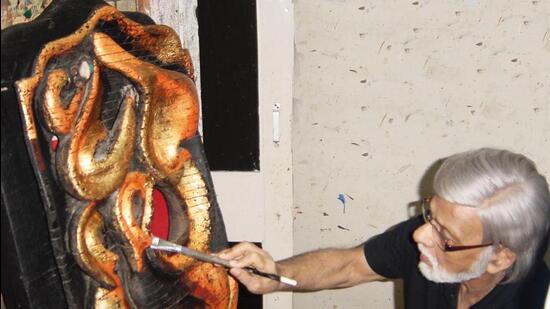
The recently concluded India Art Fair was special in more ways than one. It was finally a physical event after two years, but what made it exceptional was the ‘In Memoriam Showcase’ of the Burntwood Sculpture Series, of one of the most celebrated artists of all time, Satish Gujral, who passed away during the pandemic in March 2020.
Curated by his daughter, architect and interior designer Raseel Gujral Ansal, the series was from the family’s private collection, an initiative by Kiran Gujral (Satish’s wife) to take forward his artistic vision and honour his legacy.
“This is an invaluable homage to my father’s life and passing. Articulated in an arena that was his karma bhumi—art—and celebrated amongst his peers, there could not have been a more befitting farewell to arms for a man entombed in silent creation,” wrote Raseel, who titled the showcase The Art of Silence.
Despite his inability to hear, he ensured that his work spoke volumes. In fact, The New York Times in paying homage, once described him as the ‘Leonardo da Vinci of India.’
Challenging the challenge
{{/usCountry}}Challenging the challenge
{{/usCountry}}“The only slave driver, the only mantra or overriding trend of my father’s life was creativity. It was an obsession with him and he pulled the whole family into this vortex of creativity,” recalls Raseel, the youngest of the artist’s three children.
Raseel, like many children, clung to her father and went everywhere with him. That was when she realised that the man who was her papa was also a revered artist. “People would tell me what a great artist my father was, and seeing him work with different mediums with such obsession, I was in complete awe of him. In fact, in school, I would sometimes avoid revealing my surname to others for this reason,” says Raseel.
Most of all, Satish Gujral was unique because he never let his physical challenges affect his work.
“His focus was never on the challenges, but only on his work,” recalls Raseel. “This taught us a very important lesson—that there is no room in life for self-pity, or self indulgence. What has to be done, has to be done.”
Portrait of the artist
Satish Gujral lost his hearing when he was just eight years old in a freak accident. Born in Jhelum, now in Pakistan, his father a respected judge, Satish was an ace swimmer. One day, when swimming, he hit his knee against a boulder and bruised it badly. Afraid of getting a scolding from his mother, he chose not to tell her. Unfortunately, the wound became septic ; when he finally informed his mother, he was subjected to a series of botched operations from quacks.
“One morning when he woke up, he realised that he had lost his hearing,” says Raseel. “That’s why I titled the show The Art of Silence. He had lived in silence and created in silence. And I don’t think he could have created such masterpieces if that silence hadn’t been there.”
When he got better, Satish was sent to a school that taught the arts and crafts, run by Rudyard Kipling’s father, Lockwood. “After a few years, he was sent to the JJ School of Art. He had been studying there when Partition happened,” Raseel says.
Based on the memories of those days, Satish later painted his Partition series which won him critical acclaim.
Celebrating life
The Burntwood Series (1970-99) that was displayed at the India Art Fair was born as a result of the Emergency that was imposed in India in 1975.
“My father was very close to his brother, IK Gujral, who was the Information and Broadcasting minister at the time. Overnight, several people—artists, writers—were rounded up and sent to jail, and my uncle was sent to Moscow on demotion [IK Gujral later became Prime Minister of India]. Being creative, my father did what he did best, and that’s how the Burntwood series, which he referred to as ‘brunt wood’ (bearing the brunt of the times) came about. He transformed the dark memories of those days into vengeful tribal deities. Besides using burnt wood, he also used materials like leather belts and thongs, hemp ropes and glass and metal beads to express his views about the extremities during that time,” explains Raseel.
Satish passed away in March 2020, but instead of giving in to grief, his family decided to celebrate his life and his passion for creativity. This is why Kiran Gujral and Raseel Gujral Ansal have instituted an initiative to applaud and support meritorious attainment in the fields of arts, sports and films, looking at the core tenets of tolerance, compassion and the triumph of individual endeavour against discrimination and personal circumstance.
From HT Brunch, May 7, 2022
Follow us on twitter.com/HTBrunch
Connect with us on facebook.com/hindustantimesbrunch