
 E-Paper



Fit and Fine by Kamal Singh CSCS: Cardio or resistance training?

 Prefer HTon Google


If you ask any senior person what exercise they do to remain fit and active in their golden years, most will tell you that they go for long walks, some may also say that they do yoga
If you ask any senior person what exercise they do to remain fit and active in their golden years, most will tell you that they go for long walks, some may also say that they do yoga. In fact, most doctors recommend walking as the best exercise! But this is totally incorrect and has led to the older population being weak and prone to falls because of muscle loss and weak bones. Even medical authorities are now revising their exercise and physical activity guidelines but it does not seem to percolate down to the local doctors or maybe they are not sure what they should be prescribing for their patients!
Resistance training, and then some more resistance training
According to Brad Schoenfeld, PhD, the well-known researcher on muscle hypertrophy, “Resistance training is arguably the most important interventional strategy for overall health and well-being, yet a large % of the population isn’t aware of its vast benefits...” People are still debating whether they should do cardio or weights ad nauseum. To me, there is no scope for debate. You have to do weight training at least two times a week. As you grow older, it becomes even more important to hit the weights, no ifs or buts.
We know that muscle mass loss begins after the age of 30. This is inevitable and cannot be stopped. Loss of muscle mass is called sarcopenia and leads to weak bones as well as the general weakness associated with ageing. But if you do resistance training, the rate of loss can be slowed down. Coupled with enough protein intake, trainees have managed to improve their muscle mass even if they were senior citizens. Weight training is truly the only therapy available which is anti-ageing.
Resistance training program for everybody
This is a minimalistic training program which anybody can do in their home. It needs very little equipment – just a light to medium resistance band.
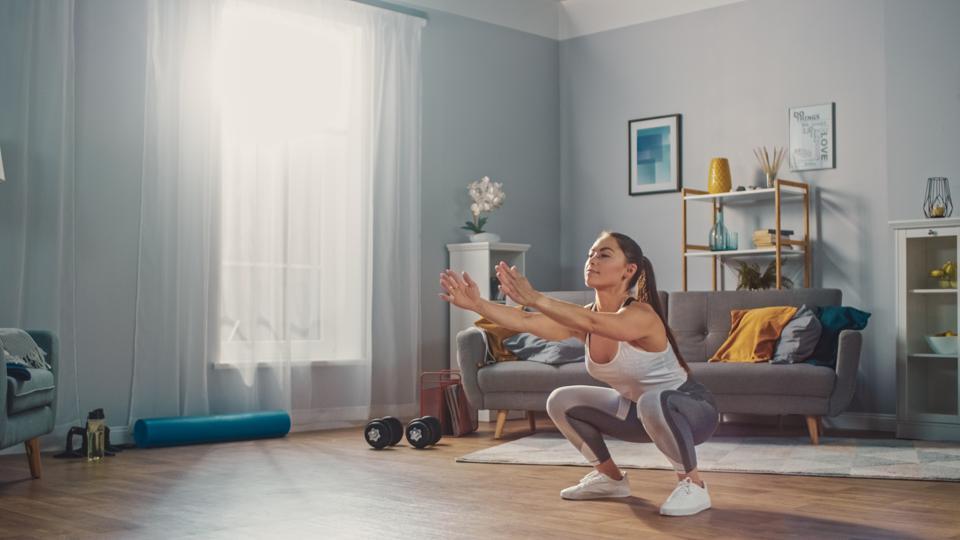
Bodyweight squats: Stand with your back to a bed or chair, keep your feet shoulder width apart, lower your hips till you touch the bed/chair behind you and then stand up. That is one repetition. Do 10-15 repetitions.
Push ups:If you cannot do push ups on the floor, do them with your hands on a sofa, bed or even a high table. Do 10-15 repetitions.
Lunges: Take a long step forward with your left leg till your back knee almost touches the floor. Then bring the left leg back to the starting position. That is one repetition. Do 8-10 repetitions per leg.
Rows: Take the resistance band and tie one end to something sturdy. Stand with your feet parallel to each other and grab the free end of the resistance band, pull to your waist. That is one repetition. Do 10-15 repetitions per side.
Glute Bridges: Lie on your back on the floor. Bend your knees, so that your feet are flat on the floor. Lift your hips up till your knees, hips and shoulders are in one line, then lower your hips to the floor. That is one repetition. Do 10-15 repetitions.
Once you can comfortably do 20 repetitions for all the above exercises, it’s time to join a gym as you need to add weight to the exercises.
There you are–a minimalistic strength program which anybody should be able to do. This should not take more than 15-20 minutes. Do this program at least three times a week. The gung ho can do it 5-6 times a week. The higher the frequency, the quicker the benefits. Now go and do it.
Kamal Singh is a Certified Strength and Conditioning Specialist who has been coaching for 15 years.
From HT Brunch, September 3, 2022
Follow us on twitter.com/HTBrunch
Connect with us on facebook.com/hindustantimesbrunch


