
 E-Paper



Fit and fine by Kamal Singh CSCS: If you could do only one exercise...
…then we’d say stick with the kettlebell swing, because this one implement and one exercise has multiple uses


A question I am asked all the time – is there an exercise which can be done with minimal equipment but gives maximal results – strength, cardio vascular conditioning and rehab? Most fitness professionals would say that no one exercise can do all those things. But over the years of training people I have come to the conclusion that the Kettlebell Swing might just be the exercise, which does it all.
Simple implement
The kettlebell is probably the simplest piece of equipment devised for strength training. It is just a hunk of metal with a handle attached on top. The kettlebell’s center mass extends beyond the hands of the user, unlike dumbbells where the mas is evenly balanced. The shape makes the kettlebell ideal for swinging type of exercises. Men start with a 16kg kettlebell and women with an 8kg kettlebell. For a lot of people, who are just starting out, a single kettlebell gives very good results for months on end.
Simple exercise
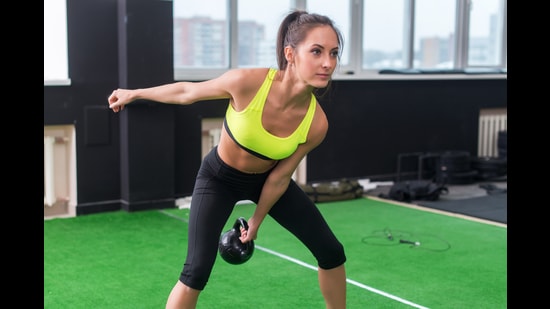
The swing is the first exercise taught and is considered the building block for the ballistic exercises like the clean and the snatch. The kettlebell is swung between the legs and the motion is reversed with an aggressive hip thrust, which brings the kettlebell up to the sternum. The arms are kept straight and the shoulders down. This is done for the desired number of repetitions.
Initially, the swing taught is the two-handed version and then later the single- hand version and finally, the hand-to-hand swing, where the kettlebell is passed from one hand to the other mid swing.
Here are some of the key points to keep in mind while doing the kettlebell swing:
•The swing works the muscles on the back of the body – we call those the posterior chain. The swing is very similar to the deadlift in that sense. The focus is on extending the hip. Thus the glutes, the hamstrings and the lower back get loaded and become strong.
•The knees are unlocked and soft. The swing is not the squat. So, keep the knee bend to a minimal and use the hip hinge. Just like in a deadlift!
•Avoid taking the swing higher than the chest. I know a type of swing is being taught, where the kettlebell ends up overhead. But this defeats the purpose of the swing, which is to load the hinge hinge. The Snatch is the lift, which teaches you how to take the kettlebell overhead.
•Keep the kettlebell close to the groin on the downward portion of the swing. Lower the bell, more the load on the lower back. This might lead to lower back issues. Thus, keep it tight to the body.
•The upward trajectory of the swing is the result of the aggressive hip snap or thrust. The swing is not a shoulder front raise!
Kettlebell swing as a part of fitness programme
The swing can be used in different ways:
•Straight sets - I usually start my trainees with a two hand swing for 10 repetitions for five-10 sets. Depending on how fit the trainee is, this regimen could be done with a two-minute rest between sets.
•EMOM - Each set can be started on the top of a minute, resting till whatever time is left till next minute. This method is called EMOM, which stands for “every minute on the minute”. EMOM is excellent for improving cardio-vascular conditioning, as well as fat loss.
•Post Rehab – I have used the swing as part of post rehab training for back injuries. It’s a good exercise for learning how to hip hinge and strengthen the posterior chain.
So there you go one implement, one exercise and multiple uses. I can’t think of any other device and exercise, which can duplicate the kettlebell swing. Now go out and do it…
Kamal Singh is a Certified Strength and Conditioning Specialist who has been coaching for 15 years
From HT Brunch, February 7, 2021
Follow us on twitter.com/HTBrunch
Connect with us on facebook.com/hindustantimesbrunch


