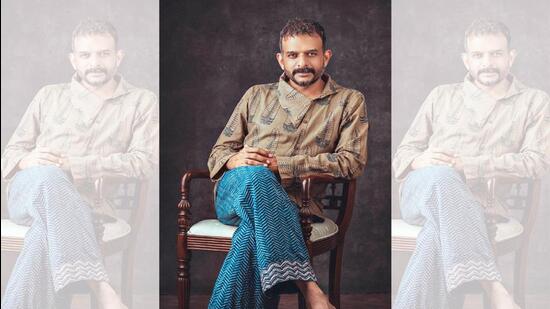
Recently, a concert by TM Krishna crowned Sahmat’s (The Safdar Hashmi Memorial Trust) celebration of 75 years of Indian Independence in Delhi. ‘Hum sab sahmat—in defence of the values of the freedom struggle’ was the theme, and it is fitting that the Carnatic singer, writer, activist and Magsaysay award winner performed in a scintillating finale. For Krishna has shattered all notions of the space an artiste must inhibit, working in spheres connected not just to art, but to society, culture and the human condition itself.
Age of anxiety
While the Sahmat concert was to celebrate a milestone in India’s history, Krishna’s own reflections on the occasion are most likely to have been about the ‘precarious state’ of the country, in which most people don’t think it’s wrong to other, villainise and wrong communities.
I ask him how his art, which places him in a rarefied sphere, and his activism that calls upon him to question everything from caste privilege to manual scavenging and the marginalisation of sexual minorities, co-exist as they do.
“Art exists in that fissure,” is his response. “If there is no fissure, there is no art. It is in that flux that art happens, where multiple streams of ideas collide, where one learns, unlearns and relearns. I see it all as a continuum.”
Krishna prompts me to ask the next logical question: so, if a creation does not stem from that fissure, can it be called art?
{{/usCountry}}Krishna prompts me to ask the next logical question: so, if a creation does not stem from that fissure, can it be called art?
{{/usCountry}}“I would say ‘no’ in capital letters,” he says emphatically. “It may be pleasurable, yes, but it cannot be considered art. I do the pleasurable thing, too, but it isn’t necessarily art. The differentiation is important.”
Quest for answers
Even in his early 20s, the prodigiously talented Krishna began to question the music he was singing and came to realise that the immensely beautiful art piece that is classical music was situated within much violence and ugliness.
“When I began to explore this beauty, I saw the ugly face of it,” he says. “It set off a relentless questioning of society, artistic networks, upbringing, the larger world, perceptions of good, bad, ugly, beautiful. I began to ask myself if I was truly responding to anything. Or, was the system programming me to respond?”
In the early stages of his career, when most artistes would wish to establish themselves in the system, Krishna positioned himself as a tough nut.
“When I changed the way I sang a concert, it rattled the industry,” he recalls. He was turning on its head a style that was essentially habituated consumption. “I overlaid that with the social and the political,” he says. “The universe I occupy is very conservative, inhabited by those who support a particular thought process. My challenge was to push back and still survive. Things have changed in the last 10 years. Whether people agree with me or not is immaterial. I am confident that the younger generation recognises there is a problem with the world and will find ways to deal with it.”
In 2016, Krishna won the Ramon Magsaysay award for “showing that music can indeed be a deeply transformative force in personal lives and society itself.” With remarkable candour, he says the notion that art is some magic that can change society is a fraud.
“It gives pleasure, yes,” he says. “And in the bubbles we inhabit, it’s pleasurable.” Having said that, he believes music has the capacity to heal. “Artistes must have intent and seriously consider the spots of danger in their hearts and minds. If that happens, art can transform.”
For his part, he says, he’s constantly trying to engage and participate and ask difficult questions in these spaces, through his writing, music and his discussions on culture and society.
TM Krishna’s artistic life is rich with collaborations. One of his longest associations is with the Tamil writer Perumal Murugan; Krishna has composed the music for and sung several of Murugan’s works. They worked for a year on a song on manual scavenging, giving deep thought to the positionality since neither of them had lived experience of this evil practice.
Krishna has also collaborated with the Jogappas, a community of transgender folk artistes from north Karnataka. And he has dedicated time to the music of Narayana Guru, performing everywhere from Pala and Kozhikode to Mumbai.
Now he is working on what he’s titled the Edict Project, exploring Ashoka’s compositions and sparking conversations on governance, the relationship between raja and praja, and the concept of dhamma. “All the work is intermingled and part of the larger discourse,” Krishna says with no trace of grandeur.
No ‘off’ switch
I met Krishna in Bangalore when he was there for TMK Unplugged, a series of events he began during the pandemic to aid struggling artistes. He describes these events as intimate and fluid. They are usually held in someone’s home with small groups in attendance and are about conversation, music and reading. Guests donate and the entire collection goes to artistes.
“I’ve done TMK Unplugged in Chennai, Bangalore, Pune and Thrissur and they have been wonderful, another way of presenting art and creating a space for conversations ranging from philosophy to culture,” he says, adding that these events demand a lot of him. “I don’t know the people; it’s a blind date and I am vulnerable. But I believe difficult conversations can only happen in intimate spaces. The outcome depends on the audience as much as it does on me.”
The pandemic and lockdowns robbed the vast majority of artistes of their livelihood. The other, privileged section took to social media. Krishna says there was a desperate need to be visible and perform on FB and Insta. “It was almost a panic situation,” he says. “The pandemic gave birth to the content creator as artiste. And as I said before, you can get pleasure from it, but is it art? An artiste may create content; all content is not art.”
He is dismissive of the quest for virality, which invariably means performances that last mere seconds.
“The time taken for a performance is determined by the piece. Once we allow an algorithm to determine how a piece of art is to be produced, we are going down a very slippery slope,” Krishna says. His response has been to launch a series titled NLBT—Not Limited By Time—on his YouTube channel. Various artistes are invited to perform one piece with the caveat it must be at least 15 minutes long.
Amidst all this, Krishna has also published four books. His last was Sebastian & Sons, in which he explored the lives of the invisible keepers of the mridangam-making tradition. It entailed four years of research. His first book, A Southern Music: The Karnatik Story, was path-breaking in many ways with its provocative ideas about the practice of this art form.
Krishna is now working on a book that looks critically at the symbols of India and the larger questions stemming from that.
Singing, writing, travelling, collaborating, supporting the causes he believes in, expressing solidarity with the marginalised in impactful ways—how does he do it all?
“I frankly don’t know,” he says. “I’m in constant switched-on mode.”
From HT Brunch, October 15, 2022
Follow us on twitter.com/HTBrunch
Connect with us on facebook.com/hindustantimesbrunch