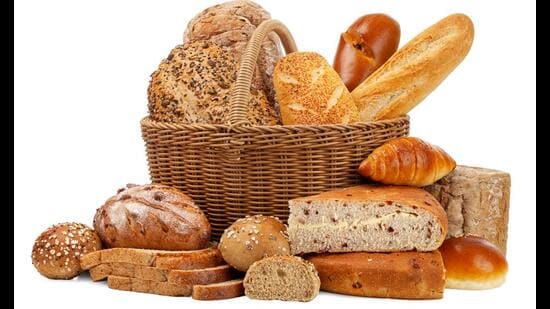
It’s such a relief to finally be able to get good bread in India. The rise in bread quality is one of the great undocumented success stories of India’s food scene.
Until the beginning of this century (and perhaps even later), bread was broadly divided into two categories. There was mass-produced bread that was relatively cheap and dominated the market. It was easily available, and such companies as Britannia became household names because of the ubiquity of their loaves. And then there was the fancy bread from five-star hotels, which cost a lot more and was passed off as vastly superior in quality to the industrial stuff. (I refer to Western-style bread. Pao is another, more complicated story).
In truth, neither category offered any guarantee of quality, and the bread was usually bad in both categories. In fact the industrial bread was better value for money.
Bread is one of the oldest foods known to man. To make good bread, all you need are flour, yeast and water. So why was most bread in the Indian market so bad?
In the mass-production category, it’s easy to see what the problem is. It takes time to make good bread. In 1961, the British bread industry got around this by introducing a process called Chorleywood (CBP to the trade) that used chemicals to make it easier to produce bread more quickly. With Chorleywood, a bakery plant could double production, use cheaper low-protein wheat and create a loaf that lasted longer on the shelf.
{{/usCountry}}In the mass-production category, it’s easy to see what the problem is. It takes time to make good bread. In 1961, the British bread industry got around this by introducing a process called Chorleywood (CBP to the trade) that used chemicals to make it easier to produce bread more quickly. With Chorleywood, a bakery plant could double production, use cheaper low-protein wheat and create a loaf that lasted longer on the shelf.
{{/usCountry}}Bread made using this process had none of the complex flavours usually associated with bread and the texture was all wrong; every time you ate a slice of Chorleywood bread, it stuck to the roof of your mouth. But because the bread was cheap, people bought it anyway: Something like 80% of all bread made in the UK (and an even higher proportion in India) is made using Chorleywood or a similar industrial process. This is the bread that is available all over India.
The so called five-star bread should have been better; it was at least three times the price. But mostly it was (and still is) as bad if not worse. For a start, the hotels did not hire good bakers. And the ones they hired also used Chorleywood-type shortcuts, relying on chemical-heavy products with such names as Bread Improver or Dough Conditioner. When you bought bread at a five-star hotel, you usually got the same chemically enhanced bread as the mass-produced version. Price was the only difference.
Five-star bread was such a con that even the so-called brown bread was a forgery. They used the same dough that they would make their white bread with, and coloured it brown by using a caramel colour. Even today, there are very few hotels where the bread is any good. It’s just expensive. (Have you ever eaten a toast at a hotel and said ‘Wow! This is so good’? I thought not.)
But the bread scene has changed over the last five years. There were always artisanal producers who made the real thing, but their breads were hard to find unless you knew where to look. Sahil Mehta has been around for a while, but he rarely seeks publicity so most people don’t know where to buy his bread. (It is Paris My Love in Delhi.)
Nearly 15 years ago, I tried the bread (and the patisserie) at the then local and low-profile L’Opera and was so impressed that I gave them an award. Last week, I met up again with Kazem Samandari, the chairman of L’Opera. Samandari runs L’Opera as a family business with his wife Christine and son Laurent, and it’s no longer a tiny low-profile operation. It has around 17 outlets and is probably the biggest quality bakery operation in Delhi.
Samandari is of Bahai-Persian extraction and the only reason he managed to do what no Indian could is because he has a passion for quality. In the years since L’Opera opened, the group has gone through a dozen French chefs, but the quality has remained consistent because of Samandari’s passion.
We eat his bread at my home - two different kinds of sourdough and multigrain loaves - and it is always good, even though it is half the price of five-star hotel bread. (L’Opera is more famous for its macarons and I am partial to its French-style crème caramels.)
Samandari is so obsessed with quality that he organises blind tastings of all the other bakery products in the market. When another product beats the L’Opera version, he tries to figure out why. At one such tasting, he was impressed by the croissants at Lavonne, the Bengaluru-based operation that has entered the Delhi market.
I asked Vinesh Johny, the founder of Lavonne, how he managed to make such good bread in a market that has traditionally valued mediocrity. Vinesh was modest enough to say that making good bread was relatively easy. If you cook Indian food, for instance, you have to cope with variations in the flavour of ingredients: Chillies may be hotter one day, tomatoes may be less sour etc. With bread, he said, it’s easy. You only need a few ingredients and they usually taste the same from day to day.
What he did not say is that his bread is made with patience, effort and top notch ingredients. His flour is milled at a mill that is carefully chosen. For his croissants, he uses very good butter.
Vinesh agreed with me that the bread market in India has changed. Perhaps it was the pandemic, he suggested, when so many of us started baking bread at home that made people realise what real bread should be like.
What is certainly true is that bakers are taking more trouble than before. I now regularly buy bread from Foodstories, a national grocery chain, and am surprised by how consistently good the bread is. I asked Avni Biyani who founded the chain where they source their bread from, and her answer surprised me. They make their own bread at their own bakeries.
If Foodstories can make such good bread in relatively large quantities (for sale at their stores and for delivery) then why can’t others?
The answer seems to be the one Samandari gave me: Passion. I thought of Varun Tuli, the Delhi restaurateur who reinvented the market for reasonably priced Asian food at his Yum Yum Cha restaurants and his Noshi delivery operation. Despite his success with East Asian food, Tuli has long had a nerdy fascination with baking. He has now turned that passion into the successful Wheaty delivery chain, making all kinds of quality bread.
Tuli’s success tells us what was wrong with the bread market. It was not that it was difficult to make good bread. It was that nobody cared enough to do it with dedication and an obsession with quality.
Because, man does not live on bread alone. It is passion that makes life worthwhile.
From HT Brunch, September 26, 2026
Follow us on www.instagram.com/htbrunch