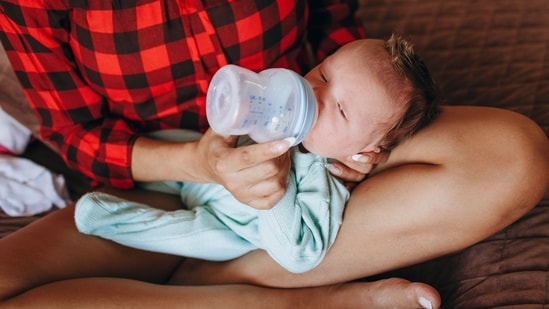
For infants, no food is as nutritious as the mother’s milk. And for many mothers, pumping and storing breast milk for later use is a major convenience. But, because of how delicate the food is, one needs to be extra careful while storing it and reheating it afterwards.
Also Read | Gastroenterologist Dr Joseph Salhab says he doesn't drink chia water: Here are 5 ways he takes them instead
In an interaction with HT Lifestyle, Dr Vandana Singh shared a few tips that every parent should know before handling breast milk, as temperature, cleanliness, and storage time influence its safety. “Parents who enjoy pumping should have basic knowledge on this subject, so as to ensure its hygiene, reduce losses and simplify the process,” she noted.
Importance of cleanliness while storing breast milk
When it comes to pumping and storing breast milk, cleanliness is of utmost importance. According to Dr Singh, safe storage commences even before the milk is placed into the refrigerator. She shared the following guidelines to keep in mind while storing breastmilk.
- Wash your hands properly with soap and water before pumping or handling breast milk.
- Pump parts, as well as bottles and any other equipment that contacts milk, have to be cleaned thoroughly after each use and dried completely.
- Use containers specially made for breast milk storage, which have tight lids and should not be full if the milk is put in the freezer, as it expands when it freezes.
- Avoid commonplace bags and boxes that are unsuitable for food.
Where and how long should breast milk be stored?
As per Dr Singh, the freshly expressed breast milk may be stored at room temperature, in the fridge, or in the freezer; however, the duration of its safety would depend on the temperature and conditions of the storage.
{{/usCountry}}As per Dr Singh, the freshly expressed breast milk may be stored at room temperature, in the fridge, or in the freezer; however, the duration of its safety would depend on the temperature and conditions of the storage.
{{/usCountry}}“It is advisable to keep the milk in the fridge if it is not going to be used in the near future and frozen in cases of prolonged storage,” noted the gynaecologist.
“It would be good to keep the milk in the back of the refrigerator, not in the door of the fridge that experiences temperature fluctuations when being opened. The frozen breast milk must be placed in the coldest temperature zone of the freezer.”
Marking each container with the pumping date is a simple yet useful practice, as it helps parents to understand which milk they should use first and prevents forgetting containers at the back of the fridge and freezer.
How to not waste breastmilk
Dr Singh shared that keeping milk frozen in small amounts makes it easier to feed it to the baby.
“It is better to heat only as much milk for the baby as he can consume, instead of melting a lot of milk for a bottle only to throw some of it away,” she stated. “This is particularly useful for babies whose feeding volumes change from one feed to another.”
The gynaecologist further pointed out that breast milk may separate during storage, with the cream rising to the top.
“This is normal and does not mean the milk has spoiled,” she noted. “Gently swirl the container to mix the layers rather than shaking it vigorously.”
How to warm frozen breast milk
Frozen breast milk should preferably be thawed in the refrigerator or gradually warmed by placing the container in warm water, shared Dr Singh. It should never be microwaved, since microwaves can heat milk unevenly and create hot spots that may burn a baby's mouth.
“Once thawed, the milk should not be repeatedly frozen and thawed,” cautioned the gynaecologist. “Parents should also be cautious with milk left over after a feed. Once a baby has started drinking from a bottle, bacteria from the baby's mouth can enter the milk, so leftovers should not simply be returned to the freezer.”
When in doubt, parents should put safety first
In the words of Dr Singh, “There’s no need for parents to complicate things in order to store breast milk the right way. Just make sure your hands are clean, your equipment washed properly, your containers suitable, your temperatures being correct, your labelling clear and your defrosting careful.”
The guidelines on breast milk storage for premature babies, sick babies or babies with any other kind of issue may also need to be more rigorous. In such situations, it is best to consult a doctor.
When milk has been too long out of the fridge and/or has been stored improperly and/or appears to be dirty, the safest option, according to Dr Singh, is to discard it.
Note to readers: This article is for informational purposes only and not a substitute for professional medical advice. Always seek the advice of your doctor with any questions about a medical condition.
Dr Vandana Singh is a senior consultant in the department of Obstetrics and Gynaecology at Kailash Hospital, Noida, with over 13 years of clinical experience.
Catch your daily dose of Fashion, Taylor Swift, Health, Festivals, Travel, Relationship, Recipe and all the other Latest Lifestyle News on Hindustan Times Website and APPs.
Catch your daily dose of Fashion, Taylor Swift, Health, Festivals, Travel, Relationship, Recipe and all the other Latest Lifestyle News on Hindustan Times Website and APPs.