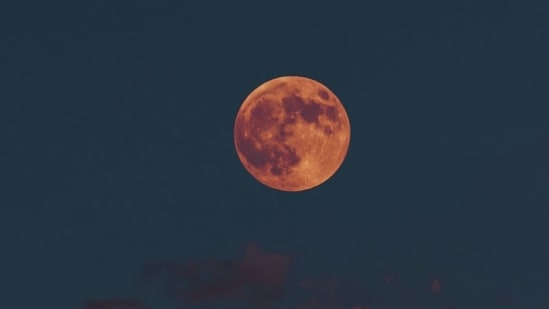
The Sturgeon Moon 2026 will light up the August sky this week, with the full Moon reaching its peak in the early hours of Friday, August 28. This year's August full Moon comes with an added celestial event: it will coincide with a deep partial lunar eclipse.
According to The Old Farmer's Almanac, the August full Moon will reach peak illumination at 12:18 a.m. Eastern Time on August 28. For much of the US, that means Thursday evening, August 27, will be the best time to step outside and watch the Moon.
Also Read Rakhi Purnima 2026: Date, timings and what the sacred Full Moon means for spiritual seekers
When is the Sturgeon Moon 2026?
The Sturgeon Moon reaches full phase on Friday, August 28, 2026.
The full Moon timing are as follows:
- Eastern Time- August 28 at 12:18 a.m.
- Central Time- August 27 at 11:18 p.m.
- Mountain Time- August 27 at 10:18 p.m.
- Pacific Time - August 27 at 9:18 p.m.
The Moon will look nearly full on both the night before and the night after the exact peak, so you do not need to catch the precise minute to enjoy it.
Why is August's full Moon called the Sturgeon Moon?
{{/usCountry}}The Moon will look nearly full on both the night before and the night after the exact peak, so you do not need to catch the precise minute to enjoy it.
Why is August's full Moon called the Sturgeon Moon?
{{/usCountry}}The name Sturgeon Moon* comes from the lake sturgeon, a large freshwater fish historically found in the Great Lakes and Lake Champlain.
The Old Farmer's Almanac explains that the fish was once abundant during this part of summer and was an important food source for Native communities living around these waterways. The publication also notes that full Moon names have different cultural and historical origins and were traditionally associated with an entire lunar month rather than only one night.
August's Moon has also been known by other seasonal names, including Corn Moon, Harvest Moon and Ricing Moon, depending on the tradition and region.
Is the Sturgeon Moon connected to the lunar eclipse?
The two are not connected phenomena. The Sturgeon Moon is simply the traditional name for the August full Moon, while a lunar eclipse occurs when the Moon moves through Earth's shadow.
This year, however, the events happen at almost exactly the same time. The Sturgeon Moon reaches full phase at **12:18 a.m. ET on August 28**, while the partial lunar eclipse reaches its greatest point around **12:12 a.m. ET**. At that moment, about 96% of the Moon will be inside Earth's darkest shadow.
What does the Sturgeon Moon mean in spirituality?
In spiritual traditions and astrology, a Full Moon is often viewed as a time for reflection, closure and setting intentions. Because the Sturgeon Moon is the August full Moon, some spiritual practitioners use it as an opportunity to pause, review the past few weeks, and consider what they want to release or carry forward.
The Moon's connection with the sturgeon has also inspired symbolic interpretations around strength, resilience and abundance. For spiritual seekers, the August full Moon can serve as a reminder to reconnect with nature and appreciate personal growth.
An astrologer from Nebula told Hindustan Times that the August eclipse is a period for slowing down and reflecting rather than reacting impulsively. For astrology followers, the Sturgeon Moon can therefore become a symbolic moment to pause, reflect and consider what they want to carry into the next chapter.
Also Read August Blood Moon Lunar Eclipse 2026: Dates, timings and astrological significance
How to watch the Sturgeon Moon
The full Moon will be visible without any special equipment, provided skies are clear. For those hoping to catch the eclipse too, the best viewing time depends on location.
The partial eclipse begins at around **10:33 p.m. ET on August 27** and reaches maximum at **12:12 a.m. ET on August 28**. Unlike a solar eclipse, a lunar eclipse is safe to view with the naked eye.
So this year's Sturgeon Moon offers two reasons to look up: it marks the August full Moon and, for observers in the right parts of the world, it will also pass through Earth's shadow during a striking partial lunar eclipse.