Call it a dress code or uniform, the Samajwadi Party has one in place as part of its image management plan this election. This is supplemented by personal grooming and behaviour guidelines as well.
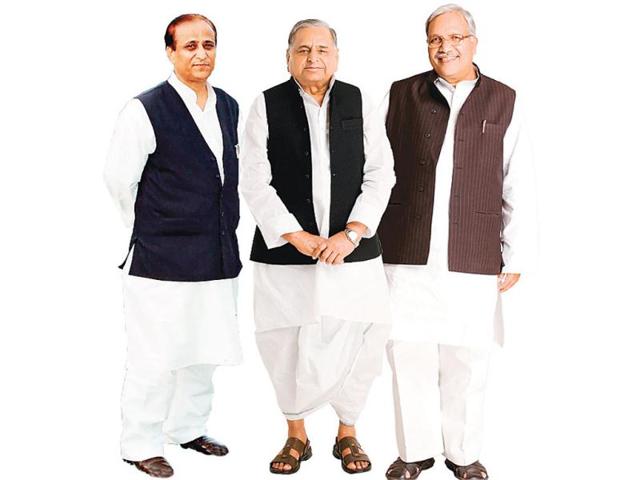
All this is part of party's strategy to erase the “rowdy and goonda” perception from public memory and replace it with “smart and we mean business” image. The party had lost the last election to Mayawati when the latter had gone hammer and tongs accusing it of unleashing a 'Goonda Raj' during its regime.
While white khadi retains its prime position, there are perceptible changes in the way it's worn, its quality and tailoring to give the party a uniform and corporate look.
Take for instance the dress for a sunny, warm day: It's gonna be smart, well stitched white khadi kurta-pyjama (or dhoti) with a small 1 x 1.5 inch party flag sticker on the left chest-pocket. On a cold day, SP men may also wear a black waistcoat or, if it is very cold, a black full sleeves coat-with the same party sticker on the left chest pocket of the coat.
People may continue complimenting their dress with party's red Gandhi topi, while Muslims in the party may have their traditional caps or the red one. This image makeover is the strategy of SP state president Akhilesh Yadav and his team of backroom boys. “The whole thing has been consciously planned,” says Abhishek Mishra (34), a former IIM-Ahmedabad associate professor and now the party candidate from Lucknow North seat. And the footwear: shoes, sandals or chappal should be in black leather. Socks too should be black.
{{/usCountry}}People may continue complimenting their dress with party's red Gandhi topi, while Muslims in the party may have their traditional caps or the red one. This image makeover is the strategy of SP state president Akhilesh Yadav and his team of backroom boys. “The whole thing has been consciously planned,” says Abhishek Mishra (34), a former IIM-Ahmedabad associate professor and now the party candidate from Lucknow North seat. And the footwear: shoes, sandals or chappal should be in black leather. Socks too should be black.
{{/usCountry}}That's not all, candidates have been advised to turn out well-groomed -- well shaven or well trimmed beard, no paan chewing in public meetings and no top-buttons open. Abhishek, who is a strategy and innovation expert, had been 'working' on Akhilesh's plan for the past two years. He chucked his IIM job last month to contest the election.
“The party's image was in a mess the way it was perceived by people. So we embarked on a holistic image changing strategy. We wanted that our men should look neat and presentable. I saw how in elections in the US one's image is consciously planned. We too decided to go in for such an idea, and Akhilesh Yadav began implementing it,” Abhishek, who hold a management Ph.D from Cambridge (UK) and Massachusetts Institute of Technology (USA).
Though there are no hard-and-fast guidelines on jacket, shoes or the color of it all, gradually more and more workers have begun following the unwritten dress code. Jyoti Yadav, former Ranji player and the Allahabad West candidate, is following the code while campaigning and so is Dr Sangram Yadav, a candidate form Azamgarh. Mulayam has been repeatedly asking partymen to change behaviour and talk to people “in a cultured, soft and respectful manner - preferably with a smile on their face.”
There is, however, no dress code for women. “But none of us wear blue saris, for obvious reasons,” chuckles Juhi Singh, Lucknow East candidate.