
 E-Paper



Queen’s gambit: Girls shine in chess but fizzle out early


As girl players grow up, there is increased pressure to marry and conform. Many drop out. What can India do to keep them in a winning position?
Experienced chess players and coaches will tell you that while Indian chess has got younger, with more prodigies, women’s chess hasn’t seen the same change. “Fresh talent is rare,” says Aarthie Ramaswamy, Woman Grand Master in 2003. “The names that are currently at the top are the same as when I was active.”
Among the Junior categories, where kids start playing from age 5, there’s little disparity. The game doesn’t call for excessive fitness, parents happily let girls participate and compete. Balaji Guttula, chief Choat at the South Mumbai Chess Academy says that while one out of 10 young players in north India is a girl, in Kerala, Tamil Nadu and Andhra Pradesh, the turnout is close to 40%. “Girls win an equal number of medals and their scores are on par with boys,” he says.
But a clear fizzling-out happens in the 15-20 age group. “All through school, a girl chess champ is a matter of pride for the family, but by Class 10, she’s seen as a liability,” observes Grand Master Abhijit Kunte who coaches chess in Pune. “The secure atmosphere is gone, the matches ahead are expensive and the professional and personal goals change.”
Kunte’s sister, Mrunalini Kunte-Aurangabadkar felt its effects first-hand. A Woman International Master and a chess coach, she says it’s not talent but society that holds woman back. “Aggression is conditioned out of you in puberty – that comes across on the board,” she says. “You’re able to analyse a game like a man but not demonstrate the moves.”
Still, in India, as in the rest of the world, there are more couples in chess than in perhaps any other sport.
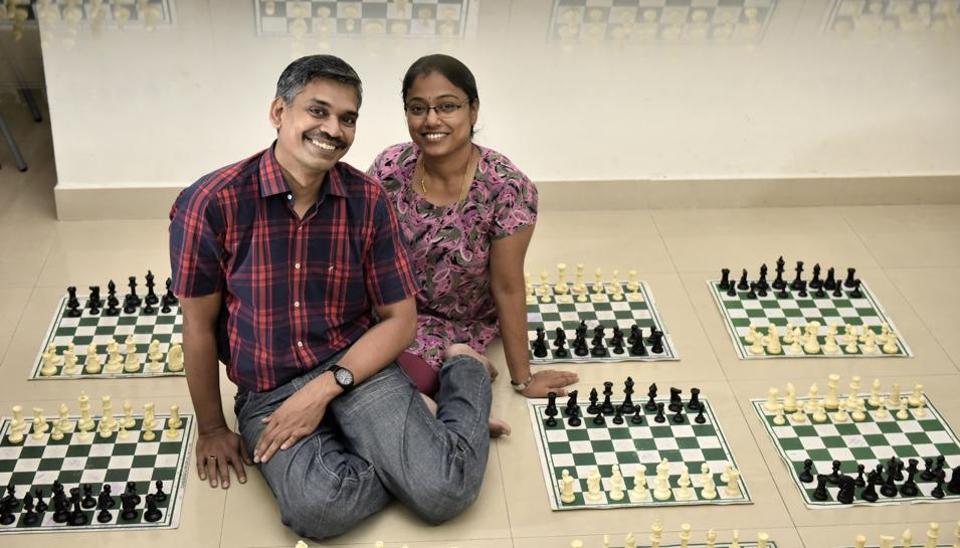
RB Ramesh and Aarthie have played each other and the world. Other couples include Dibyendu Barua and Saheli Dhar; Anupama Abhayankar and Raghunandan Gokhale; TS Ravi and Saimeera; Vasanti Khadilkar and CS Unni; Sudhakar N Babu and Krishna Jhagirdhar; Sagar Shah and Amruta Mokal; Sriram Jha and Vijayalaxmi S, and Vishnu Prasanna and Raghavi Nagarajan.
On one level, it’s easy to see why. Chess sees more women players than more physical sports. Women play against men as often as they do against women. And players tend to seek like-minded company.
But RB Ramesh, Grand Master, has another theory.
“Chess players travel a lot for tournaments and unlike other games, there’s no knockout – losing one match doesn’t mean you go home,” he says. “So we’re often stuck for none or 10 days at a time. The chess circuit is friendly, and we tend to become close buddies. It’s just easier to find a partner.”


