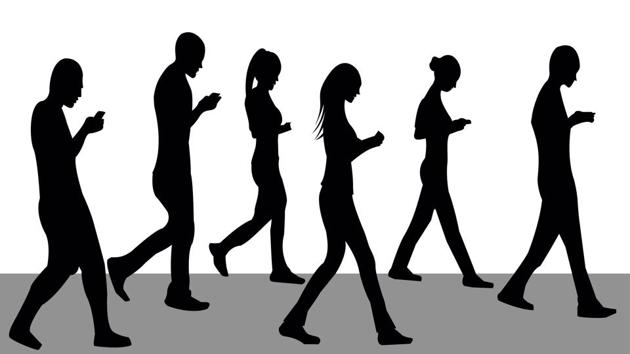
Smartphones are altering our gaits and the speed at which we walk, say scientists who found that people move at a slow, cautious pace while texting.
Researchers at Anglia Ruskin University in the UK found that when using a phone, irrespective of how it is being used, people look less frequently and for less time at the obstacle on the ground. The relative amount of time spent looking at the obstacle reduced by up to 61 per cent, researchers said.
Researchers found that writing a text results in the greatest adoptions in visual search behaviour and walking style, or gait, compared to reading texts or talking on a phone.
When writing a text the lead foot is 18 per cent higher whilst clearing the obstacle compared to not using a phone, and is 40 per cent slower. Similar, but less extreme, results are seen when reading texts and talking on the phone, researchers said. Writing a text may increase visual attention demands, as people look at the keypad to type as well as look at the screen to read what is being written, to ensure it is correct, they said.
“Our findings indicate that phone users adopt a cautious approach when faced with fixed objects on the ground. Accidents are likely to be the result of objects suddenly appearing that phone users were not aware of, for example other pedestrians or vehicles,” said Matthew Timmis, senior lecturer at Anglia Ruskin University.
{{/usCountry}}“Our findings indicate that phone users adopt a cautious approach when faced with fixed objects on the ground. Accidents are likely to be the result of objects suddenly appearing that phone users were not aware of, for example other pedestrians or vehicles,” said Matthew Timmis, senior lecturer at Anglia Ruskin University.
{{/usCountry}}“We found that using a phone means we look less frequently, and for less time, at the ground, but we adapt our visual search behaviour and our style of walking so we’re able to negotiate static obstacles in a safe manner,” Timmis added. Researchers investigated how mobile phone use affects where people look (visual search behaviour) and how they negotiate a floor-based obstacle placed along their walking path.
Participants wore a mobile eye tracker and motion analysis sensors and walked towards and then stepped over a floor-based object, which was a similar height to a roadside kerb, whilst writing a text, reading a text, talking on the phone, as well as without using a phone. The study was published in the journal PLOS ONE.
Follow @htlifeandstyle for more