On November 26, 2008, a team of 250 commandos of the National Security Guard (NSG) were all set to take on the 10 armed terrorists who had attacked multiple locations in Mumbai. From their headquarters in Manesar, Haryana, they reached Mumbai at 5am, significantly delayed because the IL-76 aircraft that was to transport them wasn’t available. Ten years later, the NSG has taken steps to make sure glitches like this don’t crop up again.
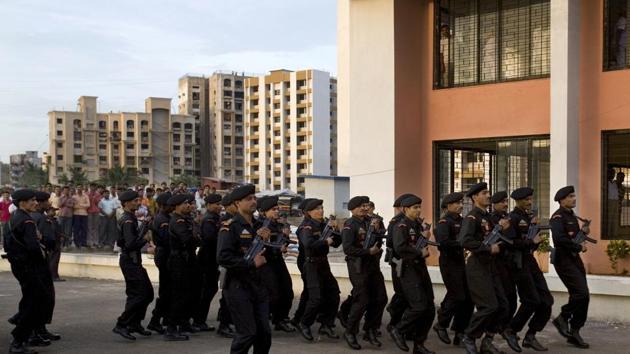
The NSG is India’s elite anti-hijacking, anti-terrorist, bomb disposal force. Since 2008, five new hubs have been created, with the first of them being inaugurated in Mumbai on June 30, 2009. Kolkata (eastern zone), Hyderabad (central zone) and Chennai (southern zone) followed in the same year. The fifth hub was created in Ahmedabad in 2015 and was inaugurated in 2016. The Mumbai hub has the responsibility of Madhya Pradesh, Goa and Maharashtra.
In 2009, NSG commandos were initially stationed at the police barracks at Kalina in Santacruz (East). “The glitches were plenty to begin with,” said a NSG officer, who was part of the unit that took part in the Mumbai operations. While being stationed in Kalina meant the NSG could respond quicker to a crisis in the region, they struggled with the ill-prepared police training grounds and firing ranges that were not designed for the kind of close-quarter combat that the elite force trains for, said the officer.
After a few roadblocks, a 23-acre campus was then set up at Marol in February 2012. However, its facilities remain unsatisfactory. The compound is supposed to have housing for commandos, an officers’ mess, a gymnasium and a training ground, among other things. The original proposal included a swimming pool, which was scrapped when the soil in Marol was found to be unconducive to such a structure. A firing range has been set up, but it is not the state-of-art facility that was promised.
{{/usCountry}}After a few roadblocks, a 23-acre campus was then set up at Marol in February 2012. However, its facilities remain unsatisfactory. The compound is supposed to have housing for commandos, an officers’ mess, a gymnasium and a training ground, among other things. The original proposal included a swimming pool, which was scrapped when the soil in Marol was found to be unconducive to such a structure. A firing range has been set up, but it is not the state-of-art facility that was promised.
{{/usCountry}}Despite these challenges, the NSG has been able to develop a cohesive unit in Mumbai. Since its inception in 1986, the NSG is made up of two separate components: The special action group, which comprises two groups of Army men, and the special rangers group (SRG), which is made up personnel drawn from the Central Armed Police Forces (CAPF).
The 51 Special Action Group (SAG) was trained to handle counter-terrorist operations. The 52 Special Action Group (SG) was trained to handle counter-hijack operations. The SRG would provide a cordon to the fighting arms. Since those from the CAPF had no training in terms of building intervention or counter-hijack situations, they initially found it difficult to cope with the mental and physical pressure of the counter-terrorism unit. “There is a distinct difference between an Army and CAPF personnel. Their training and mindset are very different, which led to senior officers having their own judgments of employing CAPF personnel with the fighting arm of NSG,” said a senior NSG officer.
NSG sources say that today, the SRG is fully integrated. “Even men from the SRG can participate in a building intervention or a counter-hijack situation,” said NSG sources. Today, in case of a multi-dimensional attack in Mumbai, the NSG has nearly 500 commandos in the city and a contingent of the SRG can easily be deployed to neutralise at least at one particular point.
Stay updated with all the Breaking News and Latest News from Mumbai. Click here for comprehensive coverage of top Cities including Bengaluru, Delhi, Hyderabad, and more across India along with Stay informed on the latest happenings in World News.
Stay updated with all the Breaking News and Latest News from Mumbai. Click here for comprehensive coverage of top Cities including Bengaluru, Delhi, Hyderabad, and more across India along with Stay informed on the latest happenings in World News.