
 E-Paper



Mumbaiwale: Two illustrators share the secret to capturing the essence of the city
For illustrators, Mumbai’s buildings and neighbourhoods are a popular muse. But what does it take to capture this crazy mix of madness and majesty?


One of my most prized possessions is a bumper book of illustrations by Mario Miranda. A sumptuous tome of his works depicting Goa, Europe, and Mumbai. And try as I might, I’ve never been able to figure out how he managed to capture Mumbai’s buzzing corners, its restless mood, its happy resignation to chaos and its familiar people. He loved his subject. But so does every other local illustrator on Instagram and Behance – or so they claim, before falling into a pool of stereotypes and narrow nostalgia. How does an artist draw the city you know, and still make you look twice?
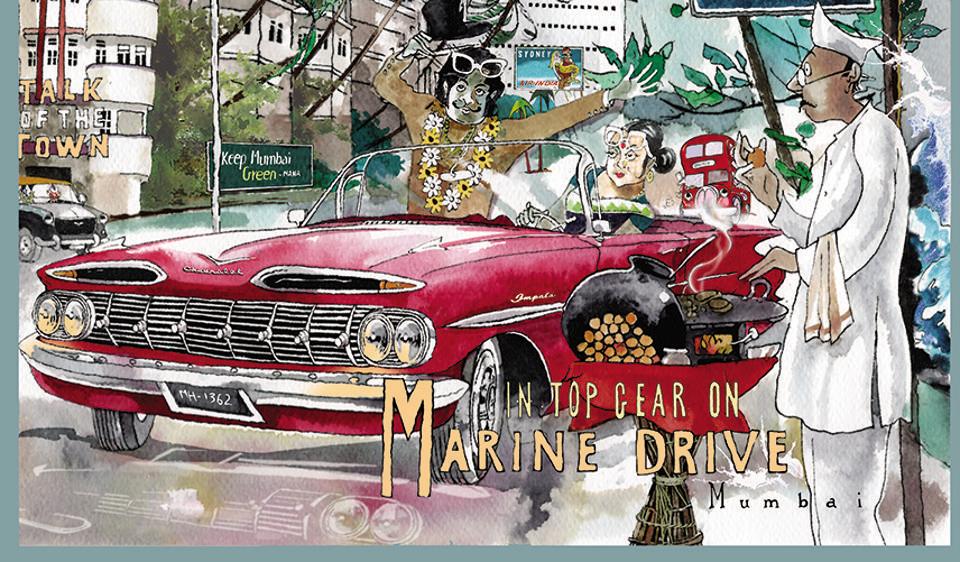
I found part of the answer this week, via another master illustrator, Bangalore-based Paul Fernandes. You probably know him as the man behind the aPaulogy Gallery in Worli and apaulogy.com. Perhaps you’ve seen his Mumbai illustrations – delicate watercolours that somehow fit in Mumbai’s madness and make you smile. Fernandes has been looking at Mumbai for 40 years. He first visited as a young artist, met his wife here and has dropped in often enough to see how much it changes and how much it stays the same.
His coffee-table book, Coast Line, features his works depicting Mumbai, with a bit of Goa, Mangalore and Kerala thrown in. “Each illustration is essentially a collection of memories,” he says. “There is diversity along the coast, and unity. It’s so cohesive, and yet you must only cross the road to meet a new world.”
His trick to break away from clichés seems simple. “I base everything on humour,” he says. “The aim is to find the light-heartedness in a situation, the simple pleasure of the moment.”
Mumbai offers plenty to laugh about, but there’s a good reason so many natives don’t see the city the way he does. “An artist must have the time to do nothing, because the more you look, the more you see. The mind needs to slow down for art.” Coast Line took years to complete, in contrast to younger artists who often produce work after a single visit. “I’m in no rush to finish – the image gets richer the longer the idea sits in your mind. And if it rots and dies, let it. Only the stories that survive are worth telling.”
***
Over at Art&Found, a Mumbai-based online store (@artandfound.co) that collaborates with local graphic designers and artists to create affordable artworks, the city is a stubborn muse.
Amidst funky graphics featuring Irani cafes, nariyalwallas and knife sharpeners, Pari Purohit’s Mumbai Recoloured series stands out. She turns the usual vintage representation of heritage buildings on its head by filling in her sketches in bright colours and stripping them of distractions in the background.
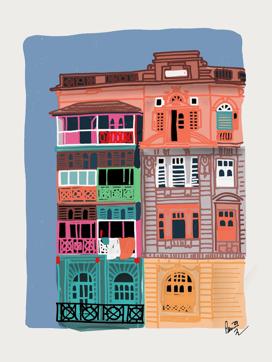
Purohit (@PariPurohit), who’s lived and worked in Colaba for years, says she knows what a privilege it is to be able to move through such a beautiful and historic part of the city. “And Mumbai is such a paradox – extreme wealth and extreme poverty, old and new neighbourhoods side by side, beautiful heritage structures and some awful architecture,” she says. “Recolouring old buildings was a way to mark that paradox, to show that kitsch and pop are as intrinsic as the history.”
Her image of Pine Mansion, a residential building in Mazagaon, is a departure from common views of Mumbai. It’s in a part of town few of us pass through and even fewer visit. The building itself would rarely merit celebration “It’s old, badly kept and easy to miss,” she says.
And yet, in her illustration, the details shine through, Mumbai’s higgledy-piggledy quality comes alive. You look closer at the design you’d have glossed over if you’d seen the building yourself.
Purohit’s trick to look beyond the obvious is to zoom out. “Mumbai is more than the financial capital. It’s more than South Mumbai. Bandra is more than a cute suburb,” she says. “It’s where communities flourish and co-exist. It’s hard and unforgiving but also accommodating and inclusive. You need to be able to see that to capture Mumbai.”


