One hates to admit this, but India may have to temporarily pause further addition to its renewable capacity, especially solar. There are two main roadblocks that have led to a situation where it must back down on renewable generation. The first is that it is not able to provide long-term permanent grid connectivity, and the second, perhaps more important, is that we have practically no storage capacity, be it batteries or pumped storage.
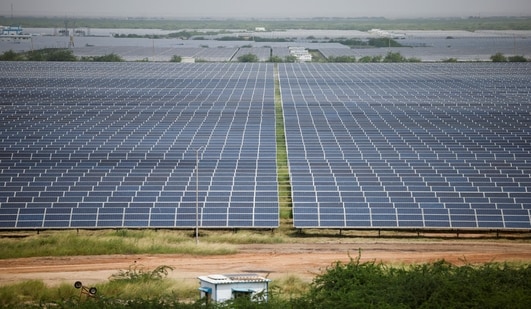
Renewable generating capacity is more dispersed compared to conventional capacity and, further, the capacities are relatively small. Consequently, one needs a transmission system that may run into a mesh of wires connecting small capacities instead of a single transmission line emanating from a big plant as we are used to. More lines would mean more “right of way” required to lay the cables. Apart from being a time-consuming affair, the fact is that the country does not have enough space available, at least in some parts. Moreover, the time required for setting up a solar plant is about 18 months whereas time taken for a transmission line can take about 36 months. This mismatch has led to a situation where the generation unit is ready but the transmission line is nowhere in sight. So, today, the generator wants compensation — that in itself is a lengthy legal battle.
Also Read | Solar power in focus: An Indian formula for African food security
{{/usCountry}}Also Read | Solar power in focus: An Indian formula for African food security
{{/usCountry}}During the solar hours, we have generation from not only solar but also wind, biogas, etc, to the extent they are connected to the grid. In addition, we have conventional generation from coal, gas, nuclear and hydro. The total generation from conventional and renewable sources is more than the demand for power during the day, at least as of now. So, somebody needs to back down since supply and demand need to match in real-time; otherwise, the grid will crash. The question is who should back down. Since the marginal cost of generation from solar and wind is zero, it is the conventional generation, such as coal, that needs to back down. In other words, renewable generation is treated as “must run” because unless we use that power, we are going to lose it forever.
But herein lies the catch. Coal-based generation cannot back down beyond a limit. The generators say that it would not be advisable to back down beyond 55% of the capacity of the plant because doing so may damage the machinery. The government, however, opines that there is no problem in backing down to even 40%. What should be this floor level (55% or 40%) is the matter of an ongoing debate.
Now that India’s solar capacity has touched 162 gigawatts (GW), the situation is such that even after going down to the floor level as far as generation from coal stations is concerned, supply is still exceeding demand. One, therefore, is now forced to curtail renewable generation also for grid stability. The curtailment was of the order of about 2 billion units (BUs) in 2025. If India had storage capacity in the form of batteries, it could have used this surplus power to charge and use these batteries during non-solar hours. The country could also have used this surplus power to pump water from the lower reservoir to the upper reservoir of pumped hydro and use it when generation went down in the non-solar hours.
As already mentioned, solar generators are suffering due to non-availability of grid connectivity. They have been demanding compensation, and there is some talk of provision of limited succour. In addition, when solar generators are asked to back down, they are paid only to the extent they have supplied. However, a lot depends on the power purchase agreement that they have signed. In case there is a “deemed generation” clause, and if they are asked to back down for reasons other than grid stability, there is a possibility that they will be paid. The process, however, can be lengthy.
So, how does India get out of this morass? The answer lies in building storage capacity. The Central Electricity Authority (CEA) has estimated that the country needs storage capacity to the extent of 888 gigawatt-hours (GWH) by 2035; what it has today is a mere fraction of this. Storage capacity in the form of pumped storage takes time as it faces all the vagaries associated with the construction of hydro plants.
Also Read | India’s solar diplomacy in the Global South
Though the gestation period for battery storage is relatively low, a new problem has emerged as far storage projects are concerned. The market-determined price (that has been arrived through competitive bidding) seems to be non-remunerative, and this affects the viability of projects and puts a big question mark on their successful completion. If India wishes not to back down on its renewable generation, one possible solution seems to be temporarily mothballing a few of the country’s inefficient coal-based plants so that overall generation from coal falls to an extent. In the meanwhile, the country focuses on seriously building its storage capacity. This, unfortunately, will not be possible since there are instances of high demand during non-solar hours where conventional generation falls short vis-à-vis demand.
To conclude, there seems to be no quick solution to India’s problem of having to curtail renewable generation in the day and losing that power forever. On the lighter side, one can say that the country is better off adding only about 13 GW per year (as we have done over the last ten years) instead of about 45 GW per year that was required to displace coal. Had we done that, our problems would have multiplied and this crisis would have been at our doorsteps much earlier.
Somit Dasgupta is visiting professor, Icrier, and former member (economic and commercial), Central Electricity Authority. The views expressed are personal