The Mecca defence agreement signed by Saudi Arabia, Türkiye, and Pakistan caused ripples both in West Asia and the wider strategic discourse. While many perhaps erroneously believed that this agreement had Iran in its crosshairs, it may, in fact, align with the security vision Tehran is pushing via its ongoing chokehold over the Strait of Hormuz.
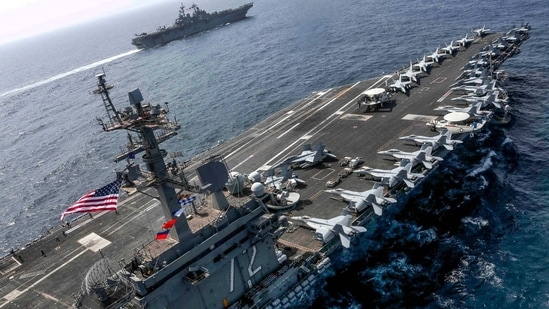
For some time now, Iran has been pushing for a region-led and region-owned security architecture that displaces the US military presence in the region, off-loads American military bases, and vests the onus of regional security in the Islamic countries. The abrupt exit of the US aircraft carrier, USS Abraham Lincoln, after a record seven-month long deployment to support US war effort against Iran — following reports of poor living conditions on-board the massive vessel due to the lack of access to the US Navy’s bases in the Gulf — highlights the challenges the US faces in maintaining its military presence in the region. Prior to the war against Iran, Gulf States had disallowed the US from launching strikes using their territories, and Al Udeid, America’s largest military facility in the region, housed by Qatar, was emptied out. Other bases and assets, including those in Jordan and Bahrain, suffered significant damage from Iranian fire. “Are America’s vast Gulf bases worth rebuilding?”, read a recent headline in The Financial Times. The conversation on “de-basification”, today, is real.
Also Read | Turkish, Saudi, Pakistani ministers’ first Mecca defence pact meeting today: 10 things to know
{{/usCountry}}Also Read | Turkish, Saudi, Pakistani ministers’ first Mecca defence pact meeting today: 10 things to know
{{/usCountry}}To be sure, the US is not leaving West Asia. However, the nature of its future presence is going to be reimagined by its allies in the region. This raises further questions, such as at what cost does hosting a US military facility bring compared to the benefits? There remains palpable anger in the Gulf States, over the US and Israel’s recklessness in attacking Iran, not taking them into confidence, and potentially starting another endless operation. Iranian attacks against them under the guise of targeting American facilities will be seen as a successful strategy should US presence in the region thin out in the coming months and the Gulf States become more wary, and unwilling, to host, without iron-clad guarantees on defence.
This opens an interesting question, if not probability, vis-à-vis the Arabian Sea: Can it become a new stage for American military might? American security calculations in the Indian Ocean, over the past few years, concentrated on the Indo-Pacific and new formulations such as Quad — the broader idea was to build a front against China’s unfettered military and economic rise. The People’s Liberation Army Navy (PLAN) already has three commissioned, indigenously built aircraft carriers as of 2026. As of the middle of August, none of US Navy’s 11 nuclear-powered aircraft carriers were in Asia. Now, a shift in the future could see the Arabian Sea taking much more space in how the US deals with Iran, the Gulf, and Hormuz. Previously, the US has conducted long-range bombing missions against Iran from as far away as Australia. In March, the UK accused Iran of attempting to attack Diego Garcia, a joint US-UK base in the Indian Ocean where American long-range bombers such as the B-52s, B-1Bs, and the stealth B-2s are often stationed.
Also Read | Six months into US-Iran war: Strait of Hormuz crisis, global economic shock and India’s strategic test
Both the Strait of Hormuz and the Bab Al-Mandeb Strait off the Red Sea open into the Arabian Sea. Over the course of the war, commercial vessels have become a target for leverage, well beyond these chokepoints. While such attacks taking place deep in the Sea have gone down in numbers, these shipping lines stand weaponised at a moment when there remains no international consensus on who is supposed to protect or deter this business. The US remains the only military capable and willing to do so, for its own interests, but President Donald Trump has made this transactional — that is, regional countries must come and join the operations or lose out. In part, the international system is also at fault, having allowed an addiction to American security blankets to get built. It was so in Afghanistan till 2021, and now on display again in West Asia.
Also Read | Ship hit by missile in Gulf of Oman, link between Hormuz Strait and Arabian Sea, near Pakistan: Report
A new weaponisation of the Arabian Sea will have geopolitical and geo-economic impact for multiple States beyond the Gulf. The India-Pakistan dynamic is already dealing with a peripheral spill-over from the Mecca agreement and the dividends from Islamabad’s weakened yet persistent play as a mediator between Washington and Tehran. Any realignment of US military presence, aimed at using the Arabian Sea in the long term to contain Iran and circumventing the incoming complexities of on-land bases, will cause concerns in capitals such as New Delhi. India does hold significant naval power and influence in these waters and a challenge to that from the US, even as a partner State, would be fundamentally against the country’s regional and neighbourhood foreign policy designs.
The question of the future of the Arabian Sea, not just the Indian Ocean, in US calculations is, of course, one of conjecture. However, it is an option and has been minimally utilised during the ongoing crisis and in the past as well. With the world going through major shifts and chaos, the immediate future will be one of strategic trial and error, and the Arabian Sea could be a laboratory.