Gopalaswami Parthasarathi’s is not a name that the present generation will recognise. It was a name that mine – now gone, mostly, or surviving in its 70s, 80s or fluking into its 90s – knew as one “to conjure with”.
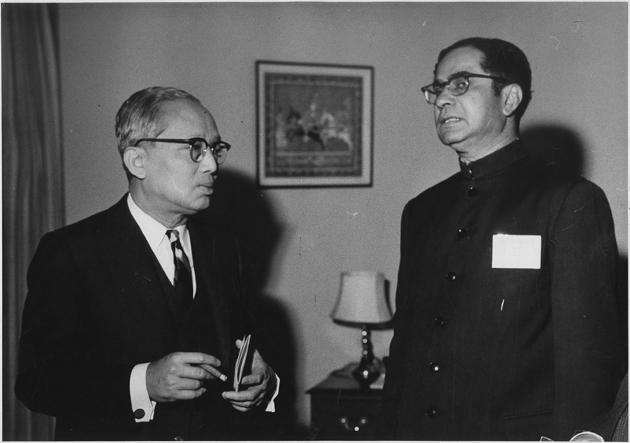
In the world of public affairs, that is. More specifically, in that of diplomacy, of policy-making and policy analysis. And, even more significantly, in that of thought, plain thought. Honest, clear, reasoned thought.
Known as GP to his small knot of friends, larger circle of colleagues and a much wider zone of cynical watchers who admired but also envied his powers of intellect and his influence in the Indira Gandhi-led years, he stood tall. Exactly that. Tall, unbent even in his twilight years, broad of shoulder, wide of forehead, firm of handshake. And measured, very measured, in that equivalent of a visiting card all of us hold on our faces – the smile.
GP’s smile was not false or fixed. It was fair. It said with almost no variation to all he met eye-to-eye: “Welcome to my attention, my consideration, my regard but not necessarily to my indulgence for I have my views and my stock of recollections on what brings you and me together. Welcome.” His smile had both warmth and reserve. It had what seems oxymoronic, a warm reserve.
This combination of formality and civility was aristocratic, and by the ‘just fact’ of that, was designed to generate both respect and distance. And it came from GP being, at the foundation of his personality, two things: an Iyengar and a sportsman. In his case ‘double blue’ meant: TamBrahm blueblood and Oxford sporting colours. His two-blue aristocracy could be forbidding for those who did not share either his Mylapore genes or his sporting helmsmanship. Toppers are looked up to, they are not chummed up with. They just cannot be.
{{/usCountry}}This combination of formality and civility was aristocratic, and by the ‘just fact’ of that, was designed to generate both respect and distance. And it came from GP being, at the foundation of his personality, two things: an Iyengar and a sportsman. In his case ‘double blue’ meant: TamBrahm blueblood and Oxford sporting colours. His two-blue aristocracy could be forbidding for those who did not share either his Mylapore genes or his sporting helmsmanship. Toppers are looked up to, they are not chummed up with. They just cannot be.
{{/usCountry}}Son of legendary civil servant ‘Sir N’, as Sir N Gopalaswami Iyengar, the late Dewan Bahadur of the State of Jammu and Kashmir and minister in free India’s first Cabinet was recognised, GP was in his young days an ace cricketer and hockey player. A man with GP’s height and bearing cannot ingress a sports ground without commanding it. And command it he did, not as a blueblood but a skilled leg-spin googly bowler and centre-half. The ‘ground’ changed from sports to diplomacy, politics and education but the commanding stayed.
GP could have, as Sir N’s astonishingly bright and only son, moved in measured and musical steps, from his PS High School, Mylapore, and Presidency College, Madras, days, to ‘writing the ICS’ and becoming part of the carved chariot of India’s civil service. He could have married a gold-girdled Iyengar bride from, say, neighbouring Triplicane and travelled the length of the country doing jobs of no mean merit but no lasting import.
But GP being all he was born into plus all he discovered for himself in the ozone of a resurgent post-war world and a renascent India, his mind teemed with an intellectual flora of its own taxonomy as his heart found its only true love, Subur Mugaseth the beautiful and brilliant Parsi student of English literature in Madras. The two were to be a couple ‘out of the ordinary’ like the Webbs, Sydney and Beatrice or the Chakravarttys, Nikhil and Renu.
Madras as it then was, produced two kinds of Iyengars. Those that were wore caste marks on their foreheads and those that held Karl Marx in their brains. The former journalist, master of the English language, scholar and thinker-diplomat became with PN Haksar, the two-pillared ‘sumaitangi’, the intellectual load-rest Prime Minister Indira Gandhi so badly needed. She had her political advisers, whose ‘inputs’ she took as a seasoned chef might use a pinch of this and a peck of that to garnish the pilaf on the stove. But on these two she leaned for her kitchen’s wholesale needs with the assurance the that they had – first, a disinterested interest in her success, second, the truest of goodwill for her personal well-being and three, crystalline integrity.
As chairman of her policy planning committee, GP was a counsellor extraordinary. He advised frankly, fearlessly. But it is also true that when over-ruled, often unwisely, he let his prime minister have her way. There lay, clearly, within his thoughts another smile that said, in Chakravarti Rajagopalachari’s words sung beautifully by M S Subbulakshmi “Kurai onrum illai”… No regrets have I, no regrets at all.
Gopalkrishna Gandhi is distinguished professor of history and politics, Ashoka University
The views expressed are personal