On February 11, in Washington DC, the Joe Biden administration released its Indo-Pacific strategy. Not only did the document emphasise the centrality of the region, there was no ambiguity about the term.
Just a year ago, secretary of defense Lloyd Austin used Asia-Pacific (China’s preferred term for the region), prompting speculation about whether Biden was seeking a reset with China on terms favourable to Beijing, rather than Indo-Pacific, an acknowledgment of Asia’s multipolar strategic order. That apprehension was allayed with the Quad summit last year, and has now been buried with a formal strategy. Across administrations, notwithstanding the crisis over Ukraine, Indo-Pacific will remain a key geopolitical focus area for the United States (US).
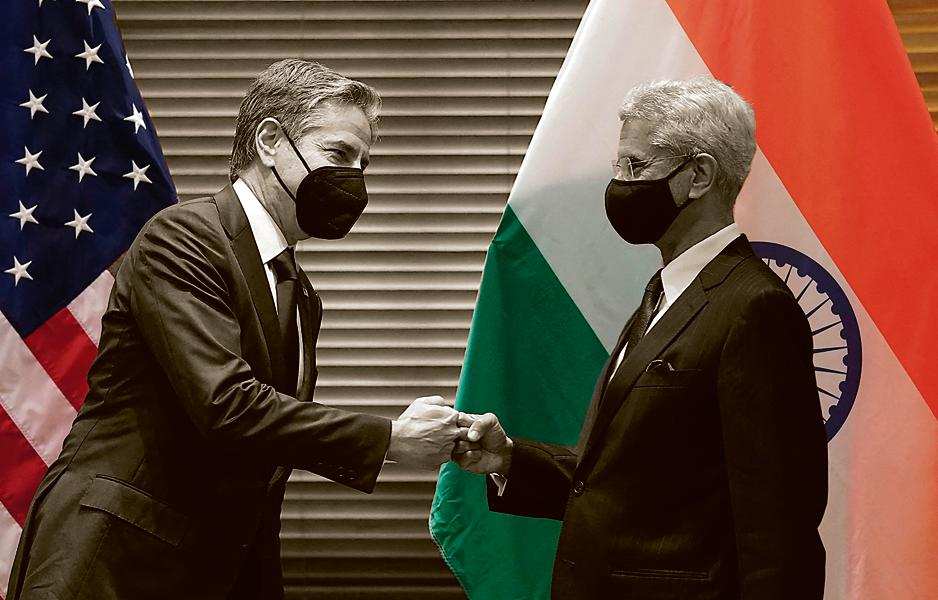
On February 11, in Melbourne, US secretary of state Antony J Blinken met external affairs minister S Jaishankar. The readout from the meeting, and a subsequent White House statement, confirmed the descriptors that the US strategy had used for India — a like-minded partner, a leader in South Asia and the Indian Ocean, a driving force of Quad, an engine for regional growth, a net security provider in the region.
Just a year ago, there was speculation that the new administration may seek a reset with India — on terms unfavourable to New Delhi because of Prime Minister Narendra Modi’s domestic political project and perceived proximity to the Republican flank. That apprehension was allayed with close consultations between the two sides in 2021, and has now been buried with the recognition of Indian centrality in the Indo-Pacific strategy. Across administrations, notwithstanding voices asking New Delhi to be more democratic, India’s role as a partner will continue to deepen.
{{/usCountry}}Just a year ago, there was speculation that the new administration may seek a reset with India — on terms unfavourable to New Delhi because of Prime Minister Narendra Modi’s domestic political project and perceived proximity to the Republican flank. That apprehension was allayed with close consultations between the two sides in 2021, and has now been buried with the recognition of Indian centrality in the Indo-Pacific strategy. Across administrations, notwithstanding voices asking New Delhi to be more democratic, India’s role as a partner will continue to deepen.
{{/usCountry}}So what explains the convergence?
The first obvious explanation is structural. China’s rise is a threat to America’s global dominance, interests, values; and China’s aggression is a threat to India’s territorial integrity, sovereignty, and regional influence.
The US knows that it cannot battle China alone nor can it change China’s domestic order. But it can, through alliances and partnerships, shape the strategic environment around China to limit Beijing’s revisionist ambitions. As the US handles Chinese aggression globally and in the Pacific Ocean, India is the only country in Asia to put up a resistance against China in the wider Indian Ocean region and on the continental front — to those who have an enlightened view of American strategic interests, if India stands its ground, it is enough.
India is aware of the asymmetry in its economic and military power vis-a-vis China. It knows that the US can provide valuable intelligence, technology and military support, and is aware that a deeper partnership with the US and allies can increase the costs of aggression for Beijing, and force it to recalibrate its behaviour. What India, thus, seeks from the US is strategic support and, strategic understanding of Delhi’s other interests.
Both the US and India also know that they have to leverage their strengths in defeating China in research and development labs, semiconductor manufacturing plants, supply chains, and shaping global norms on future technologies — the real battlefields of the current moment.
But along with China, the bilateral India-US convergence has been driven by astute Indian diplomacy. The business, trade and diaspora links have grown — indeed, the fact that the diaspora is now entrenched in both government and industry is a big asset — but India is also going beyond that.
India has widened its political engagement in the US in unprecedented ways. From consistently meeting members of both parties, leaders of various committees and subcommittees, and influential figures in various caucuses on the Hill, to engaging with state governors and city mayors, to speaking with officials across federal agencies, India has been confident in putting forth its point of view and finding common ground in DC.
So with politicians from gas-exporting states, India’s import is a point of convergence. With climate-conscious politicians, it is about India’s focus on renewables. With business-friendly leaders, it is about investment opportunities. With politicians from US states with Indian investments, it is about creating jobs. With those seeking regulation of big tech, it is about taming Silicon Valley. India’s wide universe offers a wee bit to a range of American stakeholders.
Covid-19 has brought the US and India much closer than is appreciated. There was American support during the second wave, through supply of raw materials for vaccine production, and for vaccine supplies under Quad. But there is also recognition in US political circles that India can be an indispensable partner in providing affordable health care in the US and globally.
For instance, the Black and progressive caucus on the Hill forced the Biden administration to support India’s quest for a TRIPS waiver on Covid-19 vaccines, defeating Big Pharma in the process. If this nascent coalition can stay, and expand, India will have a major unlikely ally in American politics.
India’s focus on the knowledge economy — by stepping up collaboration on education, especially in STEM — is helping. The US has capital, infrastructure and innovation; India has the market, talent, and entrepreneurship. Digital education has opened up possibilities unimaginable in the pre-Covid era.
As political capitals of open societies and chaotic democracies, Delhi and Washington are noisy cities. This is healthy for it allows all viewpoints. But beyond the noise, the story of India-US ties, under governments that belong to ideologically different schools of thought, is of resilience in terms of being able to overcome differences, depth in terms of extent of strategic cooperation, and breadth in terms of the range of areas of collaboration. This bilateral story is what enabled the Indo-Pacific strategy and Quad meet on February 11.
The views expressed are personal