Earlier this year, a corroded refrigeration line in the Manali-Pulicat industrial belt released a dense ammonia cloud that sent workers and residents in Tiruvallur district, Tamil Nadu, to hospitals while first responders arrived without realtime inventory data. A far more severe leak at a seafood processing plant in Periyapalayam followed, killing eight migrant workers and hospitalising more than 70 people across the Periyapalayam–Uthukottai corridor. Two major industrial accidents in the same district within 48 hours exposed a deeper structural weakness: India’s chemical governance is split across disconnected agencies that operate with minimal coordination.
The pattern is national, not local — and far more entrenched. In June, four workers died after inhaling toxic fumes inside an effluent treatment sludge tank in Surat. Days later, ten workers were killed at the Visakhapatnam Steel Plant when molten metal breached a containment barrier. These incidents differ in form but share the same underlying failures: ageing equipment, weak maintenance, inadequate training and regulatory silos that treat workplace safety, hazardous substances and emergency response as separate worlds. India’s chemical sector is expanding far faster than its regulatory framework can safely manage.
Industrial safety falls under the ministry of labour and state factory inspectorates. Hazardous substances oversight sits with the ministry of environment, forest and climate change (MoEF&CC). Industrial chemicals and fertilisers are handled by the ministry of chemicals and fertilisers, while transport safety is overseen by the ministry of road transport and highways. Chemical weapons compliance is managed by the cabinet secretariat’s National Authority for the Chemical Weapons Convention. Each operates with its own lists, thresholds and enforcement cultures, leaving no single authority accountable for chemical safety and security end-to-end.
Also Read | UP issues safety rules for factory, construction sites
{{/usCountry}}Also Read | UP issues safety rules for factory, construction sites
{{/usCountry}}This fragmentation creates dangerous regulatory gaps. Hazardous chemicals under MoEF&CC’s Manufacture, Storage and Import of Hazardous Chemicals (MSIHC) Rules are defined by industrial accident potential rather than toxicological or security risk. Toxic chemicals under labour emergency frameworks are defined by acute health effects. Scheduled chemicals under the Chemical Weapons Convention Act are defined by dual-use potential. Hazardous waste rules — also administered by MoEF&CC — regulate waste streams by disposal risk rather than the chemicals themselves. A single substance can, therefore, fall under one regulatory regime while remaining outside another. As a result, volatile compounds such as ammonia, chlorine, styrene, methanol, nitric acid and neurotoxic solvents sit inside a regulatory maze with no coherent logic.
The consequences of this institutional scatter are visible in national accident data. NDMA reports record more than 130 major chemical industrial accidents and 259 fatalities between 2016 and 2022. The National Crime Records Bureau documented 1,059 industrial fatal accidents in 2022 alone, many involving hazardous chemical handling. The tragedies in Visakhapatnam, Surat and Tiruvallur show how quickly routine operations can collapse when ageing machinery and weak maintenance intersect with regulatory blind spots.
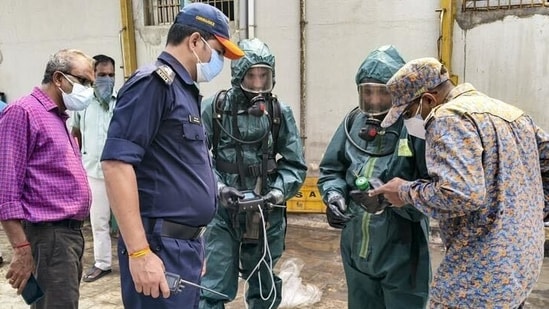
The gap between “hazardous” and “toxic” classifications determines whether district authorities receive critical inventory information, whether an industrial facility must file an offsite emergency plan, whether transport is monitored and whether first responders know what hazards they are walking into. In Tiruvallur, responders reached both accident sites without updated inventories, automatic isolation systems or standardised emergency protocols. The district administration had to improvise coordination with environmental regulators, the state pollution control board, labour authorities, chemical industry regulators, health departments and the NDRF’s CBRN unit — a patchwork response mirroring the patchwork laws governing the chemicals themselves.
Also Read | Zero tolerance towards those failing to comply with new waste management norms: NDMC
Transport represents another major vulnerability. Nearly 60% of India’s chemical cargo moves by road, often in poorly labelled containers or mixed cargo tankers. Between 2018 and 2022, hazardous goods vehicles were involved in more than 4,000 road accidents. The Petroleum and Explosives Safety Organization has repeatedly flagged missing GPS trackers, inadequately trained drivers and widespread noncompliance with hazardous material signage. A chemical that is tightly regulated inside a factory becomes almost invisible once it enters the transport corridor.
Sensitive materials face similar regulatory grey zones. Controlled substances used in law enforcement fall under policing and CWC oversight, yet their storage, transport and export require far tighter alignment with hazardous substances frameworks. Narcotic precursors are governed separately under the NDPS Act, while industrial solvents with central nervous system effects fall under occupational health norms rather than comprehensive hazard regimes. Several Schedule 1 and Schedule 2 toxic chemicals under the Chemical Weapons Convention — including biological toxins and specialised precursors — remain outside domestic hazardous chemical lists because existing rules focus on bulk industrial volume rather than toxicological or security risk.
Technology can help — but only if the regulatory architecture is unified. Chip-based tanker tracking, blockchain based inventory declarations and digital twins for chemical plants can provide realtime visibility. But technology cannot compensate for institutional incoherence when each ministry operates inside its own silo.
India now needs a unified chemical governance architecture — a single National Chemicals Code that harmonises definitions, reporting thresholds, safety norms and enforcement mechanisms across ministries. A dedicated National Chemical Authority must anchor this structure. Transportation must be brought firmly into compliance through mandatory GPS tracking, driver certification and strict legal penalties. Industrial facilities must shift to risk based digital inspections and integrated emergency planning protocols.
Chemical safety and chemical security are inseparable. India has the institutional capacity and technological capability to build a modern, integrated system. What is required now is political resolve: fragmented governance cannot keep pace with a rapidly expanding chemical economy. Bridging this divide is not only about preventing industrial accidents — it is essential for protecting vulnerable communities and safeguarding national security.
Sudhanshu Gupta is retired member, Indian Forest Service and former joint secretary, National Authority for the Chemical Weapons Convention. The views expressed are personal