The war over the hijab in Karnataka — now a national debate — is being framed as a conversation about religious practice. Even the court is being asked to determine whether the hijab is essential to Islam. If so, the curbs on it could violate the fundamental rights to practise religion protected under Articles 25-28 of the Constitution.
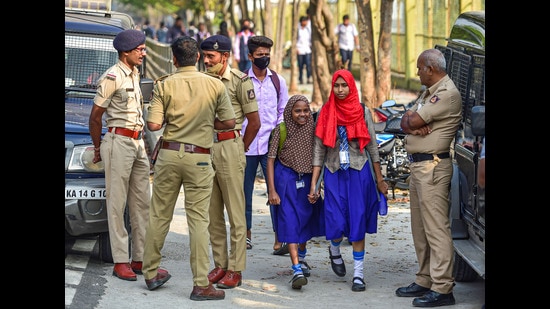
This framework for responding to what is unfolding both inside and outside the classrooms of Karnataka misses the point. Several Muslim women
The war over the hijab in Karnataka — now a national debate — is being framed as a conversation about religious practice. Even the court is being asked to determine whether the hijab is essential to Islam. If so, the curbs on it could violate the fundamental rights to practise religion protected under Articles 25-28 of the Constitution.
This framework for responding to what is unfolding both inside and outside the classrooms of Karnataka misses the point. Several Muslim women I have spoken to disagree with the argument that the hijab is an essential Islamic practice. They see it as a cultural import from a more Wahhabi and Arabised version of their faith. Yet, while not being advocates of the hijab, they are disturbed and horrified at the sight of burkha-clad teenage Muslim girls being heckled and jeered at by mobs of Hindu boys. Most disturbing has been the videos of women and girls being made to discard the hijab or burqa, right on the road, outside the gates of their institutions, before they are allowed entry. These pictures have made it clear that this is no longer a debate about the merits of schoolchildren conforming to a standardised uniform.
It is possible to be uncomfortable with the hijab — and many women I know are — and also be appalled by the undignified developments in Karnataka. That is why I am opposed to this conversation being about legality or religion; it is, at its core, about the right to an education. In a country where it is a struggle to keep girls enrolled in school — the literacy rate for Muslim women is lower than women from any other religious community — what would you prioritise — a uniform or an environment that makes it easier for a young girl to attend and stay in school?
What happened with the Sabarimala case is instructive about the limitations of using the judiciary to address social, political and religious fault lines. While the court wanted women in the menstruating age group to be allowed to offer prayers at the shrine to Lord Ayyappa, it fell back on the essentiality doctrine — a determination of what is central to a faith. Subsequently, the refusal by people, including many women, to accept the verdict has led to a review of that decision. In any case, certain universal principles of equality must override the specificity of individual religious practices. What if tomorrow women want to challenge an essential practice on the grounds of it being discriminatory?
To posit the question as to whether one is for or against the hijab against the larger backdrop of what is happening in Karnataka is to create a pointless binary. The orthodoxies of all religions militate against women. So does modern mass media and its male gaze. These are lifelong feminist battles. Even the idea of free choice in any gender debate is a slippery slope; we are all massively conditioned and socialised by centuries of patriarchy. It’s perfectly valid to oppose the hijab (or the ghoongat) and still speak up for the essential right to dignity for all women and girls. It is this that is being violated in Karnataka.
So while there is merit in calling out the Islamist politics of the Popular Front of India, whose campus wing has been linked to many of the pro-hijab protests in Karnataka; if you do so without simultaneously condemning and calling out the ugly Islamophobia that has been unveiled in the attacks on Muslim girls, you are guilty of hate-mongering.
It is also disingenuous to involve the example of the French, who have forbidden all signs of visible religiosity in public educational institutions. India is a country where religion is embedded in our everyday culture, from the temple, mosque or gurudwara at the street corner to the Christian prayers we said in assembly to the Ram bhajans, we learnt in school choirs. That explosion of cultural variety is what makes us who we are. The sudden attempt to sanitise is not even logically thought through. How far are we willing to take it? Do we remove visible religious symbols from schools or also from colleges? What about Parliament? Why should saffron robes be allowed in the workspace of our lawmakers if the hijab is not? This is a Pandora’s Box, the opening of which has led to an eruption of uncomfortable questions.
The larger debate over secularism, the nature of the relationship between religion and the Indian State, Hindutva, Islamophobia, and Islamist politics will rage on.
In the meantime, how can you punish teenage girls whether or not you agree with their hijab? That is simply unforgivable.
Barkha Dutt is an award-winning journalist and author
The views expressed are personal.
One Subscription.
Get 360° coverage—from daily headlines
to 100 year archives.
Archives
HT App & Website