It almost seemed surreal. A 30-something Maoist surrounded by angry Koya tribal women in a village deep in the Maoist bastion of Swabhiman Anchala (formerly cut-off area) listening helplessly to their harangues of no development. Despite the darkness that enveloped Janturai village of Swabhiman Anchala, the courage of the tribal men and women in questioning the Maoist ideology was quite clear in the hazy shots of the mobile camera video. The Maoist stood in fear, scared of the fate that befell upon his colleague who had been stoned to death a few hours ago. For a moment it seemed the tables had turned.
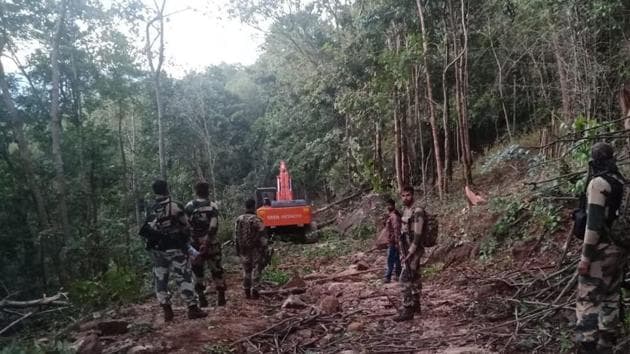
Few hours before the country was about to celebrate the 71st Republic Day, a group of 25 armed Maoists and their militias invaded Janturai village under Jodambo granpanchayat of Swabhiman Anchala. In the brawl which followed over construction of a road, a Maoist was left dead and other had to leave, something never heard in the jungles of Malkangiri, the Maoist infested region of Odisha bordering Andhra Pradesh. The rebels were asking the villagers to stall construction of a 18-kilometre-long road from Bedarpatna to Jodambo under the Pradhan Mantri Gram Sadak Yojana.
What followed next was beyond the expectation of the red rebels. Within the next few minutes, the Koya tribal men scampered home to bring out sticks, bows and arrows, while the womenfolk collected stones. Without much words, they started raining stones on the Maoists while few of them fired their arrows. Unprepared for the counter-attack, a Maoist was killed while another received major injuries leading to his arrest. The rebels while retreating, burnt down around 10 homes in Jodambo village and looted the belongings of the tribals.
In the history of Maoist activities in Odisha, the January 25 lynching incident in Janturai village of Malkangiri may go down as an watershed event when the tribals for the first time fought back against Maoist repression. Such fightbacks have happened in Andhra Pradesh, Jharkhand and Bihar in the past, but never in Odisha and that too in Malkangiri district, which was a liberated zone for the red rebels for more than three decades. In 2008, the Maoists stamped their authority when they sunk boats in Balimela reservoir killing 39 Greyhound cops, the anti-Maoist police of Andhra Pradesh. In 2011, Maoists abducted Malkangiri district collector R Vineel Krishna along with a junior engineer for 9 days when he had come to a village deep inside cut-off area for overseeing developmental works. In 2012, a BSF commandant who had set up the first camp on the shores of Balimela reservoir was killed in a landmine blast along with three of his jawans.
{{/usCountry}}In the history of Maoist activities in Odisha, the January 25 lynching incident in Janturai village of Malkangiri may go down as an watershed event when the tribals for the first time fought back against Maoist repression. Such fightbacks have happened in Andhra Pradesh, Jharkhand and Bihar in the past, but never in Odisha and that too in Malkangiri district, which was a liberated zone for the red rebels for more than three decades. In 2008, the Maoists stamped their authority when they sunk boats in Balimela reservoir killing 39 Greyhound cops, the anti-Maoist police of Andhra Pradesh. In 2011, Maoists abducted Malkangiri district collector R Vineel Krishna along with a junior engineer for 9 days when he had come to a village deep inside cut-off area for overseeing developmental works. In 2012, a BSF commandant who had set up the first camp on the shores of Balimela reservoir was killed in a landmine blast along with three of his jawans.
{{/usCountry}}“The fightback was long overdue. In this uprising they (the local villagers) were not at all bothered about the consequences. Though the presence of security forces was some sort of comfort, the January 25 fightback showed that the tribals had crossed the Rubicon when it came to Maoist threat. Their anger of cycle of killing of innocent tribals in the name of police informers had boiled over. This is almost similar to 1967 uprising against zamindari system,” said Deepak Kumar Nayak, research associate in Delhi-based Institute for Conflict Management and an expert on Left-wing extremism.
In a battle, where the terrain is extremely hostile to the security forces, the Janturai incident may have come as a huge morale booster for the state administration. The Swabhiman Anchala, a cluster of 151 villages in nine grampanchayats separated from mainland Odisha by Balimela reservoir since 60s, was almost a no-go area for the security forces till July 2018 when the government built a 910-metre bridge across Guripriya river, ending decades of isolation for the 37,000-odd people of the area. Even after building the bridge since last one and half year, the state forces control just about 15 per cent of the Swabhiman Anchal zone that currently harbours several members of the all-powerful central committee of CPI(Maoist).
The Janturai village under Jodambo panchayat was one of the most inaccessible places in the Maoist citadel that could only be reached by walking as the Hantalaguda hill was natural barrier that helped the rebels create terror in the region while preventing counter-attack of security forces. During a ghat-cutting exercise last month, part of the hill was levelled paving way for a motorable road ending years of seclusion. Apart from a plan to construct 120-km concrete road in the area from central funds, the state government has unveiled SETU (Socio-economic Transformation and Upliftment) programme for the 151 villages under which physical infrastructure in the field of road connectivity, electrification, water supply, education and health would be built.
Malkangiri district collector Manish Agarwal said the new road to Jodambo panchayat would mean the tribals in the area now don’t have to depend on the long ride by the motor boat across the Balimela reservoir. “With the construction of road, people of Jodambo can come to Chitrakonda by motorcycles or other vehicles in couple of hours which would have taken not less than 12-15 hours earlier. The people of Swabhiman Anchala have showed huge courage and the State government would provide them with all orts of facilities including pucca houses and medical facilities at doorstep. Once the smell of development wafts into the deeper pockets of the region, people would side with us,” said Agarwal.
While over 1,000 security forces personnel, including those from the Border Security Force (BSF), Special Operations Group (SOG) and District Voluntary Force are currently keeping an eye on the troubled villages of Jodambo, everyone in the region know that Maoist reprisal may be round the corner. Soon after the Janturai face-off, the MKB (Malkangiri-Koraput Border) Division Committee of the Maoists which calls the shots in Swabhiman Anchala issued a letter to the villagers telling them that it is in their best interests to co-operate with the ultras and accept the dominance of rebels. “Once the police and the heavy security personnel deployed in the area leave, the locals would be at the mercy of the Maoists,” the Maoist threatened in a letter.
Security experts also agree that despite the bravery by the tribals of Janturai, the battle with Maoists would not be over anytime soon. “The Maoists moved in as there was no development for 70 years. Now people have realised what development means for them. Government has to move in quickly and double down on their efforts while providing security. There would of course be collateral damages, but now the State is in a position of advantage,” said Nayak.