When I first saw a demo of the milli-spinner in Stanford Robotics Center, it reminded me of a 1966 film Fantastic Voyage in which a submarine crew is shrunk to microscopic size and ventures into the body of an injured scientist to repair the damage to his brain. Except scientists at the Stanford University imagined a more efficient way of dispensing targeted drug inside a human body – a worm-sized robot that can travel through veins and compress a blood
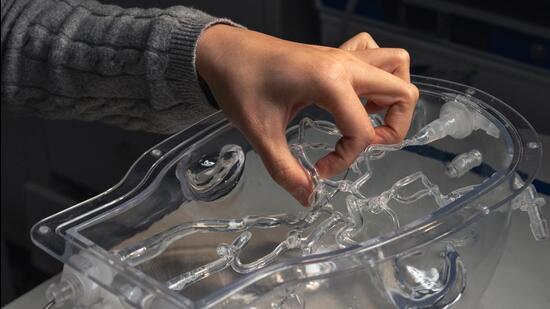
When I first saw a demo of the milli-spinner in Stanford Robotics Center, it reminded me of a 1966 film Fantastic Voyage in which a submarine crew is shrunk to microscopic size and ventures into the body of an injured scientist to repair the damage to his brain. Except scientists at the Stanford University imagined a more efficient way of dispensing targeted drug inside a human body – a worm-sized robot that can travel through veins and compress a blood clot, treating strokes and heart attacks.
The milli-spinner prototype takes up a small display in the medical robotics room. What looms in the room when I enter are larger robots used for imaging and surgery. The millirobot in comparison is less than one centimeter in size. It moves like a tiny worm inside a web of transparent tubes, controlled by a magnetic field. The hollow tube, barely visible unless you bend closer and have a look, rotates rapidly using a series of slits. It was this movement that took mechanical engineer Dr Renee Zhao, the head of the lab and the creator of the robot, years to master. The movement made all the difference. “With existing technology, there was no way to reduce the size of a blood clot. They relied on deforming and rupturing the clot to remove it,” explains Dr Zhao, assistant professor of mechanical engineering. Once they got the spinning right, the milli-spinner could enter the body through a catheter, draw the clot and compress it before suctioning it out. In a recent scientific paper published in Nature in June 2025, Dr Zhao and her team showed that this new approach to technology – compression before suction - outperformed available treatments in removal of clots from human bloodstream. “At first, we simply wondered whether this suction could help remove a blood clot,” Zhao said. “But when we tested the spinner on a clot, we observed a dramatic reduction in volume. Honestly, it felt like magic.”
Also Read: Seeing Silicon | Is this year the beginning of the end of smartphones?
The more I see and read about the upcoming technologies in medical devices, the more magical it does feel. Stanford’s not the first one to develop millirobots, though Zhao has a lot of experience working on millirobots.
After the microelectronic advances in the early 2000s, microfabrication allowed engineers to create intricate mechanical and electronic components on a microscopic scale. Due to their small size, microrobots (about one centimetre) and millirobots (less than one centimetre) could be made cheap and could be used in large numbers – like in swarm robotics. However, there was one challenge, and it took technologists another decade to solve it. How do you make these millirobots move through the body without them being tethered to a power source? The microrobots came with small lightweight battery sources but it wasn’t enough for them to navigate inside blood vessels or reach hard to reach places. (Just like Fantastic Voyage shows, our blood vessels are complicated rivers to navigate).
It was with Wi-Fi, another technology that has dramatically changed our lives, that scientists finally figured out how to control the device inside the body. This level of control meant that these millirobots could become quite useful to deliver precision medicine inside the human body. They could also be used to minimally invasive surgery, diagnostics or navigating blood vessels for treatment.
The last decade has seen a flurry of experiments in medical millirobots, the Stanford experiment being one of the latest successful examples of the technology. Some of them have already made it to our hospitals and treatment. For example, biohybrid microswimmers which are created using bacteria, microalgae have been used for advanced medical functions – like targeted therapy of tumours. But most innovations are still in laboratories of research institutions.
The next level to these kinds of robots is xenobots, the world’s first living robots – built from the heart muscle and stem cells harvested from an early African frog embryo. These AI-designed robots are less than 1 millimetre wide, can simulate a specific task and can work in swarms. They use energy from fat and protein naturally stored in their tissue, which lasts about a week at which point they simply turn into dead skin cells. Future possible uses are treating individuals by creating xenobots using their own cells (reducing the immune response challenge with bots inside your body) and even to aggregate tiny bits of ocean-polluting microplastics into a large ball of plastic to recycle.
The latest biorobotics does feel like magic rather than technology, just as Dr Zhao felt when she saw the milli-spinner compress the blood clot. More and more, the technological advances in biomedicine do sound like alchemy to me.
Shweta Taneja is an author and journalist based in the Bay Area. Her fortnightly column will reflect on how emerging tech and science are reshaping society in Silicon Valley and beyond. Find her online with @shwetawrites. The views expressed are personal.
One Subscription.
Get 360° coverage—from daily headlines
to 100 year archives.
Archives
HT App & Website