National security and foreign policy do not fetch votes, and rarely act as an effective polariser of vote banks, as seen in elections after the 26/11 Mumbai attacks. Their main dividend is peace and certainty, on the foundation of which sound economic growth is built.
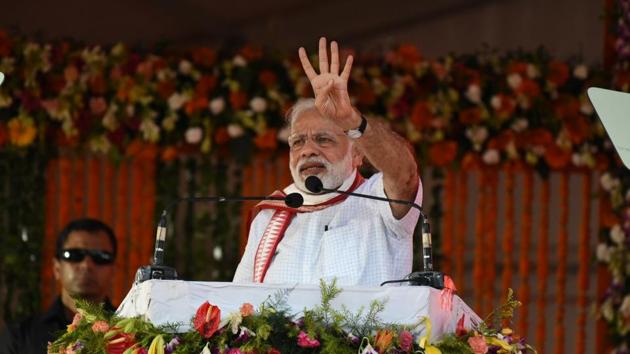
The Narendra Modi government, in its first four years, has done well on these two parameters, barring terror attacks from Pakistan-based groups in Jammu and Kashmir and bordering Gurdaspur in Punjab, and the rise of radicalisation in South Kashmir. The government’s resolve in tackling Maoists, who once ruled the mineral-rich belts of eastern India, and the capacity to prevent any major terror attack in the hinterland goes to the credit of home minister Rajnath Singh and security agencies.
The courage and resoluteness of the Indian Army, under the guidance of Prime Minister Modi and his National Security Adviser (NSA) Ajit Doval, in conducting surgical strikes in Pakistan-Occupied Kashmir (PoK) in 2016 and standing up against a belligerent Peoples Liberation Army (PLA) in the Doklam plateau last year in defence of Bhutan is now part of the military legacy.
However, the Modi government’s main success lies in its diplomatic and security engagement of West Asia and the Association of South-East Asian Nations (Asean) and that too at a time when the dark shadow of the so-called Islamic State had loomed large since 2014. Before the advent of Modi, governments used to look towards Sunni West Asia through the prism of Pakistan and hence were reticent in making overtures towards countries in the region.
{{/usCountry}}However, the Modi government’s main success lies in its diplomatic and security engagement of West Asia and the Association of South-East Asian Nations (Asean) and that too at a time when the dark shadow of the so-called Islamic State had loomed large since 2014. Before the advent of Modi, governments used to look towards Sunni West Asia through the prism of Pakistan and hence were reticent in making overtures towards countries in the region.
{{/usCountry}}Today, Prime Minister Modi and his key advisors are on an SMS basis with key west Asian powers including Saudi Arabia, United Arab Emirates, Jordan, Oman and ASEAN countries like Singapore, Indonesia, Malaysia and Vietnam. The result is quite evident in a single mention of Jammu and Kashmir in the Organisation of Islamic Cooperation’s Dhaka declaration this year; Bangladesh was at the forefront of support for India’s claim to observer status in the OIC. With Prime Minister Modi’s personal diplomacy working on global leaders, including the rulers of Saudi Arabia and the UAE, the days of Indian fugitives and terrorists taking refuge in these two kingdoms or for that matter anywhere sin West Asia are practically over.
While the US, Japan and France are India’s core partners, Prime Minister Modi has managed to forge a personal bond with Russian President Vladimir Putin and Chinese President Xi Jinping through candid conversations. The depth of the India-US relationship is evident from the bipartisan consensus in Washington on building closer ties with India; this is also reflected in the people-to-people relationship.
Pakistan and its terror shadow on Kashmir remain a matter of concern for the Modi government, as they have been to previous regimes in New Delhi since Independence. With a politically fluid situation in Pakistan and Rawalpindi General Headquarters continuing to push extremists across the Line of Control (LoC) into Kashmir, the Modi government is left with no option but to cut its losses and just manage the relationship.
The rise of radicalisation in South Kashmir is a matter of serious concern to the Centre, particularly when state government representatives are doing little to reach out to their own electorate. The sub-nationalism of the two regional parties in the V alley have confused the population between self-rule, autonomy and Indian nationalism. The answer to this only lies in Pakistan reining in extremist groups and disassociating itself from a self-made Kashmir cause.
Apart from Pakistan, the Modi government has expanded cooperation with nations in its immediate and extended neighbourhood. Close relations have been established with Myanmar, Bangladesh and Afghanistan; ties with Sri Lanka and Nepal have been brought back on track and are on the mend with China and the Maldives.
The PM’s moves are helped by the fact that he heads a single-party majority government, leaving him without pulls and pressures from allies that are guided by their own domestic constituencies. A strong electoral mandate is directly and not inversely proportional to effective national deterrence and foreign policy.