In movies, love of country is a rapturously virtuous thing. Can military valour be simply difficult to muster, or simply end in tragedy? It often is and does in conflict zones off screen; in an ideal world, conquests or martyrdom need not always measure military intelligence. Film-makers usually bypass that ambiguity---unless he or she is a Christopher Nolan (Dunkirk, 2017) or a Terrence Malick (Thin Red Line, 1988). Ever since the invention of cinema, film-makers have used patriotism and military valour effectively, to rouse nationalistic emotions and make commercially lucrative cinema. Russian cinema is full of such examples, including the early films of Sergei Eisenstein.
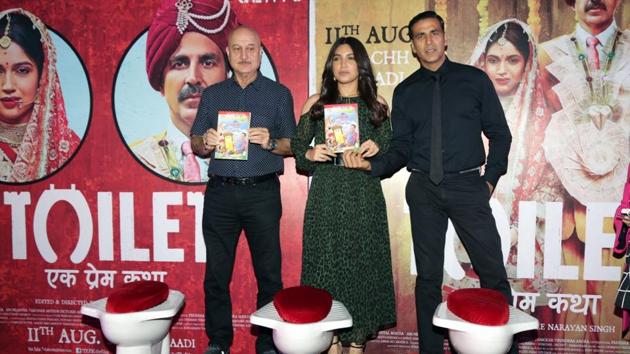
Shree Narayan Singh’s Toilet Ek Prem Katha has nothing lofty about it, but it is unapologetically patriotic. It is riding on a particularly voluble strain of the country’s new-found, newly sanctioned patriotism: The Swachh Bharat campaign.
In Hindi movies, the idea of relinquishing an enemy—another country, colonisers from another century, or worlds populated by bearded men---is a relatively recent trope. The Noughties produced Gadar: Ek Prem Katha (2001), followed by Maa Tujhe Salaam (2002), both brazenly anti-Pakistan and anti-Muslim, and both dependent on the faded machismo of Sunny Deol, and Ab Tumhare Hawale Watan Saathiyon (2004). This was around the same time that the national anthem started playing in cinema halls before the start of a movie in some states. At his best, the patriot in Hindi movies is a man, rarely a woman, who is progressive and liberal, who believes in the pluralistic image of the Indian nation. His motto is unity in diversity. This kind of patriotism permeated stories during the first two decades of film-making after independence---Shaheed (1948), Jagriti (1954), Naya Daur (1957), Mother India (1957), Hum Hindustani (1960), Haqeeqat (1964), among others. The vigilante that Amitabh Bachchan unleashed on screen in the 1970s and 1980s through films such as Zanjeer (1973), Deewar (1975) and Coolie (1983) took the idea of social justice to the streets.
The patriotism in Toilet Ek Prem Katha is primarily in furthering one of the ruling government’s most widely publicised social change campaigns, even if the rural hero exposes some of the scheme’s pitfalls. Anupam Kher, a BJP sympathiser, plays a character akin to the real life hero of India’s sanitation crusade, Bindeshwar Pathak. It is the love story of a man played by Akshay Kumar who has to save his marriage by ensuring there are toilets in his village. The goofy protagonist turns activist-vigilante. There’s no better time to release a film about sanitation miseries than now; the producers can leverage the Swachh Bharat brand equity for all its pre-release marketing requirements.
{{/usCountry}}The patriotism in Toilet Ek Prem Katha is primarily in furthering one of the ruling government’s most widely publicised social change campaigns, even if the rural hero exposes some of the scheme’s pitfalls. Anupam Kher, a BJP sympathiser, plays a character akin to the real life hero of India’s sanitation crusade, Bindeshwar Pathak. It is the love story of a man played by Akshay Kumar who has to save his marriage by ensuring there are toilets in his village. The goofy protagonist turns activist-vigilante. There’s no better time to release a film about sanitation miseries than now; the producers can leverage the Swachh Bharat brand equity for all its pre-release marketing requirements.
{{/usCountry}}The Hindi film aristocracy and its influencers are usually apolitical. Its stars don’t engage with the country’s malaises, its political misgivings or social misfortunes. Nobody has a stand on what’s happening outside Juhu or Bandra, let alone Mumbai. A majority of the screenplays that pass muster are apolitical too. But if the only way to engage with social realities and being political is to piggyback on campaigns of the ruling government, politics are best left out of Hindi movies.
In the conventional sense of movie patriotism, Toilet Ek Prem Katha is almost a cipher. The enemy is within; in regressive, irrational Indian thinking. The hero’s goal is domestic fulfilment, and his fight is not for a free community or a nation, or to defeat a dangerous enemy, but for a decent, sheltered pot to do one’s daily business of defecating in. In another time, this hero, a sort of Everyman patriot, would have been wonderfully refreshing. Now he is too much of a Swachh Bharat mouthpiece.
Last year, Russia’s ministry of culture published a list of eight subjects that film producers might want to address if they hope to win grants from the state. Besides “traditional values”, the list included “the constructive actions of civil society”. All that’s needed from Russian film-makers now is the willingness to hop on board---just like the makers of Toilet Ek Prem Katha has done, without being asked to do so.
Sanjukta Sharma is a Mumbai-based writer and critic, and a former editor of Mint Lounge.