The daughter of an autorickshaw driver and a mother who works in the Channapatna toy industry, Sushmita, 20, is dreaming big. The BCom student says she plans to take the competitive exams to “get to a position where I can help people”.
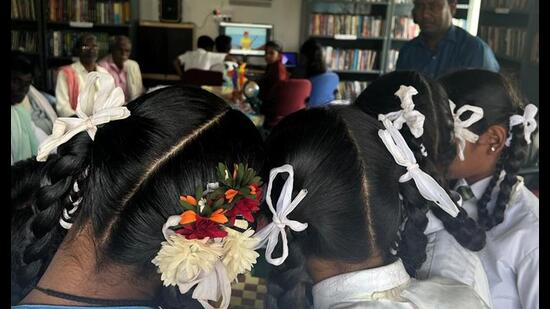
We are at the rural library in Neelasandra gram panchayat in Karnataka’s Ramanagara district, 61km from Bengaluru, where Sushmita volunteers to mentor children.
Less than 24 hours earlier, I had been on the phone with Uma Mahadevan-Dasgupta, additional
The daughter of an autorickshaw driver and a mother who works in the Channapatna toy industry, Sushmita, 20, is dreaming big. The BCom student says she plans to take the competitive exams to “get to a position where I can help people”.
We are at the rural library in Neelasandra gram panchayat in Karnataka’s Ramanagara district, 61km from Bengaluru, where Sushmita volunteers to mentor children.
Less than 24 hours earlier, I had been on the phone with Uma Mahadevan-Dasgupta, additional chief secretary, panchayati raj. She spoke with such eloquence about Karnataka’s library initiative for kids that I had to see this reading revolution for myself. Back in Delhi, the finance minister was unveiling plans under the Union Budget for libraries for children that would enable digital learning and “build a culture of reading”.
Karnataka had a head-start as one of the earliest states, along with Tamil Nadu and Kerala, to have a public libraries act. In 2019, it decentralised 5,623 rural libraries and handed them over to the panchayats. During Covid-19, these became a vital link for children and took on the additional task of monitoring the pandemic.
As the pandemic receded, the Oduva Belaku (fire of reading) programme gathered pace. Libraries were transformed with new furniture and open-air reading spaces; membership fees were waived; a door-to-door membership drive was undertaken; and timings increased. In addition, the Azim Premji Foundation, Shikshana Foundation, Pratham Books, and Dell Technologies donated books in English, Kannada and Braille, and smartphones and computers.
Across the state, 2.8 million kids now have library cards. Senior citizens, self-help groups, and accredited social health activists are all welcome. “It has become a public movement,” says Mahadevan-Dasgupta.
The children are the daughters and sons of farmers, daily wage workers and vegetable sellers. They browse through books, play board games and learn to use the computer. In Mandya district’s Ummadahally, which has a 34.8% Dalit population, there’s room for those preparing for competitive exams. In addition, all libraries run civic awareness programmes. These include attitudes to gender. At Vibhuthikere in Ramanagara district, Ulaas, who studies in the seventh standard, says working on the gender equality project inspired him to do something special for his mother, a tailor. So, he cooked her some kesri bhath (yellow rice) on her birthday. “Next time, I will make it for you,” he grins.
Schoolgirls in white uniforms, hair in neat pigtails work on a computer under a portrait of SR Ranganathan, the father of India’s library movement. But their role models also include Savitribai Phule and Onake Obavva, the 18th-century defender of the Chitradurga fort.
Perhaps most important, the library gives the children the space to dream. At Ummadahally, Sneha, a fourth standard student, tells me she borrows books to take home to read with her mother. She says she wants to be a doctor even though she doesn’t personally know any. “I will be the first to save the lives of people,” she says solemnly.
The rural library mission in Karnataka involves, as mentioned, a citizenship and life skills programme. This is run under 'My Library for a Better Me' that is a mentor-led programme by Citizenship Education in India (CMCA), under which children enrol for three years and are guided in various activities, including gender equality and forming collectives for community action."
Namita Bhandare writes on gender.
The views expressed are personal.
One Subscription.
Get 360° coverage—from daily headlines
to 100 year archives.
Archives
HT App & Website